Lhasa
World War ZLhasa functions as a threshold location in the outbreak narrative, a place where public recovery and private catastrophe occupy the same scene. The interview takes place there amid the noise of a victorious election, yet the testimony turns immediately toward concealed epidemics, desperate migration, and the commercial systems that carried people away from danger while also helping the infection travel.
Setting and Public Life
Lhasa is introduced as the capital of the People’s Republic of Tibet and as a city still recovering from the previous week’s general election. The Social Democrats have defeated the Llamist Party by a landslide, and revelers fill the streets with an exuberance loud enough to force the interviewer and Nury Televaldi to shout across a crowded sidewalk café. This setting gives Lhasa a double character: it appears politically alive and socially confident, but it also hosts an account of a crisis that official institutions tried to conceal.
The contrast between the city’s celebratory surface and the interview’s subject matter is central to Lhasa’s narrative function. The election crowd represents ordinary civic life continuing in public, while Nury’s recollections expose the less visible movements that preceded and accompanied the outbreak. Lhasa is therefore not presented as a battlefield or a ruined refuge. It is a place of testimony, where the apparent return of political normality coexists with knowledge of the systems that made the disaster international.
From Kashi to a Smuggling Hub
Nury explains that, before the outbreak, overland smuggling was unpopular because passports, fake tour buses, foreign contacts, and protection required substantial money. The lucrative routes ran toward Thailand or Myanmar, while people from Kashi generally had only the unattractive option of traveling into the former Soviet republics. For that reason, Nury says he was initially an importer rather than a shetou, dealing in raw opium, uncut diamonds, and people treated as commodities, including girls and boys brought from impoverished countries.
The outbreak transformed this marginal trade. Once rumors spread and an outbreak in Kashi was quickly suppressed by the government, requests for escape multiplied. Nury’s clients no longer came only from the mobile population; urban professionals, private farmers, and low-level government officials also sought passage. They had status and possessions to lose, but no longer cared where they were taken. Lhasa’s interview thus connects the city to a wider migration system in which fear erased distinctions between criminals, ordinary citizens, and officials.
Air Routes and the Logic of Concealment
Nury had only limited experience with air transport, moving people on occasional cargo flights to Kazakhstan or Russia. He describes the eastern provinces, especially Guangdong and Jiangsu, as the true centers of the business, where affluent clients could purchase prebooked travel packages and first-class tourist visas. They would land in London, Rome, or San Francisco, check into hotels, spend a day sightseeing, and then disappear into clandestine networks. The routes were profitable precisely because respectable tourism provided a temporary disguise for illegal migration.
Infection initially seemed manageable to the smugglers. Advanced cases were rejected, and clients were expected to look and behave as if completely healthy. Nury presents this as a business rule as much as a medical precaution: a traveler had to deceive the shetou before attempting to deceive foreign immigration officers. The arrangement was always a race against time. He recalls a wealthy businessman who had suffered a relatively minor bite, a slow-burning infection that allowed him to travel, but who collapsed in a Paris hotel room, apparently still believing that the West might provide a cure.
The later danger was made unmistakable by Flight 575. Nury distinguishes the early period, when infected travelers were relatively uncommon on planes, from the stage when air transport became inseparable from the risk of discovery. His account shows how commercial incentives encouraged smugglers to police the appearance of health without possessing any reliable means of preventing transmission. Lhasa’s distance from the original routes does not isolate it; the interview reveals the city as one point in a chain linking inland China, the former Soviet republics, Europe, and North America.
Overland Movement and the Visible Dead
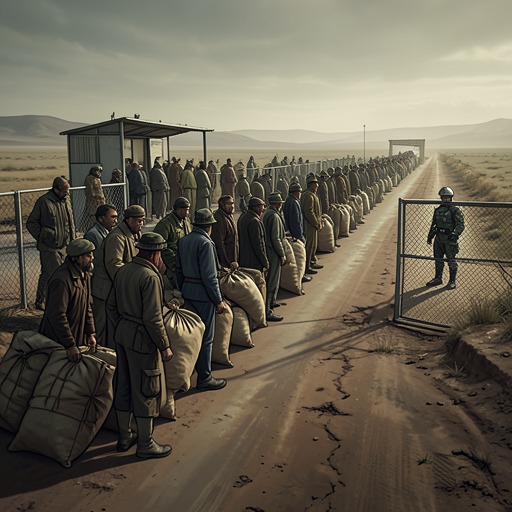
Land routes operated under harsher temporal conditions. The journey to Kashi could take weeks, while even the slowest infections lasted only a few days before reanimation. Infected clients therefore commonly reanimated on the road, where local police recognized and collected them. As infestations multiplied and police forces became overwhelmed, Nury began seeing many more infected people along his routes.
Families tried to conceal what was happening. Relatives bound and gagged infected people, hid them beneath clothing or heavy blankets, and later placed them in crates with air holes at the backs of vans. Nury remembers movement under the coverings, banging from car trunks, and the terrible inadequacy of the improvised ventilation: families were attempting to transport loved ones while still failing to understand the nature of the disease. The smuggling routes consequently became spaces where family loyalty, commercial calculation, and public danger were compressed into the same vehicle.
The routes beyond Kashi depended on corrupt or desperate authorities. Officials in economically devastated countries helped process paperwork in exchange for a share of the fee, while collaborating smugglers moved people through the former Soviet republics toward India, Russia, or Iran. Nury’s responsibility ended at the border after papers were stamped, vehicles tagged, guards paid, and his cut collected. The detail makes the border a contractual endpoint for the smuggler but not for the people being moved, whose destinations and subsequent risks remained deliberately unknown to him.
Narrative Significance
Lhasa’s importance lies less in a single local action than in the way it makes global circulation legible. The city’s election celebration supplies a public image of order, while Nury’s testimony traces the hidden traffic of passports, visas, cargo flights, vehicles, bribes, refugees, and infected bodies. The interview format places a compromised witness inside a seemingly stable civic environment, allowing the outbreak to be understood not only as a biological disaster but also as a crisis accelerated by inequality, secrecy, and the monetization of escape.
The location also sharpens the contrast between official knowledge and lived knowledge. Authorities in Kashi suppress reports of an outbreak, while rumors circulate among smugglers and families; immigration systems screen for visible illness, while infection advances invisibly; police initially collect the reanimated but later lose the capacity to contain them. Lhasa becomes the place where these partial systems are narrated together, revealing how the collapse crossed borders long before the world fully acknowledged what was happening.