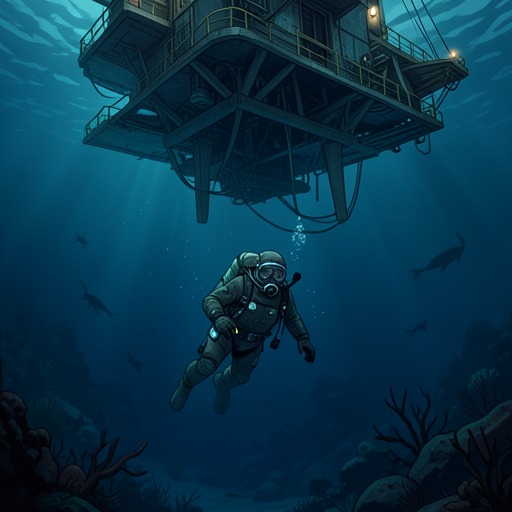
M-11 underwater weapon
World War ZThe M-11 underwater weapon is the Deep Submergence Combat Corps’ more efficient successor to the M-9, created for combat at depths where earlier underwater firearms could not survive. Its significance lies not in spectacular firepower but in the practical military lesson it embodies: equipment for the war against Zombies had to be judged by reliability, depth performance, and operational necessity rather than by conventional assumptions about cost or standardization.
Design and the Failure of the M-9
The M-11 emerged from the limitations of the first weapon issued to the underwater combat units. The M-9 was described as a cheap, modified knockoff of the Russian APS, but its design had to compensate for the fact that an underwater combat diver had no conventional hands. The suits used either four-pronged claws or industrial pincers, making it impossible to fire an ordinary gun. The M-9 was therefore fixed to the diver’s forearm, fired electrically, and equipped with a laser pointer for aiming. Its ammunition consisted of air-encased cartridges that launched four-inch steel rods.
That arrangement worked only within the shallow-water conditions for which the M-9 had essentially been designed. At the greater depths required by the corps, the cartridges imploded like eggshells. The defect was not merely inconvenient. It meant that the weapon could fail precisely where the divers were most isolated, where a hard suit deprived them of ordinary tactile awareness, and where a Zombie could approach from behind without being detected. The underwater battlefield already imposed darkness, restricted movement, poor visibility, and the danger of hand-to-hand contact; a weapon that collapsed under pressure magnified every one of those vulnerabilities.
Development and Resistance
About a year after the underwater units began using the M-9, a much more efficient model appeared: the M-11 underwater weapon. The same inventor was credited with creating the M-11, the hardsuit, and the exoskeleton used by the divers. This continuity matters because the weapon was not presented as an isolated technological miracle. It was part of a larger attempt to redesign the diver, the suit, and the weapon as a single system suited to the physical conditions of submerged combat.
The principal obstacle was economic rather than technical. The Department of Strategic Resources considered production of the M-11 too expensive. Its officials argued that the divers’ claws, combined with construction tools already available to them, should have been sufficient to deal with Zombies. That judgment reflected the wider wartime pressure to obtain the greatest possible effect from limited materials, manufacturing capacity, and transport. A dedicated weapon had to prove that its cost produced a decisive advantage over tools that could perform more than one function.
The Troll Incident
The argument changed during the Troll incident in the North Sea. The divers were repairing a Norwegian natural-gas platform, an industrial task whose noise and light normally attracted at least a few Zombies. The unit expected an attack but did not know that a swarm was nearby. When a sentry sounded the alarm, the divers moved toward his beacon and were suddenly inundated.
The encounter exposed the inadequacy of relying on claws and construction tools. Fighting hand-to-hand underwater churned up the bottom and destroyed visibility, leaving the divers surrounded by silt, disintegrating tissue, organs, and brain matter. The description makes the problem more severe than ordinary close combat: the dead did not simply fall away when struck, but broke apart into fragments that remained suspended in the water. Under those conditions, even identifying an attacker became difficult, while the hard suits prevented the divers from feeling a Zombie’s hands on them unless it actively pulled or overturned them.
The earlier equipment made the danger still worse. Helmet lights produced glare rather than clarity, and the divers could not reliably see, hear, or feel a Zombie approaching. A rotting face could appear directly against a diver’s face bowl without warning. The M-11 consequently became more than an upgrade in firepower. It answered a specific tactical crisis in which the corps’ existing methods left both military personnel and civilian oil workers exposed to ambush.
Operational Consequences
The civilian oil workers refused to return to their jobs, even under threat of reprisals, until their escorts were better armed. Their refusal followed the deaths of workers ambushed in darkness while wearing dry suits, working around welding glare, cold water, and pumped hot water, and unable to respond effectively when hands or teeth seized them. The pressure to equip the divers therefore came not only from soldiers seeking a better weapon but from the need to keep vital energy infrastructure operating.
That crisis helped establish the Deep Submergence Combat Corps as an official outfit. Its first mission was to protect rig divers and keep oil flowing. The corps later expanded into beachhead sanitation and harbor clearing, but the origin of its formal role remained tied to the practical connection between underwater security and resource production. The M-11 belongs to that same chain: improved weapon, protected divers, continued industrial work, and eventually broader underwater combat capability.
Meaning in the War’s Material Logic
The M-11’s history illustrates the war’s recurring tension between immediate thrift and long-term effectiveness. The Department of Strategic Resources initially preferred existing tools because they appeared cheaper and adequate on paper. The Troll incident demonstrated that a low-cost substitute could impose a far greater human and strategic cost when it failed in the environment where it was needed. In that sense, the weapon’s adoption reflects the resource-to-kill ratio principle associated with Travis D’Ambrosia: cost mattered, but only in relation to what the equipment could actually accomplish.
The weapon also contributes to the book’s defamiliarization of ordinary military technology. A firearm is normally imagined as an object held in the hands, aimed through familiar bodily gestures, and used in open air. The M-11 belongs to a world in which the user has claws or pincers instead of hands, cannot feel an enemy touching the suit, and may have to fire through dark water filled with suspended biological debris. Its strange form follows from a changed human body and a changed battlefield. The weapon makes that altered reality concrete: survival depends on adapting not only doctrine but the physical interface between person, machine, and environment.