On ne passe pas
World War Z“On ne passe pas” is the expression “They shall not pass,” used in the account as both a practical combat motto and a charged symbol of doomed resistance. It first appears in connection with a weapon designed for fighting in tunnels, then returns as the final radio message of a squad led by the narrator’s baby brother during the Hospital disaster. Across those appearances, the phrase moves from inherited military memory to immediate physical action and finally to bereavement.
Weapon and Battlefield Meaning
The expression is introduced while the narrator demonstrates a compact weapon of his own design. Its handle is enclosed in a semicircular steel ball from which two eight-inch steel spikes project at right angles. The design answers the conditions of tunnel warfare, where there is no room to swing a blade. The weapon is meant for a sudden punch through the eye or a thrust over the top of the head, and the narrator demonstrates precisely that quick combination of punch and stab.
He calls it a modern version of his great-grandfather’s weapon at Verdun, explicitly connecting the object to the older defensive cry. The historical reference is not ornamental: the phrase gives the weapon a lineage, turning an improvised instrument of survival into a family inheritance of resistance. In the narrator’s formulation, Verdun’s “On ne passe pas” becomes the verbal emblem of holding a line when ordinary weapons, space, and warning have all disappeared.
Tunnel Combat and the Necessity of Resistance
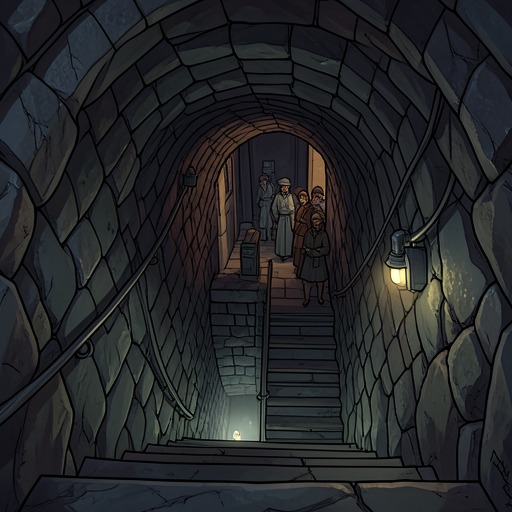
The phrase gains force from the conditions in which it is used. The defenders possess Beretta-Grechio Italian air carbines, wartime child-sized carbon-dioxide pellet guns that allow only about five shots, or six or seven when pressed directly against a target’s head. The weapons are scarce, and a missed shot can strike dry stone, create a spark, and ignite an entire tunnel, burying men alive or melting masks onto their faces. In that setting, hand-to-hand fighting is described as the safer and more reliable alternative.
The tunnels leave no room for ceremony. The enemy may appear directly before a fighter’s eyes or seize him from an unknown side passage. Everyone is armored with chain mail or heavy leather, but the armor itself creates another danger: it is heavy, suffocating, and wet, and exhausted men sometimes tear off their masks to gasp for air before they can be brought to the surface. The expression therefore names not abstract courage but a compressed tactical demand: stop the advance immediately, in darkness, at arm’s length, before panic and exhaustion make defense impossible.
The Hospital and the Last Repetition
The expression reaches its most consequential use at the Hospital, described as the shining moment of the war. The building had originally been constructed by the Nazis for mental patients, who, according to legend, were left to starve behind concrete walls. During the war it served as an infirmary for the recently bitten; later, as more infected people reanimated and the survivors’ humanity faded with their electric lamps, the infected—and perhaps others—were thrown into the sealed undead vault.
An advance team broke through without knowing what waited beyond the breach. Withdrawal remained possible: the tunnel could have been blown and the infected sealed in again. Instead, one squad faced three hundred zombies. The squad was led by the narrator’s baby brother, making the expression’s final use inseparable from family loss. His voice was the last sound heard before the radio went silent, and his last words were “On ne passé pas!” The slightly altered spelling in the remembered utterance does not weaken the motto’s function; it makes the repetition feel spoken under pressure, at the edge of disappearance.
From Heroic Motto to Tragic Judgment
The phrase is embedded in a retrospective condemnation of the decision to sacrifice fifteen thousand people, dead or missing, in only three months. The narrator contrasts this costly approach with the slower, safer clearance of London, carried out section by section after the war and at a low casualty rate. The comparison exposes the gap between resistance as an immediate necessity and resistance as a political demand for spectacle.
The defenders were told to go and fight, while leaders and civilians wanted heroes. After earlier wars, including Algeria, Indochina, and the struggle against the Nazis, the society needed new names and places to restore its pride. “On ne passe pas” consequently carries a double charge. It honors the courage of those who held the line, but it also recalls the rhetoric that made their deaths useful as national symbols. At the Hospital, the phrase is both an act of protection and the final inscription of a sacrifice that the narrator insists did not have to happen.
Narrative and Thematic Significance
As a recurring expression, “On ne passe pas” works through repetition and escalation. Its first appearance is attached to an artifact: a weapon that preserves a great-grandfather’s memory. Its second is attached to a scene of collective catastrophe: a squad confronting three hundred zombies behind a breached wall. The movement from object to voice changes the phrase from inherited emblem into personal testimony.
The expression also binds together physical boundaries and moral boundaries. The spikes defend a narrow passage; the squad attempts to contain an undead vault; the historical motto declares that an enemy must not cross. Yet the Hospital sequence reveals the instability of such boundaries. The defenders can seal the infected away only at the cost of abandoning those already inside, and the line that promises exclusion ends with the disappearance of the men who speak it. “On ne passe pas” therefore survives as a symbol of resistance, but its deepest meaning lies in the sorrowful question of what resistance demands—and who is made to pay for the honor of saying it.