Operation Shiva’s Wrath
World War ZOperation Shiva’s Wrath is the code name for a threatened thermonuclear strike during the defense of India’s mountain passes. Conceived as a last-resort method of destroying a road and blocking the advancing dead, it instead exposes the lethal contradiction at the heart of wartime command: a weapon intended to protect a safe zone could annihilate the defenders, slaughter refugees, and reshape the terrain into an easier route for the enemy.
Strategic Purpose
The operation is introduced when General Raj-Singh reaches the soldiers holding a mountain position. The road must be destroyed immediately because the air force has orders to close all mountain passes. A Shamsher fighter bomber is already overhead, and if the troops cannot or will not complete the demolition, its pilot is authorized to execute Operation Shiva’s Wrath.
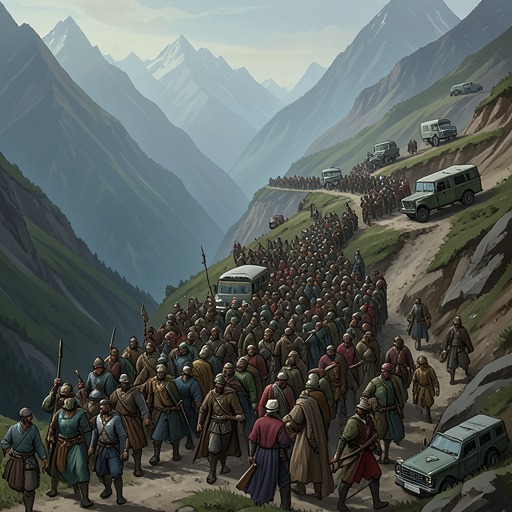
The proposed target is not an empty military installation. Explosives have been buried half a kilometer down the road, directly in the middle of a refugee column. The road is a narrow choke point hemmed in by steep mountain walls, and its destruction is meant to create a barrier inaccessible to the living dead. The decision therefore places military geography, civilian movement, and nuclear force in direct collision.
The Threat of Escalation
The soldiers understand that Shiva’s Wrath would do far more than break a road. A nuclear detonation would destroy the pass and half the mountain, transforming the confined route into a broad, gently sloping ramp. Instead of sealing the safe zone behind an impassable natural barrier, the blast could provide the dead with a perfect entrance.
That reversal gives the operation its central horror. The weapon is presented as an instrument of protection, yet its physical effect could erase the very defensive advantage the soldiers are trying to preserve. The refugees are simultaneously the intended victims of the buried charges and an involuntary part of the barrier’s tactical design, making the operation a stark example of emergency strategy treating human lives as terrain.
Raj-Singh’s Intervention
Mukherjee initially hesitates, unsure how to respond to the order. General Raj-Singh, known as the Tiger of Delhi, takes the detonator from him and accepts responsibility for what the act would mean. He thanks the soldiers, whispers a prayer, and presses both firing buttons.
Nothing happens. He checks the batteries and connections and tries again, then a third time. The detonator is functioning; the charges buried down the road have failed. The malfunction produces no clean victory. For the soldiers, it means that death may still come from the nuclear strike, while the refugees remain exposed and the pass remains strategically unresolved.
When the charges fail, the narrator thinks only of escaping far enough to survive the blast and later feels guilty for that instinct. Raj-Singh responds differently. He orders the soldiers to save themselves and reach Shimla, then runs directly into the crowd. Mukherjee and the narrator follow him, choosing movement toward the endangered refugees rather than fleeing alone.
Consequences and Significance
Operation Shiva’s Wrath never achieves its stated purpose in this account because the buried charges do not detonate. Its failure nevertheless changes the scene: the soldiers must abandon the assumption that remote firepower can solve the crisis, and Raj-Singh’s decision turns the threatened massacre into a test of personal responsibility.
The episode also places Shiva’s Wrath within the book’s broader portrait of wartime institutions. Elsewhere, governments conceal the truth about the plague, armies impose coercive punishments, and commanders adapt doctrine after catastrophic failures. Here, the nuclear option represents the most extreme version of command logic detached from consequence. Raj-Singh interrupts that logic not through a superior weapon, but through an act of leadership that accepts danger without converting refugees into expendable material.
Its significance therefore lies as much in the threatened action as in its nonoccurrence. The name evokes destruction on a civilizational scale, but the decisive moment is the pause before destruction: a failed detonator, a commander entering the crowd, and two soldiers following. The operation becomes a measure of what military necessity can demand, and of the point at which obedience must yield to the preservation of human life.