Pacific Continent
World War ZThe Pacific Continent is the postwar refugee island culture stretching from Palau to French Polynesia. It is not merely a geographic region but an improvised society formed when displacement, scarcity, and maritime mobility made survival a collective enterprise. Its decisive significance lies in the way it turns refugee movement into a new social order: people from many nations unite under the common flag of survival, and practical exchange becomes the basis of belonging.
Definition and Setting
The Pacific Continent takes shape in the shattered tropical spaces left behind by the outbreak. Manihi provides its clearest emblem. Before the war, the atoll appeared to be an untouched paradise of flat, palm-covered motus surrounding a shallow, crystal-clear lagoon, and it was one of the few places where authentic black pearls were cultivated. A naval officer who had visited the Tuamotus on his honeymoon knew the atoll firsthand, which made it a plausible destination when the postwar world required refuge rather than tourism.
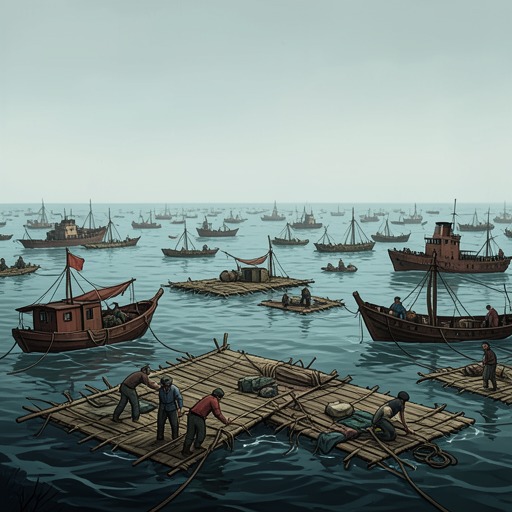
The contrast between the old paradise and the new society is absolute. By the officer’s return, the pearls had disappeared, the oysters had been eaten, and hundreds of small private boats crowded the lagoon. Tents and ramshackle huts covered the motus, while improvised canoes moved between the reef and roughly a dozen large ships anchored in deeper water. The physical landscape records the passage from leisure to endurance: the lagoon is no longer a resort but a harbor, marketplace, settlement, and shared defensive frontier.
A Society Built by Refugees
The Pacific Continent is described as a new society and even a new nation, though it has no single conventional homeland. Refugees from across the world gather within it, their common identity produced by the need to remain alive rather than by language, ancestry, or prior citizenship. Its island culture links communities over a vast maritime arc from Palau to French Polynesia, creating a dispersed political and social space where boats, reefs, and improvised settlements replace ordinary borders.
This formation stands in contrast to the large-scale refugee movements elsewhere in the postwar world. In Cuba, five million refugees from the United States, together with people from mainland Latin America, Africa, and western Europe, were placed under the government’s Quarantine Resettlement Program. The Pacific Continent represents a different response to displacement. Rather than being incorporated primarily through a state-run resettlement system, its inhabitants develop a floating and decentralized culture in which individual boats and their capabilities become the building blocks of community.
Trade as the Central Institution
Trade is the central pillar of the Pacific Continent. Integration depends less on formal credentials than on what a person, vessel, or group can contribute. A boat equipped with a large distillery sells fresh water; one with a machine shop becomes a mechanical workshop; a liquefied natural gas carrier called the Madrid Spirit sells its cargo as cooking fuel. Scarcity does not eliminate economic life. Instead, it makes every useful capacity immediately legible as a social role.
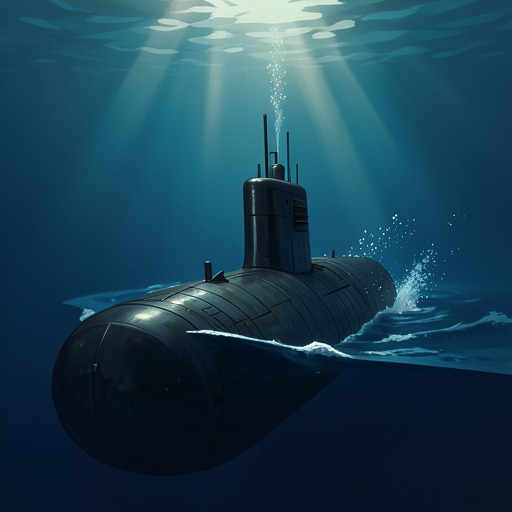
The same logic enables a naval group to establish itself within the island society. Inspired by the Madrid Spirit’s sale of fuel, Mister Song, the father of Commander Song and a hedge-fund broker from Shenzhen, proposes running floating power lines from the group’s reactor into the lagoon and leasing the electricity. This arrangement converts energy into both currency and political acceptance. The group does not simply arrive as an armed outsider; it becomes a necessary provider whose technology supports the wider settlement.
Material Prosperity and Mutual Dependence
Within the Pacific Continent’s barter economy, success is measured in supplies and services rather than conventional money. The power providers become millionaires in the equivalent currency of food, medicine, spare parts, and raw materials for manufacturing. Their operation acquires a greenhouse and a miniature waste-recovery plant capable of turning human waste into valuable fertilizer, making the settlement more self-sufficient and giving even refuse an economic function.
Electricity also restores fragments of prewar comfort. Equipment for a gymnasium, a full wet bar, and home-entertainment systems is obtained for the enlisted mess and wardroom. Children receive toys and candy when supplies permit, while converted barges provide continuing education through international schools. The group’s members are welcomed into homes and aboard boats, and enlisted personnel, along with some officers, receive free credit on five comfort boats in the lagoon.
The benefits extend beyond luxury. Power restores air conditioning and refrigeration, brings computers back online, and provides many inhabitants with their first hot showers in months. These conveniences carry social meaning because they reduce the distance between survival and ordinary life. The power network becomes a form of reconstruction: it preserves health, communication, education, leisure, and dignity at once. Because the group lights the settlement and powers its machinery, the island council grants it a reprieve from perimeter-security duty, an exemption it politely refuses.
Historical and Thematic Significance
The Pacific Continent embodies a postwar reorganization of global exchange. The old world depended on complex industrial supply chains whose fragility was exposed by the war: even a bottle of root beer required materials and components drawn from multiple countries, while large machines such as computers and nuclear-powered aircraft carriers demanded vastly more extensive networks. Once the living dead control most of the world’s landmass, American production is restricted largely to the western states, refugees crowd merchant shipping, fuel shortages immobilize much of the navy, and the logistical system that sustained prewar abundance collapses.
Against that collapse, the Pacific Continent offers a maritime alternative. Its inhabitants do not recreate the old global economy in miniature; they assemble a new one from whatever survives aboard ships, in workshops, on reefs, and inside improvised settlements. A reactor, a distillery, a machine shop, a cargo of gas, or a waste-recovery plant can become the nucleus of a community. The society’s wealth is therefore inseparable from its infrastructure, and its politics grow out of the distribution of practical usefulness.
The term also names a shared emotional and political condition. The refugees are not united by a romantic return to a lost homeland but by the recognition that survival requires cooperation across national lines. Their common flag is survival, and their social order rewards exchange over isolation. In that sense, the Pacific Continent is both a consequence of catastrophe and an experiment in post-catastrophic citizenship: belonging is earned through contribution, mutual reliance, and the ability to make damaged materials serve collective life again.