Paul Knight
World War ZPaul Knight is a former government intelligence officer whose most important contribution to the crisis was not a battlefield victory but an act of recognition: he understood that the emerging plague required the brain itself to be destroyed and helped convert that insight into an international warning. Working with Jurgen Warmbrunn, he produced the Warmbrunn-Knight Report, a concise, comprehensive document intended to prevent the outbreak from becoming an epidemic. The report’s later neglect gives Knight’s achievement its tragic significance: the knowledge existed, but institutions failed to turn it into timely action.
Identity and Background
Knight had served in government for many years and had known Jurgen Warmbrunn since the Entebbe operation. He later retired just before his agency underwent its reforms and entered private consulting in Bethesda, Maryland. Retirement did not end his intelligence work. He continued examining the outbreak on his own time, preserving the habits of an analyst even after leaving official service.
His professional identity is established through method rather than biography. Knight collected evidence, compared findings, and treated the apparent disease as a problem that had to be understood before it could be controlled. His earlier idea of using a double of Amin’s black Mercedes also shows the practical ingenuity associated with his intelligence career. The detail links him to covert operations while foreshadowing the more consequential investigation he would undertake with Warmbrunn.
The Investigation with Jurgen Warmbrunn
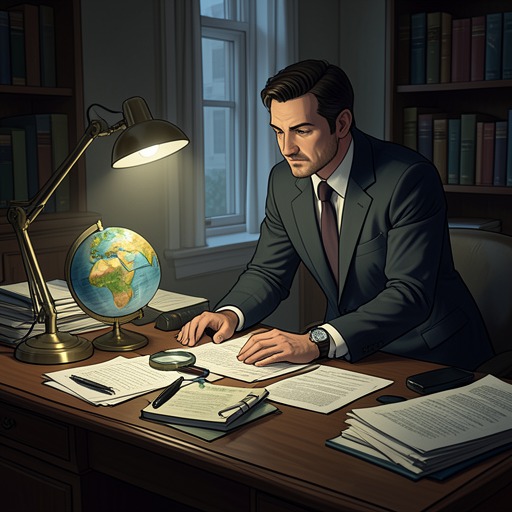
When Warmbrunn visited Knight at his home, he discovered that Knight had independently been working on the same project. Knight’s file was nearly as thick as Warmbrunn’s, and the two men spent the entire night reading each other’s findings. They did not debate their conclusions or attempt to persuade one another; they worked in concentrated silence, absorbed by the written evidence until dawn.
That scene defines their collaboration as a convergence of independent expertise rather than a spontaneous partnership. Each investigator had reached similar conclusions before contacting the other, and their overnight comparison confirmed that the outbreak was not an isolated or ordinary medical incident. Knight’s importance lies in the fact that he was already looking for confirmation while official systems were still struggling to recognize the scale of the danger.
The practical insight behind the investigation was stark. The infected body could continue functioning without the ordinary biological support required by a living human being, so attacks had to be directed at the brain itself. Knight’s work therefore helped shift the problem from conventional disease control to a fundamentally different form of threat analysis. The conclusion was simple in formulation but politically and militarily disruptive in implication.
The Warmbrunn-Knight Report
Knight turned the final page of their overnight review and asked what they were going to do about the situation. That question became the report’s governing impulse. The Warmbrunn-Knight Report was not merely a private exchange between two intelligence professionals; it was an attempt to make dispersed knowledge legible to governments and institutions before the crisis crossed the threshold into global catastrophe.
Warmbrunn later resisted treating the document as belonging only to its two named authors. Fifteen other people contributed their names and expertise, including virologists, intelligence operatives, military analysts, journalists, and a United Nations observer who had been monitoring elections in Jakarta when the first Indonesian outbreak occurred. The report ran to just under one hundred pages. Its stated virtues were concision and comprehensiveness: it was designed to contain everything its authors believed necessary to keep the outbreak from reaching epidemic proportions.
The report’s title also conceals its collective character. Knight was one of the central investigators, and he personally delivered an “Eyes Only” copy to the director, but the work represented a network of experts who had arrived at comparable conclusions independently. Its failure was therefore not a failure of one isolated warning. It was the failure to act on a body of converging evidence.
Suppression, Delay, and Political Consequences
Knight’s warning encountered the institutional inertia that the report had been created to overcome. The copy he personally delivered was eventually found at the bottom of a clerk’s desk in the San Antonio field office of the FBI, three years after the Great Panic. By then, the discovery had become almost meaningless. Israel’s public declaration of Voluntary Quarantine had already ended the period in which advanced warning could have changed the political response. The facts were no longer hidden; the decisive question had become who would believe them.
The report was not wholly ignored. Some governments read it and followed portions of its recommendations, but the response was insufficient, and the cost was enormous. The later reliance on the South African war plan was deserved, yet the report’s authors maintained that such a desperate plan would never have been necessary if more officials had read the document and implemented its proposals earlier. Knight’s work thus occupies the painful space between discovery and consequence: it supplied understanding without possessing the authority to enforce it.
The same pattern appears in the official decision to promote Phalanx as a reassuring medical answer. Government officials knew that Phalanx did not work, but they defended the deception as a means of calming the public while authorities continued their preparations. The truth—that the crisis involved a mysterious plague capable of reanimating the dead—was regarded as politically unmanageable. Knight’s report represents the suppressed alternative: a demand that institutions confront the actual nature of the danger before fear, riots, economic damage, and electoral calculations made honest preparation impossible.
Relationships and Narrative Role
Knight’s defining relationship is with Jurgen Warmbrunn. Their friendship reached back to Entebbe, but the report transformed personal trust into a professional alliance. The two men required no prolonged argument because each had already performed the investigative labor independently. Their silence while reading one another’s files conveys mutual recognition more powerfully than a formal declaration of partnership, and Knight’s direct question about what to do next turns their shared diagnosis into a collective obligation.
Knight also becomes important through the network surrounding the report. The involvement of experts from medicine, intelligence, military analysis, journalism, and the United Nations gives his work a polyphonic authority: no single profession can claim complete ownership of the truth. His investigation is strongest when these voices converge, and most vulnerable when bureaucracies reduce that convergence to a document that can be misplaced, delayed, or ignored.
As a character, Knight is defined less by a private arc than by an ethical and epistemological function. He is the investigator who recognizes the pattern early, seeks confirmation rather than relying on instinct, and insists that knowledge must lead to action. Yet the narrative does not make him an uncomplicated hero. His report cannot overcome institutional cowardice, political self-preservation, or the public’s unwillingness to accept an impossible explanation. His achievement is therefore inseparable from its failure: he helped create the warning that might have prevented catastrophe, and the story measures the catastrophe partly by the warning’s neglect.