Paul Redeker
World War ZPaul Redeker is the most morally divisive strategist associated with the survival of South Africa during the undead epidemic. A man who treats emotion as humanity’s fundamental defect, he converts catastrophe into a problem of population, terrain, logistics, and resource allocation. His solution preserves a remnant of government and military power, but only by sacrificing those outside a protected zone and using abandoned civilians as living bait. The plan’s effectiveness makes Redeker indispensable; its deliberate cruelty makes him, in Xolelwa Azania’s judgment, both an angel and a devil.
Identity and Intellectual Formation
Redeker is introduced through Xolelwa Azania’s account from Robben Island Psychiatric Institution, where Azania is writing the third volume of Rainbow Fist: South Africa at War. Azania describes Redeker as dispassionate, a quality more revealing than any conventional label. Some people revere Redeker as a savior, while others revile him as a monster, but his defining characteristic is his refusal to let feeling interfere with calculation.
Redeker believes that humanity’s fundamental flaw is emotion. He holds that the heart should exist only to pump blood to the brain, regarding every other function of feeling as wasted energy. His university papers, which proposed alternate solutions to historical and social problems, attracted the attention of the apartheid government. Although psychobiographers have tried to define him as a racist, Redeker rejects racism as an expression of irrational emotion. He considers both love and hatred irrelevant, describing them as impediments to the human condition and imagining what might be achieved if humanity could shed its humanity altogether.
This philosophy makes Redeker useful to power precisely because it strips moral injury from political decision-making. A small group at the center of Pretoria’s government sees his remoteness not simply as wickedness but as an invaluable source of liberated intellect. His thinking promises an escape from hesitation: once people become numbers, and sentiment becomes an obstacle, even the most terrible choice can be presented as a technical necessity.
Plan Orange and the Logic of Sacrifice
In the early 1980s, South Africa faces internal revolt, armed racial conflict, hostile neighboring states, the Soviet-backed and Cuban-led civil war in Angola, increasing isolation from Western democracies, and a critical arms embargo. The apartheid government fears that a full confrontation may destroy not only the Afrikaner regime but the Afrikaners themselves. It therefore asks Redeker to revise Plan Orange, a doomsday strategy created in 1948 to protect the country’s white minority during an all-out uprising by the indigenous African population.
Redeker completes his revision in 1984. Orange Eighty-Four incorporates population figures, terrain, resources, logistics, Cuba’s chemical weapons, and South Africa’s nuclear option. Its most consequential innovation is not a weapon but a classification: the plan determines which Afrikaners will be saved and which must be sacrificed. Redeker calculates who should be brought into safety according to income, intelligence, fertility, other desirable qualities, and proximity to a potential crisis zone. The plan therefore turns survival into a selective administrative process, treating human worth as a checklist rather than an ethical question.
His underlying argument is that attempting to protect everyone would overwhelm the government’s resources and doom the entire population. He compares the situation to survivors in a sinking ship capsizing a lifeboat that cannot hold them all. The plan’s closing principle is that sentimentality must be sacrificed first, because preserving it would destroy the society it seeks to protect. In this earlier political context, Redeker’s method is designed for racial survival; the later epidemic gives the same method a broader, more catastrophic field of application.
The Redeker Plan During the Epidemic
During the Great Panic in South Africa, Redeker withdraws to a Drakensberg cabin purchased with profits from business consulting. He is there when agents of the National Intelligence Agency break in. Redeker initially assumes that the agents have come to execute him as a final act of revenge against an apartheid intellectual. Instead, the multiracial team lowers its weapons, removes its gas masks, and asks whether he has a plan for the crisis.
He has already been developing one. The work began as an intellectual exercise in isolation, without any expectation that anyone would survive to read it. Redeker gives it no name because names exist only to distinguish one thing from another, and until then he believes no comparable plan exists. Yet the document becomes the strategic foundation for South Africa’s response because it accounts not only for the country’s military situation but also for the physiology, behavior, and combat doctrine of the living dead.
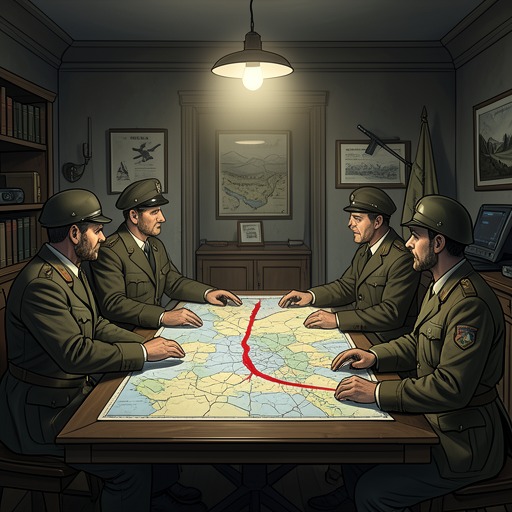
The first stage is a conventional military retreat reorganized for an inhuman enemy. Redeker concludes that the outbreak has progressed too far for everyone to be saved and that the armed forces have been weakened beyond their ability to isolate the threat. Since the military is spread too thinly and grows weaker each day, its units must be consolidated and withdrawn to a defensible safe zone. Mountains, rivers, or an offshore island may provide the natural barrier needed to hold the perimeter. Once concentrated, the armed forces can eradicate the infestation inside the zone and use the remaining resources to resist further attacks.
The second stage concerns civilians and is the source of the plan’s lasting infamy. Only a small fraction of the population is to be evacuated into the safe zone. These selected civilians provide the labor needed for eventual wartime economic reconstruction and help preserve the legitimacy and stability of the government by demonstrating that its leaders are still protecting someone. Survival is thus made to serve both practical recovery and political authority.
Those excluded from evacuation are not merely abandoned. They are to be gathered into isolated zones and used as human bait. The refugees must remain uninfected, alive, defended, and, if possible, resupplied so that the undead remain fixed around them instead of pursuing the retreating army toward the safe zone. The logic is brutally explicit: every undead creature besieging those survivors is one less creature attacking the defenses. The plan converts protection into confinement and humanitarian maintenance into a military resource. Its victims are preserved precisely so that their continued existence can consume the enemy’s attention.
Disappearance and Moral Afterlife
The agents take Redeker by helicopter to Kimberley, the underground base where he had first written Orange Eighty-Four. There, the surviving cabinet hears his report, provoking a furious response, especially from the Zulu defense minister, who would rather fight in the streets than remain hidden in a bunker. The president, however, receives Redeker differently. After Redeker explains the necessity of the plan, the president embraces him. For a man defined by emotional impermeability, the embrace is an extraordinary moment: genuine warmth reaches the strategist who has built his worldview around excluding it.
Azania refuses to claim that the embrace changed Redeker. It may have been only a sentimental gesture directed at a heartless monster, and the embrace may have had no effect on him at all. Nevertheless, it is the last occasion on which anyone is known to have seen Paul Redeker. His disappearance remains unexplained. Azania enters the operation afterward, arguing that years of working with Redeker and understanding his methods make him uniquely qualified to help implement the plan. He works through the retreat, the consolidation months, and the remainder of the war, becoming one of the living instruments through which Redeker’s reasoning is turned into national policy.
Years later, Azania expresses neither worship nor hatred but pity. He hopes that, if Redeker still exists somewhere, he has found peace. The final irony lies in the place where this account is recorded. Azania signs out at Robben Island Psychiatric Institution and discovers that the patient named on the visitor register is Paul Redeker. The text does not confirm whether the institution contains the vanished strategist, a surviving man under protection, or a symbolic prisoner of his own doctrine. It leaves Redeker suspended between historical figure and living secret, while the guard’s warning that many people want to send him to hell preserves the public hatred surrounding his name.
Narrative Role and Significance
Redeker functions as the nightmare form of rational expertise. He does not defeat the undead through personal heroism or emotional conversion; he supplies a system that makes organized survival possible by deciding in advance whose lives will count toward the future. His continuity from apartheid’s Orange Eighty-Four to the epidemic’s retreat plan shows that the emergency does not create his ethics. It reveals what those ethics can do when the scale of crisis becomes national and existential.
His doctrine also exposes the political power of selective visibility. Those inside the safe zone become the recognized population, the workers, citizens, and proof of governmental legitimacy. Those outside become a managed remainder: still alive, still defended, and still supplied, but only because their suffering serves the defense of others. Redeker’s coldness is therefore not mere personal eccentricity. It becomes an institutional method, allowing a government to call abandonment strategy and captivity protection.
The character’s unresolved ending prevents an easy judgment. Redeker may be remembered as the monster who designed a population to be sacrificed, or as the strategist whose refusal of sentiment saved the remnant that could rebuild. The narrative does not erase either interpretation. Instead, it makes their coexistence the point: Redeker’s plan is effective because it accepts a moral cost that ordinary political language tries to conceal, and his legacy remains inseparable from the lives preserved and the lives deliberately left behind.