Paul Redeker–Xolelwa Azania association
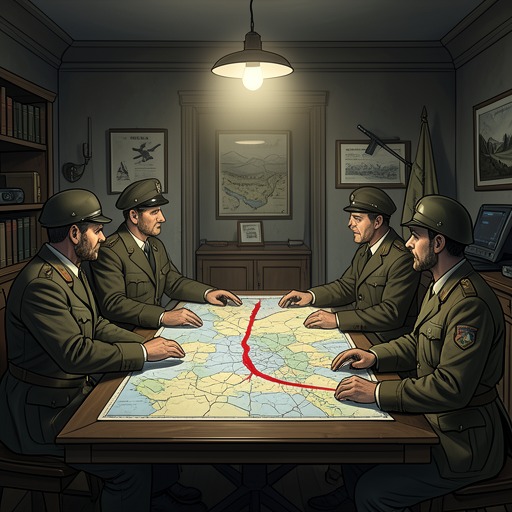
World War ZThe Paul Redeker–Xolelwa Azania association is a relationship of professional understanding, wartime service, and unresolved moral judgment. Xolelwa Azania presents Paul Redeker as a brilliant but terrifying thinker whose plan saved the surviving structure of South Africa by accepting that most people could not be saved. Azania’s own long familiarity with Redeker’s thinking allowed him to help carry that plan through the retreat and the consolidation of the safe zone, yet the relationship ends not in reconciliation or certainty but in pity for a man who disappeared after becoming indispensable.
Intellectual Association and Opposing Temperaments
Xolelwa Azania encounters Redeker through the legacy of Redeker’s ideas and through a claimed history of working with him for many years. Azania describes Redeker as dispassionate: a figure revered by some as a savior and condemned by others as a monster. Redeker’s fundamental conviction was that emotion constituted humanity’s central weakness. He reduced the heart to an organ whose only proper purpose was to pump blood to the brain, treating love, hate, and other attachments as impediments to clear thought. Azania’s account therefore establishes a sharp contrast between the two men. Redeker’s authority rests on abstraction and emotional refusal, whereas Azania remains capable of sympathy, uncertainty, and pity.
Redeker’s earlier papers on alternative solutions to historical and social problems had attracted the apartheid government, which saw his “liberated intellect” as politically useful. His own formulation that racism was merely a by-product of irrational emotion reveals the cold universalism of his reasoning: he rejects both racial hatred and human attachment by placing them in the same category of emotional error. Azania does not erase the danger of this worldview. Instead, his account holds together Redeker’s intellectual force and the possibility that such force had become morally monstrous.
The Redeker Plan and Azania’s Wartime Role
When agents of the National Intelligence Agency found Redeker in his Drakensberg cabin during South Africa’s Great Panic, they asked whether he had written Orange Eighty-Four. Redeker expected a revenge killing connected to his apartheid past, but the agents lowered their weapons and asked whether he had a plan. He had already developed one as an intellectual exercise, assuming that no one would survive to read it. Azania’s later role depends on the same quality that made Redeker’s work so influential: an ability to understand the undead not only as a military threat but through their physiology, behavior, and combat doctrine.
The plan’s first principle was that the entire population could not be saved. South Africa’s armed forces had been weakened and dispersed until they could no longer isolate the outbreak. Redeker therefore proposed withdrawing them into a defensible safe zone, preferably protected by mountains, rivers, or an offshore island, where the living could destroy the infestation inside the perimeter and resist further attacks. The second principle was more politically and ethically radical: only a small fraction of civilians would be evacuated. Those selected survivors would provide the labor needed for economic reconstruction and preserve the government’s legitimacy by demonstrating to the population inside the zone that its leaders were still looking after them.
Azania became involved when the plan was implemented throughout the country. After Redeker vanished, Azania persuaded the authorities that his years of work with Redeker, and especially his understanding of Redeker’s method of thinking, made him uniquely useful. He worked on the retreat, continued through the months of consolidation, and remained involved until the end of the war. His association was therefore not merely biographical or intellectual; it became an operational partnership in which Azania helped translate Redeker’s ruthless logic into national survival policy.
Disappearance, Witness, and Moral Judgment
The last known sighting of Redeker is framed through uncertainty. Azania recalls an embrace involving the nation’s father and acknowledges that the scene may be too sentimental: Redeker might have remained entirely unmoved, and the embrace might have had no effect on him. That hesitation is central to the relationship’s meaning. Azania cannot confirm whether Redeker’s emotional armor ever broke, just as no one can confirm what happened to him afterward. The plan made Redeker essential, but its implementation also seems to have erased him from ordinary human history.
Azania becomes the surviving interpreter of this absence. He does not claim that Redeker was secretly redeemed, nor does he reduce him to a simple villain. He calls him both an angel and a devil, reports that some people hate him while others worship him, and places himself outside both camps. His final position is pity. If Redeker still exists somewhere, Azania hopes that he has found peace. This response recognizes the damage caused by Redeker’s ideas without denying the isolation and self-annihilation that shaped their author.
Narrative Function and Significance
The association is presented through Azania at Robben Island Psychiatric Institution, where he is writing the third volume of Rainbow Fist: South Africa at War. The setting makes the relationship archival as well as personal. Azania is not simply remembering a colleague; he is composing the history of the turning point when South Africa pulled itself back from the brink. His notes and writing desk place Redeker inside an ongoing act of historical interpretation, while Azania’s invitation to exchange seats and enjoy the ocean breeze creates a brief atmosphere of ordinary courtesy around a subject defined by mass death and impossible choices.
The relationship’s deepest tension lies between Redeker’s doctrine and Azania’s narration. Redeker believed that emotion should be discarded so that humanity could think clearly. Azania’s testimony shows that the plan could be analyzed, executed, and defended in strategic terms, but could not be separated from grief, revulsion, uncertainty, and compassion. His own service proves the practical power of Redeker’s intellect; his pity proves that the plan’s survivor could not remain entirely within Redeker’s emotional universe. The association thus preserves Redeker’s legacy while refusing to grant his logic the final word.