Prochnow Plan
World War ZThe Prochnow Plan is Germany’s version of the Redeker Plan, a strategic doctrine built on sacrificial retreat. Rather than attempting to defend every population center during the first collapse, it preserves selected military forces by abandoning civilians and assigning rear units to delay pursuit. Its decisive significance lies in the collision between operational necessity and individual conscience: the plan may save troops needed for the eventual counteroffensive, but it makes those troops participants in a deliberate mass abandonment.
Definition and Strategic Logic
The plan emerges from the material conditions of the war against the living dead. The Allies of the Second World War prevailed through industrial production, natural resources, and logistics; during the Zombie War, the balance is reversed. The living dead control most of the world’s landmass, while American production depends largely on resources within the western states. Refugee-filled merchant vessels, fuel shortages, and dry-docked naval forces make conventional global resupply impossible. Against an enemy that does not need to be bred, fed, or led, ordinary military assumptions collapse.
In that setting, a retreat is not merely a movement away from danger. It is a method of conserving the people, equipment, and logistical capacity required for a later offensive. The plan therefore divides human life into strategic priorities. Civilians in threatened areas can be left in place, while selected units withdraw toward defensible positions and preserve the force structure needed for the next phase of the war. The plan’s German designation marks a national application of the same logic associated with the Redeker Plan: survival is secured by deciding who will be sacrificed now so that others may fight later.
The Hamburg Withdrawal
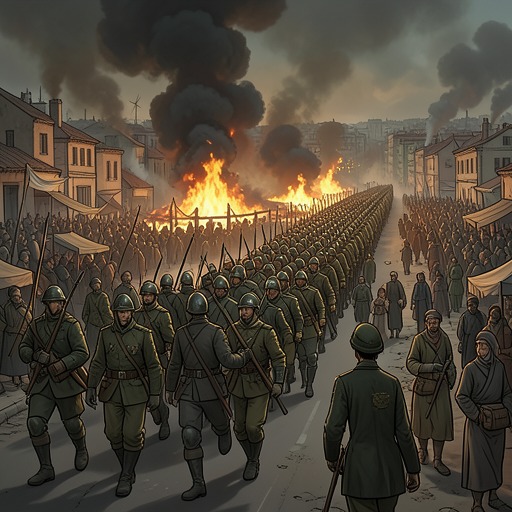
The plan becomes visible during the collapse of the Hamburg Garrison. After days of retreat, the unit receives an unusual order to rally at Schafstedt, north of the Nord-Ostsee Kanal, near Denmark. Earlier instructions had used civilian place-names over open channels so refugees could find assembly points; this transmission instead uses coded map-grid coordinates from a map not used since the end of the Cold War. The change signals that the army is no longer organizing a common evacuation. It is separating military movement from civilian protection.
The order is explicit: the soldiers must withdraw toward Schleswig-Holstein, must not move the civilians, and must not even tell them that the garrison is leaving. The commander seeks confirmation repeatedly, suspecting a mistake, but General Lang confirms that the instructions are deliberate. The soldiers are to rally what remains of the Hamburg Garrison and proceed north immediately. The effect is not an accidental evacuation failure but a planned abandonment, with the civilian population left exposed to the advancing dead and to the breakdown of urban defenses.
The order places the commander in a conflict between military obedience and West German historical conscience. He describes himself as a good soldier but insists that a West German upbringing taught him that uniformed service does not erase responsibility for one’s actions. He knows that refusal will bring charges of treason and prosecution against both himself and his men, especially in an atmosphere shaped by reports of Russian mutinies, crackdowns, and decimations. Concern for the eighteen- and nineteen-year-old soldiers under his command finally prevails. He orders the withdrawal, not because he accepts the morality of the plan, but because he cannot expose his men to punishment for disobedience.
The retreat is met with cries of cowardice and betrayal from the buildings. The commander promises that the force will return the next day with more men, but the civilians do not believe him; one woman accuses the departing soldiers of letting her baby die. Some refugees attempt to cling to the armored personnel carriers or force open their hatches. The soldiers knock them away and seal themselves inside while objects are thrown from the buildings, including furniture and human waste. The physical separation between the armored column and the trapped civilians becomes the plan’s moral image: protection is converted into exclusion.
Expendable Forces and Delayed Pursuit
The withdrawal is covered by Rapid Reaction Stabilization Units that had already been badly mauled. The commander later learns that these units were classified as expendable. Their assignment is to prevent zombies or refugees from following the retreating column, and they are ordered to hold to the end. The plan thus sacrifices not only unarmed civilians but also military formations whose purpose is to buy time for the forces deemed more valuable.
The rear guard’s commander stands through the cupola of his Leopard tank. He and the Hamburg commander had served together in NATO’s IFOR in Bosnia, where the older comrade once took a Serbian bullet that probably would have struck him. During the retreat they exchange a silent salute on the shattered autobahn. The departing officer hides his tears by pretending to study a map, then privately resolves to kill General Lang when the force returns. The gesture captures the plan’s double structure: tactical cooperation continues even as personal loyalty, gratitude, and hatred become inseparable.
Revelation and Moral Consequence
Only later does the commander learn the details of the Prochnow Plan. That knowledge does not soften his judgment of General Lang; it intensifies his hatred. Understanding the plan explains why the order was issued, why civilians were abandoned, and why rear units were left to die, but explanation is not absolution. The plan’s logic is precisely what makes it unbearable: Lang knew that the war would be long and that surviving soldiers such as those withdrawn from Hamburg would be needed to win it.
The commander’s condemnation rests on responsibility rather than ignorance. He argues that no one can shift the blame to the plan’s architect or to a superior officer. Each person must make a choice and live with its consequences. Lang, in his view, saw the steep road ahead but could not bear the moral weight of what that road required. He deserted the civilians in the same way the garrison deserted them, and the surviving soldiers were left to drag the burden of that decision through the rest of the war.
The plan therefore creates a form of discipline based not only on command but on shared guilt. Its soldiers may claim that they were following orders, yet the narrative refuses to let that phrase erase their agency. The decision to withdraw preserves a future army, but it also produces men who understand that survival was purchased through the abandonment of people they had been charged to protect. The Prochnow Plan’s enduring power in the story comes from this unresolved exchange: it may be strategically necessary, but its success cannot be separated from the human beings it deliberately leaves behind.