Quisling
World War ZQuisling is the condition in which a living person psychologically crosses into imitation of the undead, becoming a hostile, zombie-like attacker while remaining biologically alive. The condition matters because it destroys the apparent boundary on which survival tactics depend: a figure who shuffles, sounds, bites, and tries to eat like a Zombie may still have warm flesh and bright red blood. Quislings therefore turn fear, recognition, and diagnosis into weapons against the living.
Definition and Psychological Origin
The people later called Quislings were understood as individuals who could not cope with a fight-or-die situation. Instead of resisting what terrified them, they were drawn toward it: they wanted to please it, join it, and become like it. The explanation compares their behavior with reactions associated with kidnapping and Stockholm Syndrome, as well as with collaborators in conventional wars who join an invading enemy and sometimes become more zealous than the people they imitate. The name was linked to the idea of collaboration, although the speaker is uncertain about its linguistic origin.
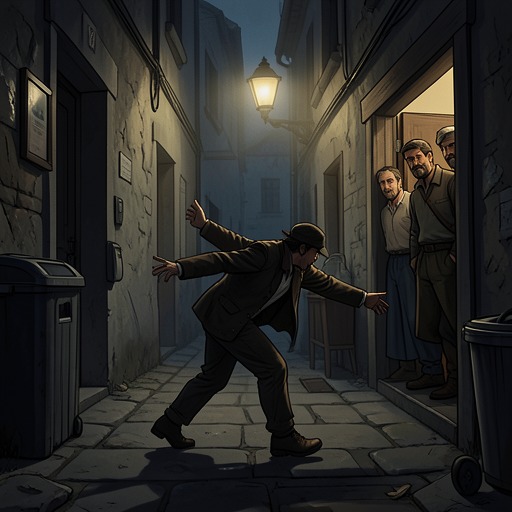
This response was especially destructive because the war offered no meaningful middle ground. A person could not surrender to the undead by claiming to be on their side; there was no gray area and no safe in-between identity. Some people apparently could not accept that absolute division. They moved and sounded like Zombies, attacked other people, and attempted to eat them, transforming psychological collapse into a condition that looked like a new form of the enemy.
Discovery and Identification
The first Quisling encountered by the speaker’s unit appeared to be an ordinary adult male in his mid-thirties: dirty, dazed, and shuffling down a sidewalk. The soldiers initially assumed that he was experiencing Z-shock. The diagnosis changed when he bit one of them in the arm. The speaker responded with a head shot, then turned to the wounded soldier, who was crumpled on the curb, swearing, crying, and staring at the gash in his forearm. Because a bite ordinarily implied a death sentence, the injured man was prepared to kill himself.
The apparent execution instead became a reprieve. The shot subject had bright red blood pouring from his head, and examination showed that his flesh was still warm. He had not been one of the undead but a living person who had adopted their behavior. The wounded soldier survived the immediate fear of infection, although the Quisling’s bacteria-laden mouth nearly killed him through a severe staph infection. The encounter established the central danger of the condition: visual behavior could imitate death, while the body retained the capacities and vulnerabilities of life.
Medical Misrecognition and Physical Capabilities
The soldiers first believed that they had stumbled upon a new discovery, but Quislings had already been appearing elsewhere. The Centers for Disease Control and Prevention was preparing to announce the phenomenon and sent an expert from Oakland to brief units on how to respond to further encounters. The delayed public understanding helped create widespread confusion about apparent immunity. People taking Phalanx could be bitten and survive, but observers might not know that Quislings existed; they could therefore mistake a Quisling encounter for proof that the drug had protected them.
The same confusion amplified the reputation of supposed wonder drugs. Survivors who were bitten by a Quisling and lived could attribute their survival to Phalanx or another remedy without realizing that the attacker had been alive. In this way, Quislings became an unseen explanation behind both mistaken medical certainty and inflated claims about pharmaceutical protection.
They were also more physically capable than ordinary Zombies in important conditions. They did not freeze merely because the weather was moderately cold, particularly if they had gone under while wearing warm clothes. They could grow stronger from the people they ate, unlike Zombies, and could maintain their physical condition over time. Their living bodies gave them a durability and adaptability that made them hostile in a way the ordinary undead were not.
The Undead’s Recognition and the Failed Imitation
Quislings were as hostile as regular Zombies and could be even more dangerous, yet their imitation did not grant them acceptance by the undead. Early in the war, people sought a method for turning the living dead against one another. Eyewitness accounts and video footage seemed to document Zombies fighting among themselves, encouraging the belief that the undead might possess internal divisions that could be exploited.
The apparent infighting was misread. The Zombies were attacking Quislings, not one another. Human observers could not reliably tell the difference, but the real Zombies could. The imitation failed at the level that mattered most: the undead recognized the living body concealed beneath the borrowed movements and sounds.
The resulting violence was especially bleak because Quislings did not scream or meaningfully resist. They lay still, writhing in a slow, mechanical manner while the creatures they were trying to resemble ate them alive. Their attempt to escape the human position by identifying with the enemy thus ended in rejection by both sides: they were no longer able to live as ordinary people, but they were never accepted as Zombies.
Narrative and Thematic Significance
Quisling makes the war’s categories unstable without making them equal. The condition shows that imitation can reproduce the outward signs of monstrosity while leaving the body alive, and that survival depends on more than recognizing a familiar silhouette or gait. It also turns psychological surrender into a material threat: terror is not merely an emotion experienced by witnesses but a force capable of reorganizing a person’s behavior against everyone nearby.
The state exposes the danger of treating visible difference as a complete diagnosis. The soldiers’ first interpretation, the injured man’s assumption that death was inevitable, the public enthusiasm for Phalanx, and the supposed evidence of Zombie infighting all arose from the same error: people saw the performance and inferred the wrong underlying reality. Quislings therefore function as a recurring warning that the war cannot be understood through appearances alone. Their most tragic irony is that they abandon so much in an attempt to join the enemy, only to be identified by the enemy and consumed by it.