Resource-to-Kill Ratio
World War ZResource-to-Kill Ratio (RKR) is the central wartime rule for deciding what humanity can afford to build, deploy, maintain, and replace against the Zombies. It transforms war from a contest of technological grandeur into a calculation of production, raw materials, transport, fuel, labor, maintenance, and actual killing power. Its decisive significance is that survival depends not on possessing the most advanced weapon, but on producing enough effective weapons to sustain a campaign across a world whose enemy does not need food, ammunition, fuel, water, or logistics.
Definition and Strategic Premise
RKR emerges from the recognition that modern war is an industrial chain rather than a sequence of heroic engagements. The winning side in World War II had been able to manufacture more bullets, beans, and bandages, draw on abundant natural resources, and move both materials and finished products to the front. During the Zombie War, that advantage was reversed: the Zombies controlled most of the world’s landmass, while American production depended largely on what could be harvested in the western states. Refugees filled the merchant fleet, fuel shortages immobilized much of the navy, and the country could no longer assume access to an entire planet’s resources.
The rule therefore compares the total burden of a system with its practical effect. Fuel, specialized parts, trained personnel, industrial time, aircraft maintenance, delivery infrastructure, and replacement requirements all count alongside the weapon’s performance on paper. RKR rejects the assumption that a weapon is valuable because it is powerful, sophisticated, or prestigious. A system that kills efficiently but cannot be supplied, repaired, or manufactured in sufficient quantity may be strategically inferior to a simpler weapon that can remain in the field indefinitely.
Institutional Adoption and Production
Travis D’Ambrosia formalized RKR after becoming chairman of the Joint Chiefs and developed a broader strategy for applying it. The principle gave the Department of Strategic Resources de facto influence over military research and development because civilian contractors depended on resources controlled by the department. Military officers protested the cancellation of Stealth bombers and tank production, but the counterargument was material rather than ideological: an M-1 Abrams required jet fuel that was no longer readily available, and Stealth aircraft offered little value against an enemy without radar.
The same logic shaped the postwar labor crisis. The surviving economy had been postindustrial and highly specialized, leaving more than 65 percent of the civilian workforce classified as F-6, with no valued vocation for the emergency economy. Executives, representatives, analysts, and consultants were poorly suited to a world that urgently needed carpenters, masons, machinists, and gunsmiths. Reconstruction consequently required mass retraining and the conversion of white-collar labor into practical industrial capacity. RKR was thus not merely an accounting formula for weapons; it became a rule for allocating human skill.
Recycling supplied a second foundation for the doctrine. Prewar America possessed enormous stocks of clothing, kitchenware, electronics, automobiles, and other manufactured goods, including millions of vehicles concentrated around the Los Angeles basin. An industry of more than one hundred thousand workers operated three shifts a day to collect, catalog, dismantle, store, and ship usable components to factories along the coast. Material that had once represented comfort became a reserve of industrial inputs, allowing the surviving population to replace lost global supply chains with systematic recovery.
Weapons and Programs Revalued
RKR sharply downgraded weapons whose apparent sophistication concealed crippling logistical demands. Zeus and the Mobile Tactical High Energy Laser were nearly lost because the latter required a convoy of delicate, interdependent vehicles, tremendous electrical power, and large quantities of unstable, toxic chemicals. Its mobile designation suggested flexibility, but its actual support structure made it poorly suited to a war fought over damaged terrain and limited infrastructure. The program survived only long enough to be filmed after resources had already judged it a gross waste.
Project Yellow Jacket represented a more spectacular failure. Its designers promised a theoretical victory within forty-eight hours by scattering millions of micro-missiles from transport aircraft and guiding them by satellite toward the brains of Zombies across North America. The proposal sounded like a wonder weapon, but the resources poured into it became an opportunity cost: every factory, component, and unit of labor devoted to the project was unavailable for weapons and systems with more reliable battlefield returns. Its failure becomes a warning against confusing technical imagination with strategic value.
The Joint Standoff Weapon suffered a similar reversal after the Battle of Yonkers. It could release a GPS- and inertial-guided bomb from as far as forty miles away; each bomb carried 140 submunitions, and each bomblet combined an anti-armor shaped charge, an anti-infantry fragmentation case, and a zirconium ring designed to ignite the kill zone. Yet the full cost of one delivery system—including materials, labor, time, energy, aircraft fuel, and ground maintenance—could instead support a platoon of infantry capable of killing vastly more Zombies. The B-2 Spirits, B-1 Lancers, and even B-52 bombers were consequently abandoned as former crown jewels whose returns no longer justified their burdens.
The doctrine also corrected the ammunition assumptions exposed by the failed conventional response. Tanks had too few canister rounds, the ammunition that functioned like a giant shotgun against dense groups of walking corpses, while armor-piercing depleted-uranium darts and other conventional rounds produced little useful effect against Zombies. The problem was not simply insufficient bravery or firepower; it was the failure to match ammunition supply to the enemy’s physical vulnerability. Sustained operations required the right kind of shot in quantities large enough to matter.
From Central Policy to Battlefield Culture
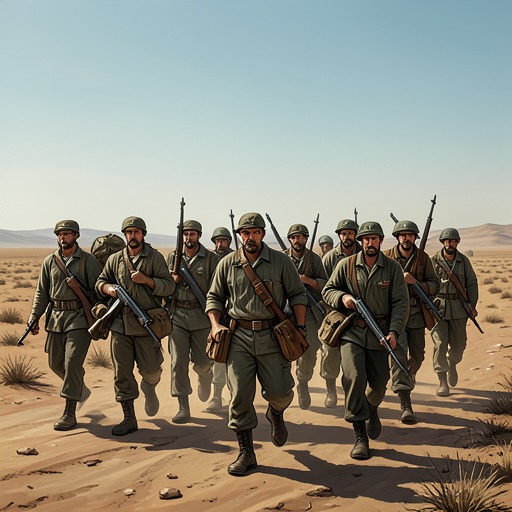
RKR became effective when it spread beyond bureaucratic planning into the habits of soldiers. Troops began comparing systems in ordinary conversation, asking why one weapon should be retained when another cost the same and could kill many more Zombies. The rank and file also improvised, designing cheaper tools than military planners had anticipated. The Marines proved especially adaptable because their dependence on naval procurement had long forced them to improvise for land warfare.
The Standard Infantry Entrenchment Tool, known as the Lobotomizer or Lobo, embodies this practical turn. Marines fashioned it from recycled automobile steel, combining the functions of a shovel and a double-bladed battle-axe. Twenty-three million were produced during the war. Its value lay not in novelty or prestige but in availability, durability, and direct usefulness: a mass-produced tool made from recovered material that could perform essential battlefield work without demanding the fuel, precision infrastructure, or maintenance burden of advanced machinery.
The Standard Infantry Rifle and Cherry PIE ammunition demonstrate the same balance. The rifle resembled a World War II weapon because composite materials were difficult to mass-produce, but it was accurate, reliable in mud, sand, and saltwater, and adaptable through interchangeable parts and barrels for sniper, rifle, or carbine use. Its folding spike also supplied a close-combat option when the Lobo was unavailable. Cherry PIE ammunition shattered inside a Zombie’s skull and burned the brain with its fragments, avoiding the spread of infected gray matter and reducing the need for wasteful burning. Even burial procedures changed: during BS4 duty, bodies could be placed in trenches whole without decapitation.
Logistics, Screening, and the Limits of Calculation
The Continental Airlift applied RKR to a dispersed defensive geography. Blue Zones, civilian strongholds that had secured small territories, required resupply, while Red Zones contained factories, mines, and power plants guarded by custodial teams for possible future use. Maintaining contact with these isolated areas, processing demands, coordinating with the Department of Strategic Resources, and prioritizing each delivery became the largest statistical undertaking in air force history.
The airlift favored self-sustaining drops over dependency drops. Tools, spare parts, and equipment capable of making further spare parts were prioritized over food and medicine that required repeated deliveries. The governing idea was that isolated communities needed the means to produce and repair for themselves, not merely temporary relief. Yet RKR was never allowed to become an excuse for abandoning immediate survival. Each autumn, aircraft still delivered fish, wheat, salt, dried vegetables, and baby formula, because winter could kill communities before self-sufficiency became possible. Specialists such as doctors, engineers, and Special Forces instructors were also inserted when no manual could substitute for trained expertise, even though many Blue Zones lacked airstrips and some of those personnel had no prospect of extraction.
The principle also illuminates practices beyond weapons procurement. Medical examinations in the Yeroham resettlement camp consumed time, personnel, and emotional dignity, but blood, skin, hair, saliva, urine, and feces testing served the larger goal of determining who could safely enter the population. Dogs were first used in triage to identify the infected, following the Israeli practice of sending people past caged animals. Though early training failures caused handlers to lose hands, arms, and throats, the dogs’ terror response probably saved millions of lives. In each case, survival required turning limited bodies, animals, labor, and institutional capacity toward the most consequential threat.
Moral and Narrative Significance
RKR is inseparable from the darker arithmetic of wartime triage. The Redeker Plan applies a comparable logic to civilians by preserving only a small fraction as a labor pool and as proof that government leaders are protecting someone, while leaving others in defended, isolated zones as human bait to hold the Zombies in place. Resource efficiency can therefore become a language for deciding whose life is strategically useful and whose suffering is treated as an input to survival.
The rule’s reach extends into population management. The evacuation of civilians is tied to labor and governmental legitimacy; the classification of workers determines who must be retrained; quarantine examinations reduce individual bodies to medical data; and even Russian reproductive policy treats fertile women as national resources, with the leader identifying a woman’s uterus as the motherland’s greatest weapon. These examples do not make all such measures equivalent, but they reveal how the same pressure to maximize collective survival can turn people into units of labor, risk, diagnosis, or reproduction.
RKR ultimately marks the military’s painful transition from prewar abundance to disciplined scarcity. It favors durable rifles over prestigious aircraft, explosive ammunition over indiscriminate fire, recycled steel over specialized manufacture, and airlifted tools over endless dependency. Its achievement is practical: it helps create a force capable of confronting two hundred million Zombies, an enemy exempt from the restrictions that govern every human army, which must be bred, fed, and led. Its danger is equally clear. Once efficiency becomes the dominant measure, moral cost can disappear behind a ledger, and the language that saves civilization can also make sacrifice appear inevitable.