Robben Island Psychiatric Institution
World War ZRobben Island Psychiatric Institution is presented as both a fortified place of confinement and the final known address of Paul Redeker, the dispassionate strategist whose plan saved a remnant of South Africa by abandoning much of its population to the living dead. Its significance lies in the collision between the scale of Redeker’s wartime reasoning and the intimate, almost quiet setting in which his fate is discussed: a writing desk, an ocean breeze, a visitor’s badge, and a patient’s name recorded in an institutional register.
Setting and Function
Robben Island Psychiatric Institution stands in Cape Town Province, United States of Southern Africa, separated from the mainland by a ferry crossing and protected by tight security. The interviewer reaches the island by ferry, signs out an entrance badge, and is photographed again by a tall Afrikaner guard, whose casual warning that many people want to send Redeker to hell reveals the continuing danger surrounding the patient. The institution is not merely a medical facility in the background. It is a controlled site in which political memory, public hatred, and state custody converge.
The institutional setting also creates a deliberate contrast with Redeker’s public image. Outside the island, he is remembered as either a savior or a monster; inside it, he is reduced to the administrative category of a patient. The final register identifies the person being visited as Paul Redeker, making the bureaucratic label more chilling than a public condemnation. The man whose calculations determined the movement of armies and civilians is now encountered through security procedures, a ferry schedule, and a line in a visitors’ log.
Redeker and the Plan
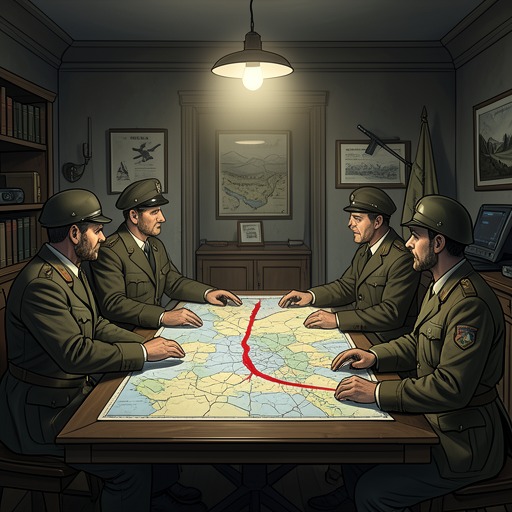
Redeker developed his solution to the undead epidemic while isolated in a hideaway, initially treating it as an intellectual exercise because he believed no one would survive to read it. The plan began from an uncompromising premise: the outbreak had progressed too far for everyone to be saved. Military forces, weakened and dispersed, were to withdraw into a defensible safe zone protected where possible by mountains, rivers, or an offshore island. Once concentrated, they could destroy the infestation within the zone and defend it against further attacks.
The second stage made the plan morally infamous. Only a small fraction of civilians would be evacuated, both to preserve a labor force for economic reconstruction and to maintain the government’s legitimacy by demonstrating that its leaders were protecting someone. The remainder would be gathered into isolated areas, deliberately kept alive, defended, and resupplied when possible as human bait. By holding the undead in place, these abandoned populations would prevent the hordes from pursuing the retreating army and attacking the safe zone. The plan therefore converts civilians into a strategic resource: people are preserved not for their own sake but because each undead creature occupied by them is one less attacking the survivors chosen for evacuation.
The Disappearance of Paul Redeker
During the chaotic weeks when the Redeker Plan was implemented across South Africa, Redeker disappeared from public view. Xolelwa Azania recalls that the last day anyone saw him followed an embrace from the nation’s father, an unexpected gesture of genuine emotion that pierced Redeker’s otherwise impenetrable shell. Azania admits that the embrace may have meant nothing to Redeker and that the sentiment surrounding it may be wishful interpretation. Nevertheless, it marks the last confirmed sighting before Redeker’s fate becomes unknowable.
Azania then entered the operation. He persuaded the authorities that he had worked with Redeker for many years and understood his thinking better than anyone else still alive in South Africa. That claimed expertise brought him into the retreat, the subsequent consolidation months, and the war’s final phase. His account gives the island an additional function: it is where the historical consequences of Redeker’s decisions are narrated by someone who helped translate them into practice, while Redeker himself remains unavailable to explain or defend them.
Memory, Judgment, and Uncertainty
Azania’s judgment of Redeker refuses a simple moral verdict. Redeker is described as an angel and a devil; some people hate him, others worship him, while Azania says that he pities him and hopes that, if he still exists somewhere, he has found peace. The contradictory responses preserve the central tension of the plan. Its logic is praised as the turning point that pulled South Africa back from the brink, yet its method depends on treating living people as expendable instruments.
The institution intensifies that contradiction rather than resolving it. No definitive account is given of what happened to Redeker after his disappearance. The reader is first brought close to him through the consequences of his reasoning, then kept at a distance by the uncertainty of his whereabouts and condition. The cool ocean breeze, the cleared writing desk, the ferry, and the photographed badge create an atmosphere of calm administration around a figure whose name still provokes demands for damnation. Robben Island Psychiatric Institution thus becomes a place where history’s most consequential decisions are contained without being settled: Redeker is alive as a patient, absent as a witness, and permanently present as a problem of survival and responsibility.