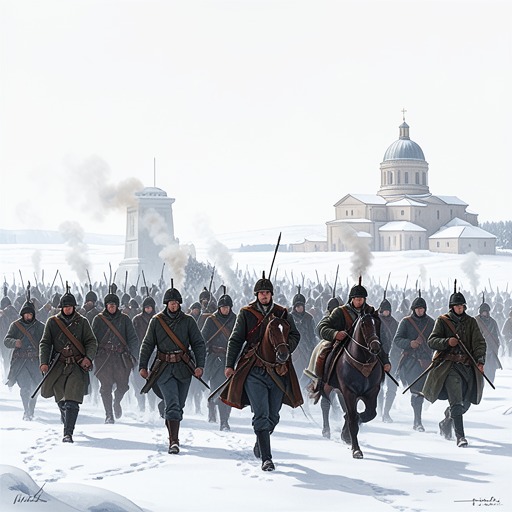
Russian Army
World War ZThe Russian Army functions in the novel as both a surviving instrument of national defense and a record of institutional exhaustion. Unlike forces supported by large-scale wartime production, it must defend a vast homeland with limited industry, extreme weather, obsolete equipment, and commanders increasingly damaged by the moral and psychological demands of the Zombie War.
Origins and Strategic Position
The Russian Army’s endurance rests partly on the legacy of a military-industrial state. Russia lacks the Department of Strategic Resources and has little industry beyond producing enough food to keep its population alive, but decades of prioritizing tanks, guns, and other military hardware left behind stockpiles that become decisive when the homeland needs them. What had once appeared economically wasteful becomes, during the crisis, a reserve of weapons and vehicles capable of saving the country’s remaining population.
Russia fights on two fronts. The Ural barrier protects the west, while zombie swarms move from the southeast through the unstable regions of Asia. Siberia is stabilized but not fully secure because refugees from India and China, together with frozen ghouls, continue to create danger when thawing begins each spring. The Russian Army therefore uses winter not merely as a season to endure but as an operational resource: the prolonged cold gives it time to reorganize forces, marshal civilians, inventory matériel, and distribute military stocks before the next campaign.
Equipment and Battlefield Doctrine
The army’s combat methods are described as loose, destructive, and costly rather than precise. It saturates the dead with DShK heavy-machine-gun fire, uses flamethrowers and Katyusha rockets, and crushes zombies beneath the tracks of old T-34 tanks. This approach is inefficient and produces needless casualties, but it reflects the conditions under which the Russian Army fights: cities are filled with rubble, ammunition is unreliable, and every assault risks exposing soldiers to bites and reanimation.
The first major offensive battle is the Battle of Ufa. Russian troops advance through devastated urban terrain after prolonged artillery bombardment, fighting block by block, house by house, and room by room. The experience teaches them to stop entering cities during winter and instead wall them up, converting seasonal withdrawal into a defensive method. Ufa thus becomes an institutional lesson: massed firepower cannot by itself make close urban combat against the dead sustainable.
The army’s equipment is often dangerously old. A Thirty-second Motor Rifle division uses fourth-class matériel, including PPSH submachine guns, bolt-action Mosin-Nagant rifles, and worn uniforms inherited from earlier generations. Ammunition has sat exposed in crates for decades, producing the feared “Cugov,” a weapon that clicks when a ghoul is already within killing distance. These failures turn technical obsolescence into immediate moral danger, because a misfire can kill the soldier who depends on the weapon and expose an entire unit to infection.
Command, Learning, and Comparison
The Russian Army is contrasted with the more organized American military, whose forces develop the Resource-to-Kill Ratio and use it to judge weapons by their cost and effectiveness. The American approach favors scalable production, logistics, and systems such as the Standard Infantry Rifle and Cherry PIE ammunition. The Russian force has no equivalent level of centralized resource management, and its battlefield style remains more improvisational and wasteful.
The contrast does not make the Russian Army irrelevant. Its inherited arsenal, geographical depth, and ability to exploit winter compensate for its industrial weakness. Where the United States must build a new war economy around transport, factories, and carefully prioritized matériel, Russia draws on the accumulated hardware of an older military state. The same historical inheritance that impoverished ordinary life supplies the weapons with which the country resists annihilation.
The Russian Army also learns through catastrophe. The Battle of Ufa changes urban doctrine, while the wider offensive reveals that conventional military assumptions cannot be applied unchanged to the dead. The living must recruit, feed, and lead their armies; the zombies require none of these conditions. Against an enemy that neither needs supplies nor obeys command structures, Russian practice becomes a struggle between overwhelming but wasteful firepower and the need to conserve soldiers, ammunition, and leadership.
Casualties and Psychological Collapse
The army’s greatest crisis is not only logistical but ethical. It has no equivalent of the American L pills, so infection can be dealt with only by a bullet. Yet soldiers cannot easily shoot comrades who have been bitten. Such executions recall the Russian practice of decimation, and ordering one soldier to kill another threatens to cross a line that could provoke mutiny.
The burden falls on the wounded themselves. Bitten soldiers gather at field hospitals and synchronize their suicides, finding a grim form of companionship in the knowledge that they will not die alone. The practice reveals how completely the war has inverted ordinary military solidarity: comradeship remains, but it can culminate in collective self-killing rather than rescue.
Command suffers with the troops. During the first campaign, the division loses four experienced leaders, three junior lieutenants, and a major in the first week. Some officers shoot themselves; another chooses “suicide by combat,” volunteering for increasingly dangerous missions until he dies attempting to face a dozen ghouls with only a bayonet. Major Kovpak disappears after leading his company on foot from Curta in the Salib Mountains to Manaskent on the Caspian Sea, carrying supplies and wounded people through sixty-five days and thirty-seven major engagements. Although he had earned the right to become an instructor and had been invited by STAVKA because of his experience, his return to combat ends in his being treated officially as a deserter.
This wave of officer suicides becomes known as the Russian Decimation. Nearly one in ten officers kills himself, bringing the war effort close to collapse. The term links modern psychological breakdown to older traditions of military punishment, making the army’s crisis feel like a repetition of national military history under radically altered conditions.
Institutional Significance
The Russian Army represents survival through inherited capacity rather than efficiency. Its weapons are often obsolete, its ammunition unreliable, and its attacks brutally expensive, yet its stockpiles and defensive depth provide the means to hold territory while winter and reorganization create opportunities for recovery. The organization survives not because it possesses an ideal doctrine, but because its historical weaknesses coexist with reserves that become valuable in an unprecedented war.
Its story also makes the Zombie War’s human factor impossible to ignore. The army can wall up cities, fire artillery, deploy tanks, and draw on enormous stores of matériel, but it cannot eliminate the dilemma of deciding who must kill the infected, nor can it fully protect commanders from despair. In the Russian case, military power preserves the state while consuming the people responsible for wielding it.