Sand Lakes Provincial Wilderness Park
World War ZSand Lakes Provincial Wilderness Park is one of the clearest landscapes of survival and delayed catastrophe in World War Z. Once a place of subarctic wilderness, it became a destination for refugees fleeing north during the Great Panic, then a seasonal worksite where Jesika Hendricks and several hundred volunteers confront abandoned vehicles, debris, and human corpses still partly frozen into the gray snow and ice. The park preserves the war’s central paradox: nature offered temporary protection from the living dead, but human survival systems were not prepared to sustain the people who reached it.
Setting and Postwar Condition
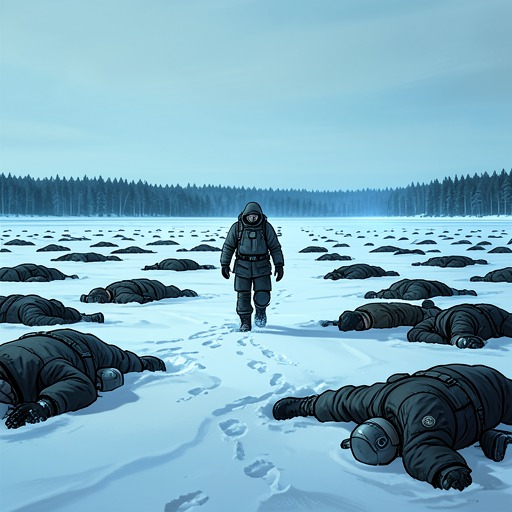
Sand Lakes Provincial Wilderness Park lies in Manitoba, where the natural beauty of the subarctic has been overwhelmed by the material remains of mass displacement. Wrecked vehicles, scattered debris, and partially frozen bodies remain embedded in the landscape, making the park less a pristine wilderness than an immense, unfinished graveyard. Jesika Hendricks, originally from Waukesha, Wisconsin, is now a naturalized Canadian and part of the region’s Wilderness Restoration Project. She returns every summer with several hundred other volunteers, although even the claimed progress of the project offers no visible end to the work.
The park’s postwar function is therefore both ecological and memorial. Its volunteers are clearing and restoring a damaged environment, but the damage cannot be separated from the human decisions that produced it. The landscape records not one spectacular battle but the cumulative effects of refugee movement, depleted fuel, exhausted food sources, exposure, disease, and abandonment. The slow disappearance of wreckage and the slow emergence of remains make recovery a process measured in seasons rather than victories.
Refuge and the Northern Flight
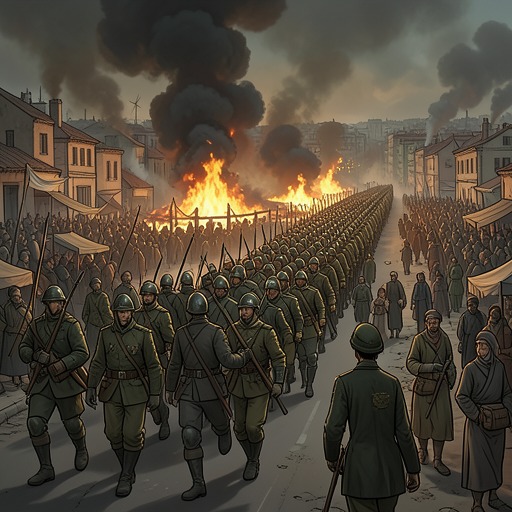
During the first wave of the crisis, Sand Lakes briefly seemed to fulfill the promise of the north. Families reached camps beside the lakes, where the relative absence of people created a sense of safety and collective relief. Refugees hunted and fished together, held nightly cookouts, and used dynamite in the water to bring fish to the surface. Chainsaws, car radios, musical instruments, and enormous bonfires gave the camp the atmosphere of a temporary festival. For a short time, cooperation and abundance made displacement feel like arrival in a promised land.
That refuge depended on resources that could not last. Trees were cut for fires, then leaves and stumps were burned, followed by plastic and rubber. Fish disappeared, game became scarce, and the smell of burning synthetic material entered the air, clothing, and bodies of the refugees. The camp’s confidence rested on the assumption that winter would freeze the living dead and make the north safe. Yet freezing the enemy did not answer the more basic question of how human beings would survive the winter themselves.
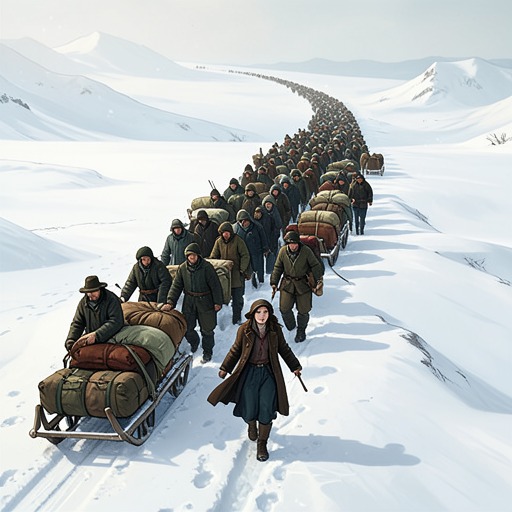
The failure was intensified by inadequate information. Hendricks can understand why authorities diverted refugees north rather than allowing everyone to follow the army west behind the Rocky Mountains. Feeding, screening, and protecting such a mass of people would have been impossible, and the authorities feared that the undead would follow the retreat. Northern regions at least offered the possibility that falling temperatures would immobilize the dead. What she cannot forgive is the irresponsible way the diversion was carried out and the absence of vital information that might have helped people survive. Sand Lakes thus embodies an environmental refuge created through emergency policy but supplied without the knowledge or resources needed to make that refuge viable.
Starvation, Death, and the Gray Winter
As autumn deepened, fuel vanished. Refugees used gasoline for cooking and to keep vehicle heaters running, leaving them to travel on foot or remain in camps that could no longer provide warmth. Groups of ragged, half-starved people continued moving through the area, carrying possessions that had become useless while preserving the desperate hope that conditions would improve. The sight of a pit filled with too many bones to count gives physical form to the consequences of that hope.
The refugee family at the center of Hendricks’s recollection deteriorated with the camp. A child who had been heavy before the journey was nearly skeletal by November; the parents also lost weight, and their former domestic restraint collapsed into constant arguments. Illness followed starvation: the child became too weak to leave a sleeping bag, developed a swollen belly, and suffered sores around the mouth and nose. A neighboring recreational vehicle emitted the smell of cooked meat, while the parents argued over an act that the mother considered necessary and the father rejected as a moral surrender. Their conflict shows how deprivation converted a family’s ordinary disagreements into a struggle over what kind of people they could remain.
The broader mortality was immense. Eleven million people were said to have died during that winter in North America alone, without counting Greenland, Iceland, or Scandinavia, and without accounting for refugees from southern China, Japan, and India. The First Gray Winter was not only a period of cold; it was also associated with atmospheric filth that altered the weather. The possibility that some of the airborne ash came from human remains turns the environment into a grim circulation of the dead, linking mass death to the altered climate through which survivors had to move.
The Return of the Living Dead
When the weather finally warmed, the apparent protection of Sand Lakes collapsed. The sun returned, snow began to melt, and by mid-July spring had arrived together with the living dead. A frozen body was discovered buried from the waist down in the ice, while its head, arms, and upper torso remained active, thrashing, moaning, and clawing toward the people nearby. The scene overturns the refugees’ expectation that winter had solved the threat: cold had immobilized some of the dead without destroying them.
The encounter ends with Hendricks using a long iron crowbar to smash the creature’s skull after it makes a great lunge and its frozen lower torso begins to snap. The action is practical rather than ceremonious. The park’s danger is not removed by a grand military operation but by the repeated labor of people who must recognize what the landscape has concealed and finish what the cold could not. The frozen corpse is both an ecological hazard and a delayed consequence, waiting beneath the surface until seasonal change releases it.
Wilderness Restoration and Wider Ecological Loss
Sand Lakes also belongs to the book’s larger account of damaged human and nonhuman environments. Refugees stripped the temporary camps of timber and fish, while across the wider war animals were forced into new patterns of movement and survival. Monkeys fled through crowded Himalayan roads, feral dog packs threatened long-range missions, and F-lions emerged as dangerous predators in landscapes reshaped by the collapse of human systems. Military dogs were trained to detect infection and escort human reclamation teams, while the oceans became killing grounds for whales hunted by fishing fleets converted from naval forces.
The park’s restoration work therefore cannot mean a simple return to a prewar wilderness. It is a place where environmental recovery, human memory, and unfinished danger overlap. Volunteers clear wreckage while the ice and thaw continue to reveal what the crisis left behind. As an image of the postwar world, Sand Lakes Provincial Wilderness Park gives the lie to any clean division between victory and aftermath: the war has ended, but its bodies, shortages, damaged habitats, and disputed decisions remain active in the land.