Sardar Khan
World War ZSardar Khan is the project manager directing the return of Udaipur Lake Palace to civilian life, yet his decisive significance lies in the memory beneath that official role. The former maharaja’s residence on Jagniwas Island became a luxury hotel and then a refuge for several hundred people before a cholera outbreak killed them all; under Khan’s direction, the hotel, Lake Pichola, and the surrounding city are beginning to recover. His testimony therefore places reconstruction beside catastrophe. He is not presented simply as a hardened survivor, but as a civilian engineer whose wartime experience still carries the panic, guilt, and moral confusion of an ordinary man forced into an extraordinary decision.
Identity and Postwar Role
Sardar Khan is identified as the project manager responsible for the restoration of Udaipur Lake Palace. The setting gives his work an unusually layered meaning. The palace is described as an idyllic, almost fairy-tale structure that has passed through three radically different functions: royal residence, luxury hotel, and refugee haven. The last of those functions ended in mass death from cholera, leaving the site as a monument to both shelter and failed protection. Khan’s task is not merely architectural repair. He is helping a damaged society reclaim a place whose history records privilege, displacement, epidemic disease, and survival.
The contrast between Khan’s present position and his remembered self is central to his characterization. In the interview, he sounds less like a highly educated, battle-hardened civilian engineer than like a young and frightened lance corporal caught on a chaotic mountain road. The recollection strips away the authority attached to his later title. What remains is a man who was not prepared for combat, did not understand the mission at first, and nevertheless became one of its witnesses and participants.
Forced Entry into the Crisis
Khan emphasizes that he was not supposed to be at the mountain pass and was not a combat engineer. He belonged to the Border Roads Organisation, whose work was to build roads rather than destroy them. At Shimla, while wandering through an assembly area and trying to locate whatever remained of his unit, he was seized by Sergeant Mukherjee and ordered into the driver’s seat of a jeep. Mukherjee carried a radio-like device and immediately directed him to return to the pass.
Khan tried to explain that he was only a steamroller driver and was not even fully qualified for that work. Mukherjee, preoccupied with the device, ignored the distinction. The charges had already been placed, he explained; the only remaining requirement was the order to detonate them. Khan’s questions about which charges and whose order expose the gulf between his ordinary technical role and the military emergency into which he has been pulled. He is not a volunteer seeking battle. He is an available driver absorbed by a collapsing command structure.
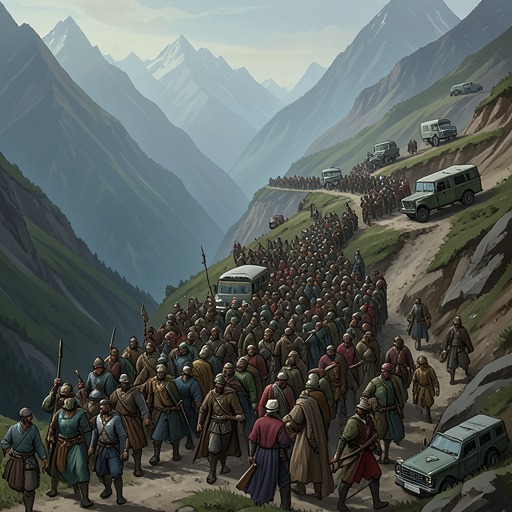
The road itself was already a landscape of flight. Khan remembers hundreds of monkeys scrambling over vehicles and people as refugees streamed along a narrow Himalayan track notorious as a death trap even in peacetime. Thousands struggled past stalled vehicles while clinging to suitcases and boxes; one man refused to abandon a desktop computer monitor. A monkey used the man’s head as a stepping-stone, and both fell over the edge. A bus went over despite not moving, its doors jammed by the press of foot traffic. A woman attempted to climb through a window while holding something tightly in her arms, and no one nearby stopped to help. Khan tells himself that the bundle was only clothing, but the memory remains uncertain and morally unbearable. The crowd’s indifference becomes part of the horror: people continue forward, unable or unwilling to acknowledge the person falling beside them.
The Road Demolition and the Moral Choice
The immediate conflict concerns whether the pass should be destroyed while refugees are still using it. A soldier from the Rashtriya Rifles, the unit assigned to secure the mountain entrance, runs past the jeep. Mukherjee confronts him for failing to clear the road, but the soldier replies that clearing it would mean shooting civilians, even relatives, and pushes past in fear and anger. The exchange makes the military dilemma explicit. The road is both an escape route for the living and a potential entrance for a vast zombie swarm.
Over the radio, a younger officer orders the road blown regardless of how many people remain on it. Mukherjee refuses to accept that command immediately. He argues that detonation would send dozens of refugees to their deaths and trap thousands on the far side. The officer counters that the road will never be clear because millions of zombies are behind the fleeing population. Mukherjee insists that he will detonate only when the zombies arrive, not before, rejecting what he calls murder even under military necessity. His resistance gives Khan a moral model, but it also shows how little time remains for principled delay.
The crisis changes when General Raj-Singh appears. Khan recognizes him as the Tiger of Delhi and remembers him as a nearly gigantic figure, despite the general’s torn uniform, bloody turban, injured right eye, and bandaged nose. Raj-Singh has escaped Gandhi Park on the last helicopter, with one of his own men smashing him in the face to force him aboard. His battered appearance does not diminish his authority; instead, it turns command into a visible burden carried by a wounded body.
Raj-Singh tells the men that the road must be destroyed immediately. The remaining air force has orders to close the mountain passes, and a Shamsher fighter bomber is already overhead. If the ground team cannot or will not complete the mission, the pilot is authorized to execute Operation Shiva’s Wrath. Khan understands the phrase as the rumored code for thermonuclear weapons. Such a strike would not create a narrow barrier. It would destroy half the mountain, flattening the choke point into a broad ramp that could give the living dead an ideal route into the supposedly safe zone. The proposed solution thus threatens to defeat its own strategic purpose while annihilating the refugees and defenders in the process.
The Failed Detonation and Raj-Singh’s Sacrifice
Mukherjee hesitates until Raj-Singh reaches out for the detonator. The general accepts responsibility for the mass killing that the order may require, thanks Mukherjee and Khan, whispers a prayer, and presses both firing buttons. Nothing happens. He tries again, checks the batteries and connections, and makes a third attempt, but the detonator is functioning; the buried charges, placed half a kilometer down the road in the middle of the refugee flow, have failed.
Khan’s first reaction is pure self-preservation. He thinks that everyone will die and focuses on escaping far enough to survive a possible nuclear blast. He later feels guilty for caring only about himself at that moment. That admission is essential to his character. Khan does not present himself as instinctively heroic. His testimony preserves the shame of fear before it records the courage that follows.
Raj-Singh responds by ordering the two engineers to save themselves and return to Shimla. He then runs into the crowd. Khan and Mukherjee follow him, only after looking at each other and deciding, with little hesitation, that they should do so. The general’s action is not a speech or a formal display of leadership; it is a movement into the danger that others are trying to escape. His command becomes credible because he personally enters the mass of refugees and the approaching dead.
When Khan regains consciousness, he is beneath a microbus on the other side of a shattered road. He hears a faint tapping, the crackle of his radio, and the constant howling of the living dead. He is alone among abandoned belongings, with a charred cliff wall before him and the severed road beyond. The tapping is revealed as the bodies of zombies falling from the broken edge into the valley. The image converts the mountain barrier into an undead waterfall, making the completed destruction both a tactical success and a scene of grotesque aftermath.
Khan concludes that Raj-Singh must have activated the demolition charges by hand, reaching them at the same moment as the zombies. He does not know whether the general was bitten first, and the uncertainty remains part of the memory’s pain. Khan later hopes that Raj-Singh is pleased with the statue erected above a modern four-lane mountain freeway, but he acknowledges that he was not thinking of the sacrifice when he first emerged from the wreckage. At that instant, he was unsure that anything around him was real.
Memory, Guilt, and Narrative Function
Khan’s recollection is shaped by delayed recognition. During the evacuation, he sees individual accidents, abandoned possessions, animals fleeing, and a woman clutching an unidentified bundle, but the full moral meaning of the scene arrives later. He cannot confidently determine what the woman held, and in dreams he cannot tell the difference between the refugees and the monkeys. That disturbing comparison does not erase the humanity of the crowd; it registers the way panic has reduced every living creature to the same frantic movement through a lethal environment.
His memory also refuses a clean heroic conclusion. Raj-Singh’s sacrifice establishes the general as a legendary protector, while Khan’s account preserves the failure of the detonator, the threat of nuclear escalation, the possibility that the charges were surrounded by civilians, and the witness’s own selfish terror. The scene’s value lies in that tension. Survival required the destruction of a road, but the moral legitimacy of the act depended on postponing it until the zombies arrived; military necessity demanded mass danger, while individual responsibility resisted treating refugees as expendable obstacles.
In the postwar frame, Khan’s reconstruction work becomes an indirect continuation of the same struggle. The palace has already been a site of authority, commerce, refuge, and epidemic death, and it is now beginning to return to life. Khan stands between those layers of history. His professional identity represents the organized future, while his testimony keeps alive the unprocessed memory of the pass, the failed machines, the falling bodies, and the general who chose to run toward danger. He is therefore both builder and witness: a figure through whom the narrative shows that rebuilding the world does not mean making its catastrophes disappear.