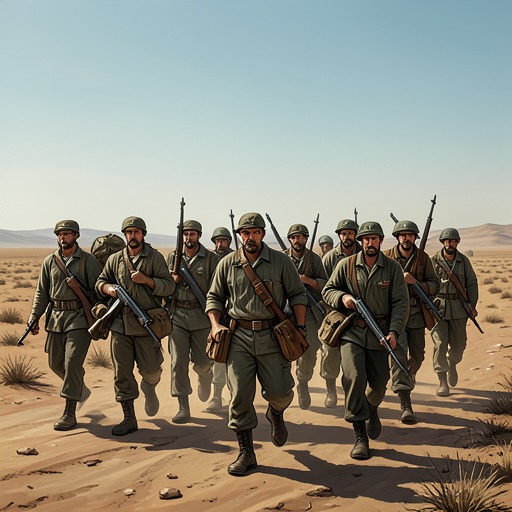
Standard Infantry Rifle
World War ZThe Standard Infantry Rifle is the principal firearm of the rebuilt American army and one of its clearest expressions of wartime pragmatism. Commonly shortened to SIR and affectionately called “Sir,” it replaces unreliable or strategically mismatched high technology with a weapon that can be produced in large numbers, adapted in the field, maintained under brutal conditions, and fired repeatedly in disciplined formations. Its importance lies not in spectacular power but in dependability, logistical logic, and its fit with a doctrine designed to kill the living dead at sustainable cost.
Development and Design
The weapon entered the army’s procurement debate under the resource-to-kill ratio developed by General Travis D’Ambrosia after he became chairman of the Joint Chiefs. Arthur Sinclair, Junior, specifically cites the Standard Infantry Rifle as a system he trusted General Travis D’Ambrosia to identify as vital. That endorsement places the SIR within the broader military reorientation away from expensive weapons whose impressive capabilities consumed scarce resources without producing proportionate results. The war had reduced the United States to a materially constrained power: the living dead controlled most of the world’s landmass, overseas resources were unavailable, fuel shortages had crippled much of the navy, and American production depended heavily on what could be obtained in the western states.
The SIR’s exact ancestry is uncertain. It is variously rumored to be a modified AK, a stripped-down version of the XM8, or a weapon first invented and produced during the siege of the Hero City before its plans were transmitted to the Honolulu Conference. The uncertainty is part of the rifle’s characterization: unlike a prestige weapon whose identity depends on a celebrated inventor or breakthrough, the SIR is defined by what it does in the hands of ordinary soldiers. Its wooden furniture gives it the appearance of a World War II rifle, apparently because composite materials were too difficult to mass-produce. Its historical look therefore reflects industrial limitation rather than nostalgia alone.
Capabilities and Field Adaptation
The SIR fires only in semi-automatic mode and kicks hard, but it is described as exceptionally accurate and almost impossible to jam. Mud, sand, and even prolonged exposure to saltwater do not stop it from functioning. This reliability is decisive in a campaign where troops march across enormous distances, fight through changing weather and terrain, and cannot assume access to sophisticated repair infrastructure. The rifle is not merely effective when conditions are ideal; it remains trustworthy when the conditions are precisely those most likely to destroy a more delicate system.
Its modular conversion kit extends the same principle of adaptability. With additional parts, furniture, and barrels of different lengths, one SIR can become a long-range sniper weapon, a mid-range rifle, or a close-combat carbine within the same hour, without the soldier needing to reach beyond the equipment carried in a ruck. A folding spike, approximately eight inches long, provides an emergency close-combat option when the Lobotomizer is unavailable. Even without the spike, the rifle can serve in hand-to-hand fighting. The design consequently reduces the need to transport and maintain several specialized weapons while allowing a single infantryman to shift roles quickly.
The rifle’s standard ammunition is NATO 5.56 “Cherry PIE,” whose pyrotechnically initiated explosive charge is designed for the physiology of the living dead rather than for conventional targets. The round shatters inside a zombie’s skull, and its fragments destroy the brain without scattering infected gray matter. That feature eliminates the need for wasteful bonfires and can simplify battlefield sanitation: on BS4 duty, troops can bury an entire body after digging the trench rather than decapitating it first. The SIR and Cherry PIE therefore function as an integrated system, linking weapon design, ammunition design, disposal procedures, and the economy of sustained operations.
Use in the Rebuilt Army
The rifle belongs to an army radically different from the mechanized force that fought at Yonkers. The new formation has no tanks, artillery, tread vehicles, or Bradleys in its immediate marching force; those vehicles remain in reserve while being modified for the eventual recapture of cities. Humvees and a small number of M-7 ASVs carry ammunition and supplies, but the soldiers themselves travel on foot in long columns. Their dark blue, bite-resistant uniforms, protected gloves, and face-covering hoods complement a system built around close, repetitive infantry work rather than armored shock action.
The SIR is central to the army’s two-rank firing line. One rank remains active while the other serves as a reserve, allowing soldiers to replace empty magazines without creating a gap in the line. In theory, the formation can keep the living dead falling for as long as its ammunition lasts. The method reverses the logic of the failed defense at Yonkers, where troops were placed on the ground behind sandbags and fighting holes instead of being given commanding firing positions, and where conventional ammunition and armored weapons proved badly matched to the enemy. Against the living dead, the SIR’s accuracy, semi-automatic control, and specialized ammunition support a slow, steady, mechanical rate of fire rather than indiscriminate expenditure.
During an engagement in the desert, the firing line forms after military working dogs draw the zombies forward and are recalled behind the human troops. The first rank kneels, waits for the targets to cross a designated marker, and fires only at those who have reached the line. A soldier signals that a magazine is empty by raising the rifle above her head; positions then switch, and the next shooter takes over. The SIR’s value is thus collective as well as individual. It makes possible a rhythm in which accuracy, ammunition discipline, and replacement are coordinated across the formation.
Strategic and Narrative Significance
The Standard Infantry Rifle represents the war’s larger lesson that industrial capacity and logistics matter more than isolated technical brilliance. The Allies of the Second World War prevailed through manufacturing capacity, natural resources, and the ability to move materials and finished goods to the front. During the Zombie War, the United States lacks the earlier global abundance, so a weapon’s usefulness must be judged by how many can be produced, supplied, repaired, and used over years of marching combat. The SIR answers that requirement more successfully than systems conceived as technological wonders without regard to their opportunity cost.
Its reliability also dramatizes the contrast between failed confidence and earned confidence. At Yonkers, the army’s advanced tools, training, and ammunition were exposed as products of a doctrine aimed at conventional enemies who could be frightened, suppressed, or destroyed through shock. The living dead could neither be shocked nor awed, and the resulting collapse of human morale nearly lost the war. The SIR belongs to the corrective: it does not promise a spectacular victory within forty-eight hours, as Project Yellow Jacket supposedly did with satellite-guided micro-missiles; it supports the patient, resource-conscious labor of clearing ground inch by inch.
That slow labor eventually becomes the method of the continental advance. The army moves in two solid lines across the country, and when a small group of zombies appears, a Force Appropriate Response unit halts only the necessary section, platoon, or company while the secondary line fills the temporary gap. The rifle is therefore an object of military learning made tangible. Its “Sir” nickname turns a standardized tool into a trusted companion, but the trust is not sentimental: it has been earned through accuracy, durability, modularity, compatible ammunition, and the ability to keep functioning across the long road toward New York.