The Battle of Hope
World War ZThe Battle of Hope is the first major ground engagement fought by the rebuilt American army since the Battle of Yonkers, and its decisive significance lies in the reversal it produces: the soldiers arrive expecting to repeat an earlier disaster, but leave with the confidence that a methodical campaign to reclaim the continent is possible.
Purpose and Preparation
The engagement takes place near Hope, New Mexico, a settlement whose open desert frontage and mountains behind it give military planners clear fields of fire and a defensible rear. The name is treated as an almost embarrassingly appropriate choice, even though officers insist that the terrain, rather than symbolism, determined the location. More important than the town’s geography is its institutional role. The brass wants the test operation to demonstrate that the new people, new equipment, new training, and new battle plan can function together in one sustained action. The battle is therefore not merely an encounter with the undead; it is a public and military examination of the lessons drawn from Yonkers.
The preparations reflect that change in priorities. Soldiers place shelter stakes marked with orange Day-Glo tape at ten-meter intervals, creating a precisely measured firing garden in which weapons can be zeroed and ranges judged. Units clear brush, arrange ammunition, refill water systems, eat, and attempt to sleep. The army has learned that exhausted troops cannot sustain the concentration required by the new doctrine, yet rest also leaves them alone with the question of why they have come to the undead’s territory at all. Their anxiety reveals the battle’s psychological stakes before the first shot: the army must overcome not only Zack but the memory of its own collapse.
The New Battle Doctrine
The engagement is built around a straight firing line of two ranks, one active and one reserve. The front rank fires while the second rank replaces weapons or ammunition, allowing the line to maintain continuous pressure rather than dissolving into individual acts of panic or heroism. Soldiers are ordered to engage only those undead that cross designated range markers, conserving ammunition and imposing a rhythm on the battle. This is the opposite of the improvised, exposed posture criticized after Yonkers, where troops were placed on the ground behind inadequate sandbags even when rooftops and tall buildings offered commanding views.
The weapons embody the same practical philosophy. The Standard Infantry Rifle is accurate, durable, and resistant to jamming in mud, sand, and saltwater. Its conversion kit allows the same weapon to serve as a long-range rifle, a midrange firearm, or a close-combat carbine, while a folding spike provides an emergency alternative when the Lobotomizer is unavailable. Its ammunition, Cherry PIE ammunition, is designed to shatter inside an undead skull and destroy the brain without spreading infected matter, reducing the need for wasteful burning and simplifying burial procedures. The battle thus turns industrial design into battlefield discipline: every round, weapon feature, and movement is meant to produce maximum effect with minimum waste.
Canine handlers locate the approaching undead, and sniffer dogs make contact before the main force commits itself. The dogs are then recalled behind the line, leaving the soldiers to activate their Primary Enticement Mechanism. The hard-rock recording “The Trooper” is used less to attract Zack than to alter the emotional condition of the living. It gives the troops a shared pulse, replacing dread with aggression and making the coming engagement feel chosen rather than imposed. The music fades as the horde reaches the front range marker; the command to ready, aim, and fire then converts collective excitement into controlled violence.
Course of the Engagement
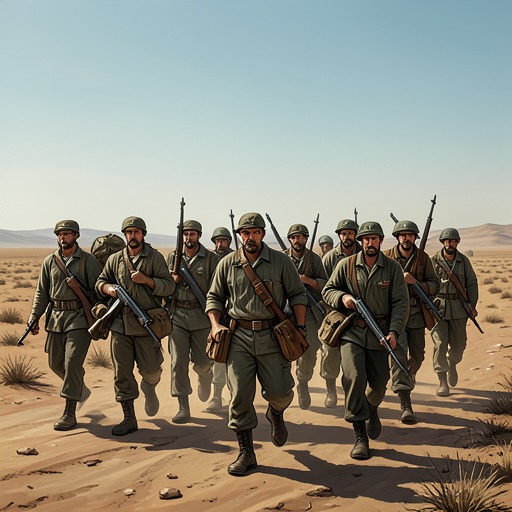
At approximately 1300 hours, the radios report canine contact, and the troops take their positions. Hundreds of undead appear on the horizon. The first rank kneels, the music clicks off, and the order to fire begins a disciplined ripple along the line. Each soldier waits for targets to cross the proper marker rather than firing at the mass indiscriminately. A reserve soldier takes over when a front-line weapon is empty, preserving the continuity of fire that the formation was designed to achieve.
As the attack develops, undead begin approaching from the sides, the flanks, and the rear. The army responds by forming a Reinforced Square, also called a Raj-Singh, with two ranks on every side and vehicles in the center. The formation is dangerous because it encloses the troops and removes an easy route of retreat, but the risk is made acceptable by the abundance of ammunition, replacement personnel, water, and food. Combat-psychology teams monitor the soldiers and quietly remove them for brief rests when stress begins to damage their accuracy or reaction time. The pause is not presented as weakness; it is treated as maintenance, another way the new army converts human limits into a managed part of the system.
The fighting continues into the night. Vehicle searchlights cast red-coated beams that preserve night vision, while Cherry PIE rounds sometimes illuminate undead faces and eyes as they enter the skull. The battle tapers around 0400 hours as fewer heads appear and the moaning diminishes. Officers communicate through scopes and radios without formally announcing that the attack is ending; the soldiers recognize the change through the officers’ expressions and the thinning pressure at the perimeter. The last shot is fired shortly before dawn, after which the troops wait for daylight.
Victory and Immediate Aftermath
At sunrise, the army is surrounded by a ring of corpses at least twenty feet high and more than one hundred feet deep. Dozer-blade Humvees must carve a passage through the mound so the survivors can leave. Some undead remain alive beneath or within the mass, including late arrivals and those that attempted to climb over the dead and slid back down. When burial begins, these survivors emerge, and the Lobotomizer is finally used in the close work for which it was designed.
A reserve unit takes over battlefield sanitation, allowing the exhausted soldiers to avoid the full burden of cleanup. The force marches ten miles east and establishes a bivouac protected by watchtowers and concertainer walls. Equipment is disinfected, weapons are inspected, and the unit discovers that not one Standard Infantry Rifle has jammed. The soldiers are permitted to sleep as long as they wish the following day. When they wake to one another’s voices, laughter, and battle stories, the emotional atmosphere has shifted completely from the silence and dread before the attack.
Historical and Narrative Significance
The Battle of Hope demonstrates that the failure at Yonkers was not simply a matter of defective machinery or inadequate preparation. Its deeper lesson is psychological. Traditional armies depend on shock and fear to break an enemy’s will, but the undead cannot be shocked, awed, intimidated, or persuaded to withdraw. At Yonkers, the inability to frighten Zack caused fear to rebound upon the living. At Hope, the army instead builds a system that assumes the enemy’s emotional immunity and protects human morale through formations, rotation, music, training, and overwhelming logistical preparation.
The victory also validates the resource-to-kill ratio associated with General Travis D’Ambrosia. Rather than pursuing impressive but inefficient weapons, the rebuilt military measures equipment by the number of undead it can eliminate for the resources invested. That principle appears at Hope in the reliable rifle, specialized ammunition, canine reconnaissance, and carefully sustained firing line. It later expands into the slow continental advance, in which Force Appropriate Response units halt only the portion of the line needed to destroy isolated undead while the rest of the army continues forward. Hope is therefore both a battle and a template: its value lies not only in the bodies destroyed but in proving that the United States can reclaim ground without repeating the errors that nearly lost the war.
The soldiers do not mistake the victory for the end. They understand that the campaign across America will be long and that the road to New York will take years. Yet the morning after Hope gives them something Yonkers destroyed: the sensation that the future belongs to the living again. The battle’s final transformation is consequently inward as well as territorial. A force that arrived asking what it was doing on Zack’s ground leaves convinced that the beginning of the end has finally begun.