The Battle of the Hero City
World War ZThe Battle of the Hero City, also remembered as the Battle of New York and the Siege of the Hero City, is one of the defining engagements of the Zombie War. It first appears as a symbol of military failure, when a modern army discovers that its weapons, formations, and assumptions cannot break an enemy incapable of fear. In the war’s final stages, however, the same city becomes an immense submerged battlefield whose harbor must be cleared piece by piece before deepwater shipping can return. Its eventual memory is not triumphal spectacle but exhausted recognition: on VA Day, soldiers watch the dawn over New York and struggle to understand what peace means after fear and killing have become ordinary.
Background and Strategic Stakes
The battle grows out of the wider collapse of the prewar world. The infection has crossed borders through several channels, including illegal migration, global commerce, and possibly human organs removed from infected victims before anyone understood the disease. The crisis therefore cannot be contained by treating it as a local epidemic. Trade routes, refugee movements, hospitals, organ markets, and state secrecy all become part of the catastrophe’s geography. The resulting war is fought against an enemy whose numbers eventually reach approximately two hundred million.
That scale overturns the assumptions of conventional military history. Armies must normally be bred, fed, and led: they require recruits, supplies, and authoritative command. The living dead require none of these. They do not need food, do not suffer from exhaustion or hesitation, and cannot be deterred by the psychological pressure that normally makes organized violence effective. The campaign therefore forces the surviving human states to write a new military doctrine from scratch rather than apply the inherited book of war.
New York carries a particular strategic and symbolic burden. Its urban density and infrastructure make it both a major objective and a nightmare of concealment. The city later becomes even more formidable after evacuation and destruction transform its harbor into a submerged maze of sunken ships, vehicles, aircraft, cargo, and debris. Reclaiming it is not merely a matter of planting a flag. It requires reopening a route through which the postwar economy and the military supply system can function.
The First Failure
The early battle is associated with a disastrous ground defense in Yonkers, where troops are placed behind sandbags and in fighting holes instead of on the roofs and upper floors that would have provided commanding views of the valley and the freeway. The defensive arrangement reflects an obsolete fixation on conventional cover and concealment. Against the living dead, concealment is almost meaningless, while the ground-level position exposes soldiers to the mass advancing toward them. Even tanks receive fighting holes blasted into the parking lot, an image of doctrine mechanically reproducing the defensive habits of an earlier war.
The failure is not simply technical. The battle reveals that the army’s decisive weapon has been psychological, and that this weapon has no effect on the enemy. Human armies seek to shock, awe, and frighten an opponent into abandoning the fight. The living dead cannot be shocked or awed, and their lack of fear reverses the intended effect. Human violence, instead of breaking the enemy’s spirit, returns upon the people employing it. The soldiers become the ones who are shocked and awed by an enemy that advances through every demonstration of force.
For that reason, the battle is remembered as more than a defeat in equipment or preparation. It exposes fear itself as the failed weapon. The public expected the engagement to restore confidence; instead, the battle nearly convinces the American population that survival is impossible. Only the later adoption of the South African plan prevents that failure from becoming the final shape of the war.
Relearning How to Fight
The war’s later doctrine emerges from this humiliation. Rather than relying on expensive systems designed for conventional enemies, planners adopt the resource-to-kill ratio associated with General Travis D’Ambrosia. The principle evaluates weapons by the number of zombies they can eliminate for the resources consumed. It influences major procurement decisions, including the Battle Dress Uniform and the Standard Infantry Rifle, and gradually spreads beyond headquarters into the ordinary culture of the ranks.
The Standard Infantry Rifle is designed for reliability and flexibility rather than ornament. Its wood furniture recalls a World War II weapon, and although its exact origin is uncertain, it fires only on semi-automatic and is valued for accuracy and an almost absolute resistance to jamming. Its conversion kit allows the same weapon to serve as a long-range rifle, a midrange rifle, or a close-combat carbine. A roughly eight-inch folding spike provides an emergency close-quarters option when the Lobotomizer is unavailable.
Its ammunition is equally shaped by the new conditions. NATO 5.56 Cherry PIE ammunition is designed to shatter inside a zombie’s skull and destroy the brain without spreading infected material. This removes the need for wasteful mass bonfires and can make battlefield sanitation simpler: on certain burial details, whole bodies can be buried once the brain has been destroyed. The weapon system embodies the larger transformation from spectacle and technological excess toward dependable, repeatable killing under constrained resources.
The operational formation also changes. In the later battle doctrine, infantry mass in two straight ranks, one active and one in reserve. The reserve replaces weapons being recharged so that the firing line does not fall silent. The purpose is continuous fire: as long as ammunition lasts, the advancing dead should continue to fall without creating a gap in the human line.
The Submerged Harbor Campaign
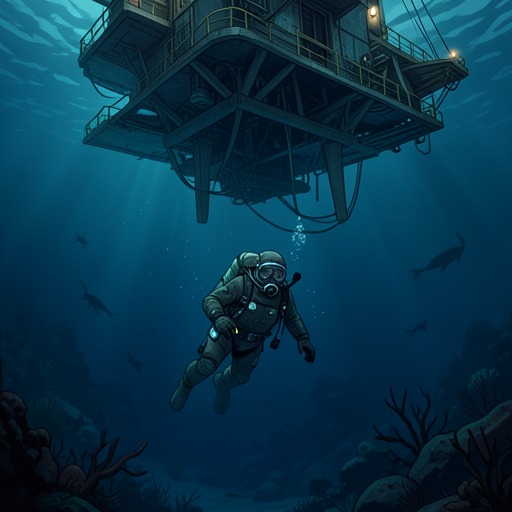
In the final stages of the war, the objective changes from establishing a beachhead to reopening harbors for deepwater shipping. The Battle of the Hero City becomes a massive combined operation involving mesh divers, deep-submergence combat units, and civilian volunteers equipped with scuba gear and spear guns. The underwater environment turns the city into a distorted continuation of its streets: sunken ships replace buildings, wrecked cars and aircraft form barriers, and dumped cargo creates unstable fields of household debris.
The clearing teams move through this landscape while imagining the dead behind washing machines, air conditioners, and other wreckage. Such fear is not always merely imagined. The worst work involves sunken ships, which must be searched compartment by compartment before they can be raised. The refugee ship Frank Cable, a large submarine tender, lies at the mouth of a harbor and must be cleared before recovery. Hatches are blocked by debris, forcing divers to cut through them or through decks and bulkheads. Damage and corrosion make the structure unstable; during one operation, a deck collapses beneath a diver, dropping him into an engine room crowded with hundreds of zombies.
The underwater campaign therefore replaces the open-field logic of massed fire with claustrophobic engineering and physical endurance. The exoskeleton that assists the divers becomes bulky and unwieldy in narrow passages. Every hatch, deck, and compartment can conceal an attack, while the wreck itself may fail without warning. The harbor is not simply occupied territory; it is a three-dimensional accumulation of war, evacuation, commerce, and death.
The Long Road to Victory
The broader American advance toward New York is deliberately slow. Three Army Groups—North, Center, and South—move across the Great Plains and Midwest before dividing at the Appalachians, with the wings driving toward Maine and Florida while Army Group Center crosses the mountains. The campaign takes three years because the forces advance on foot through difficult terrain, changing weather, enemy concentrations, and a doctrine that refuses to leave ground unchecked.
The army moves in two solid lines extending from Canada to Mexico. Whenever a zombie is detected, a Force Appropriate Response unit halts only the portion of the line necessary to destroy and sanitize the threat. A single zombie does not stop an entire Army Group; a larger concentration may require a section, platoon, or company. The gap is filled by an equal force from the secondary line behind it, allowing the front to continue without breaking. This leapfrogging method is slow, methodical, and relentlessly comprehensive: no inch between the Rockies and the Atlantic is deliberately skipped.
The same logic governs the battle’s final meaning. Victory does not arrive as a single brilliant maneuver. It is accumulated through reliable rifles, controlled ammunition expenditure, trained formations, canine detection, underwater searches, and the patient removal of every remaining threat. The military learns to value continuity over drama and coverage over speed.
Memory and Aftermath
The battle’s public image is complicated by the way it is filmed and remembered. Roy Elliot’s documentary about the Battle of the Five Colleges provides a contrasting version of heroic resistance: three hundred students at Scripps Women’s College hold off ten thousand zombies for four months, and the film frames their preparation for the final attack with music from Roxy Music. The students’ stand offers an image of courage and communal defense, but the later soldiers’ recollections resist the polished emotional grammar of wartime cinema. Real soldiers are not witty figures around a campfire; they are quiet people asking what they are doing on the enemy’s front lawn.
The Hero City’s final image is quieter still. On the Jersey riverbank, soldiers receive the news that it is VA Day and watch the dawn over New York. There is no cheering because peace feels unreal. After years of fear, fighting, killing, and waiting to die, the absence of war is not immediately experienced as liberation but as an unfamiliar condition. The sunrise becomes a national icon precisely because it records uncertainty rather than uncomplicated celebration.
The Battle of the Hero City thus joins military catastrophe, institutional learning, and traumatic memory. It begins by proving that modern equipment and inherited doctrine cannot defeat an enemy without fear; it ends through an army remade around sustainable force, disciplined logistics, and exhaustive reclamation. Its decisive consequence is not only the recovery of New York Harbor but the recovery of a human capacity to imagine a future after survival has ceased to feel temporary.