The First Gray Winter
World War ZThe First Gray Winter was the first great cold-weather catastrophe of the Zombie War, a season in which refugees fleeing south-to-north across North America found temporary safety only to encounter hunger, pollution, social collapse, and a threat that winter could not permanently destroy. The event exposed the danger of treating climate as a solution: the cold immobilized the Zombies, but it also trapped millions of living people in an improvised wilderness economy with too little food, fuel, information, or preparation.
Causes and Background
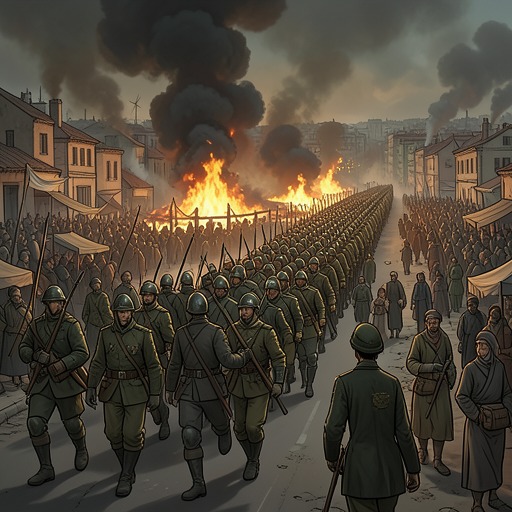
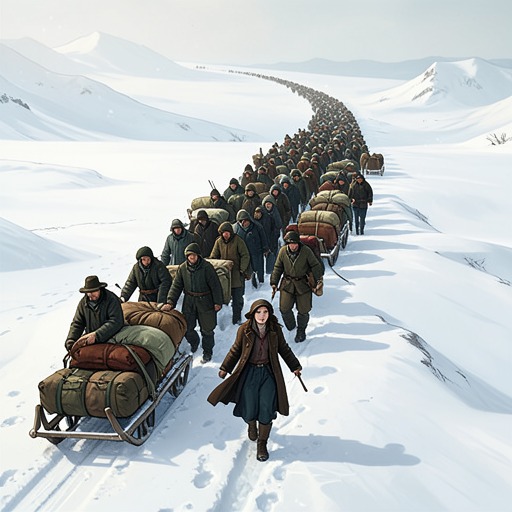
The winter followed the breakdown of ordinary society and the mass movement of civilians toward colder regions. Jesika Hendricks recalled that officials diverted refugees north because they could not feed everyone, screen everyone, or safely move the entire population west behind the Rocky Mountains while the undead armies followed. The northern route offered a chance that the falling temperature would freeze the Zombies, whereas stopping refugees at the Rockies or using force against them would have created another massacre. Her judgment was therefore divided: the strategic decision was understandable, but the failure to provide vital information was not. The authorities sent people toward a possible refuge without adequately explaining how they would live once they arrived.
The refugees carried assumptions shaped by desperation rather than planning. Hendricks remembered travelers heading north while imagining mooseburgers, wild berries, and a promised land in which everything would become all right. For a time, that hope seemed justified. The destination was not an organized settlement but a lakeside camp with enough people to feel safe and enough communal activity to make the crisis resemble a holiday. The emotional value of the camp mattered as much as its practical resources: after terror and flight, companionship created the illusion that survival had already been secured.
The Refugee Camps
The first phase of the northern camps was marked by abundance borrowed from the surrounding landscape. Refugees held nightly cookouts, combining hunted and especially fished food, while others used dynamite in the lakes to bring fish to the surface. Families cut trees for fuel, played music from car radios and instruments, and gathered around enormous bonfires. The explosions, chainsaws, songs, and fires formed a temporary soundscape of collective relief. The camps appeared secure not because their systems were durable, but because the refugees had not yet exhausted the environment that sustained them.
That reserve disappeared as later waves arrived. Trees gave way to leaves and stumps, then to anything that would burn. Plastic and rubber filled the air with a smell that clung to mouths and hair. The fish vanished, game became scarce, and the population continued to rely on winter as though freezing the Zombies were equivalent to defeating them. The camp’s ecological depletion was gradual rather than spectacular, which made it easy to ignore. Each individual act of cutting, burning, fishing, or hunting seemed necessary; together, those acts stripped the refuge of the resources needed to survive the season.
The same short-term thinking shaped expectations about the months ahead. Many people had not considered how they would endure winter after the dead froze. Some expected the authorities to rescue them, while others assumed they could simply return home. The repeated confidence that everyone would be back before Christmas converted uncertainty into a shared fiction. The camp was safe only in the narrow sense that immediate attacks had diminished; it had no durable answer to food, heat, sanitation, or the arrival of additional refugees.
Winter and Mass Death
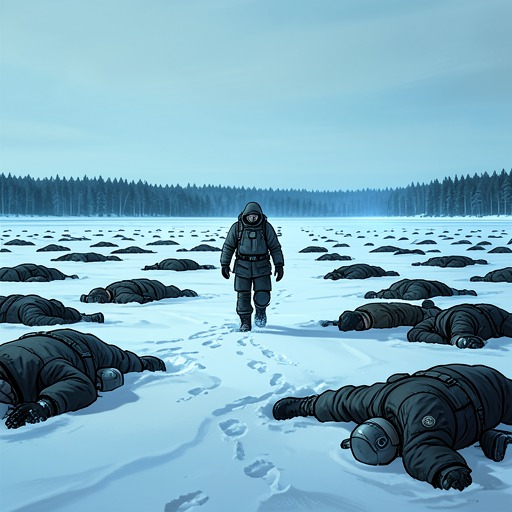
Winter arrived in early December with snow literally higher than the survivors’ heads. The snow was thick and gray from pollution, and the camp fell silent. Fighting and shooting stopped, but the silence did not signal recovery. It accompanied the disappearance of food and the collapse of the social world that had briefly made the camp feel communal. By Christmas Day, food was plentiful only in the most horrifying sense: the dead had become the remaining source of nourishment for some survivors. Broken bones with their marrow extracted, and a miniature femur scraped clean with a knife, make the camp’s hunger materially visible rather than merely reported.
The scale of the disaster extended far beyond one settlement. Reports placed the North American death toll for that winter at eleven million, excluding Greenland, Iceland, and Scandinavia, while the narrative also evokes refugees from southern China, Japan, and India facing comparable cold-weather catastrophe. The pollution darkening the snow altered the weather itself, and some of the airborne filth was believed to have come from the ash of human remains. The winter therefore became both a demographic disaster and an environmental feedback loop: mass death contaminated the atmosphere, while the altered climate intensified the conditions under which further people died.
The First Gray Winter also demonstrates that the Zombies were only one element in a compound hazard. In North County near San Diego, a family that had relied on Phalanx, a gun, and the normal routines of suburban security discovered how quickly ordinary defenses became meaningless when the infected entered through a shattered sliding door and a broken bedroom window. On the refugee routes, the danger came from exposure, resource exhaustion, crowding, and misinformation. In government offices, officials feared panic, riots, and political paralysis as much as the plague itself. The event’s victims were consequently produced by the interaction of direct violence with institutional concealment and material deprivation.
Thaw and Aftermath
The winter did not end the undead threat. Eventually the sun returned, temperatures rose, and the snow began to melt. By mid-July, spring had arrived—and so had the living dead. A partially buried Zombie, frozen from the waist down but still alive in the head, arms, and upper torso, thrashed in the ice and clawed toward the observers. The image overturns the hope that cold had solved the crisis. Freezing delayed movement without delivering death, leaving the survivors with a new wave of immobilized but active bodies emerging from the thaw.
The aftermath remained visible long after official hostilities ended. At Sand Lakes Provincial Wilderness Park, abandoned vehicles, debris, and human corpses still lay partially frozen in gray snow and ice. Hendricks and several hundred volunteers returned every summer through the Wilderness Restoration Project, whose claimed progress could not conceal that the landscape offered no obvious end point for repair. Restoration became an admission that survival was not the same as recovery: the physical terrain, the dead, and the ecological damage all outlasted the military phase of the war.
The winter’s effects also formed part of a worldwide pattern. Cuba later described itself as having won the Zombie War, while admitting that the victory emerged from a society already shaped by deprivation, rationed food and fuel, isolation, and strict state control. Elsewhere, the United States confronted mass despair even after stabilizing the Rockies and sanitizing safe zones: Asymptomatic Demise Syndrome killed people who had little physical injury or were otherwise healthy because they had lost the will to face another day. The Gray Winter thus belongs to a larger sequence in which survival required psychological endurance, administrative capacity, and access to resources—not merely distance from the Zombies.
Narrative and Historical Significance
The event’s most important contrast is between the language of refuge and the reality of postponement. Refugees were told, implicitly or explicitly, that moving north would buy time until winter froze the dead. Instead, the cold froze mobility, exhausted food systems, and concealed a second threat beneath the snow. When the thaw came, the Zombies returned to a landscape already marked by corpses, pollution, and broken institutions.
The First Gray Winter also turns environmental damage into a form of slow violence. Its destruction accumulates through polluted snow, depleted forests, emptied lakes, mass cremation or decomposition, and the uncounted consequences of relocating vulnerable populations without sufficient information. Those with the least power bear the greatest exposure: refugees, the poor, people fleeing cities, and communities expected to improvise their own survival. The event’s horror is therefore not limited to the spectacle of the undead. It lies in the delayed recognition that a temporary escape route can become a system for distributing death across time, geography, and social class.