The Great Denial
World War ZThe Great Denial names the period in which societies confronted reports of African rabies and the reanimation of the dead by rejecting, minimizing, or misclassifying what was happening. It was not simple ignorance: people repeatedly received fragments of accurate information, but political hostility, commercial incentives, cultural prejudice, and the desire for ordinary life transformed warning signs into jokes, propaganda, and reassurance. When the truth finally became undeniable, the emotional and institutional collapse was correspondingly violent.
Definition and Early Conditions
The state first appears through disbelief toward Israel’s announcement of “voluntary quarantine.” In Kuwait City, Saladin Kader watched the broadcast from behind the counter of a crowded Starbucks, where customers responded with jeers and catcalls. Because the warning came from a hated enemy and described African rabies as a plague that turned corpses into cannibals, he and those around him treated it as a Zionist lie rather than a credible epidemiological report. The reaction shows how political antagonism could overpower evidence before the disease had become a direct personal threat.
The denial also depended on selective hearing. Kader did not hear the second part of the Israeli ambassador’s speech, which offered asylum without questions to foreign-born Jews, people with Israeli-born parents, Palestinians from the formerly occupied territories, and Palestinians whose families had once lived within Israel’s borders. The offer included his own family history, but hostility toward Israel made the warning itself—and the possibility that it might carry practical consequences—nearly impossible for him to receive.
Media, Commerce, and Manufactured Reassurance
The first reports did not simply inform the public; they converted uncertainty into spectacle. When the outbreak was still called African rabies, the report on the Cape Town outbreak contained only about ten minutes of factual coverage followed by an hour of speculation about what might happen if the virus reached the United States. The news therefore magnified fear without necessarily producing understanding, creating the emotional market in which denial and panic could coexist.
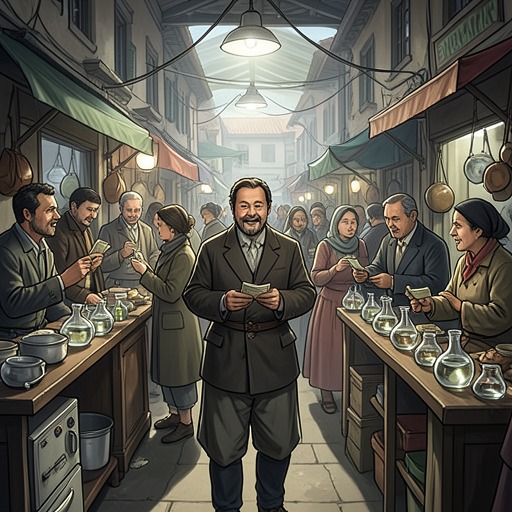
Commercial actors recognized that market immediately. A businessman who treated fear as the most valuable commodity saw the outbreak as an opportunity and proposed a genuine vaccine for rabies, despite knowing that the product was not a cure for the new disease. A cure would be purchased mainly by people who believed themselves infected; a vaccine could be sold repeatedly to people who feared that infection might be somewhere ahead of them. With contacts in the biomedical industry, on Capitol Hill, and on Pennsylvania Avenue, his associates expected a prototype within a month and a proposal within days.
The resulting product, Phalanx, was presented as protection from fear rather than as a proven answer to the outbreak. Its sales helped the biomedical sector recover, encouraged the stock market, and restored consumer confidence sufficiently to create the appearance of an economic recovery. The commercial success thus reinforced denial: people could purchase reassurance and interpret the act of purchasing it as evidence that institutions still controlled the crisis.
From Denial to Panic
The state began to fracture when the press reported that there was no wonder drug. The revelation was described by the profiteer as pulling the rug from under the public and causing the spiral that became the Great Panic. His response is itself part of the mechanism of denial: he denied personal responsibility, blamed whoever had first called the disease rabies, blamed those who had authorized the fraudulent confidence, and finally blamed consumers for failing to investigate their purchases. The distinction between deliberate deception and passive self-deception became impossible to maintain once the reassuring structure collapsed.
The social consequences were visible in the mass flight from danger. From a combat dirigible, Gavin Blaire saw traffic stretching to the horizon: sedans, trucks, buses, recreational vehicles, tractors, a cement mixer, and even a flatbed carrying a billboard advertising a gentlemen’s club. People rode on roofs and between luggage racks, while luggage, furniture, abandoned cars, and a smashed grand piano filled the roadsides. Some travelers walked beside the traffic, moving faster than the immobilized vehicles, and others tried to trade sex or possessions for fuel. Farther along the route, drivers flashed their lights, rammed cars, fought in the roadway, and ran past people lying motionless by the roadside. Denial had not prevented catastrophe; it had delayed preparation until movement itself became a form of desperation.
The same collapse appeared at the coast. At a shipyard crowded to the shoreline and backlit by inland fires, hundreds attempted to swim toward vessels while small boats ferried passengers from land for every possession they could surrender. Refugees packed the Tulip, and when the Delmas departed at flank speed, it dragged the Tulip’s stern into deep water; the vessel rolled over and sank within seconds, carrying at least a thousand people. The scene exposes the practical cost of delayed recognition: the refugees’ actions were irrational only from the safety of hindsight, while at the time the entire shore had become a single, panicked calculation of survival.
Denial as Collective and Cultural Behavior
The Great Denial was not confined to governments or markets. A political comedy figure argued that everyone had unconsciously known the truth and that the eventual disclosure caused such an extreme reaction because it shattered a shared psychological defense. His explanation was mixed with unrelated claims about high-fructose corn syrup and the feminization of America, but its central insight remained: the public’s panic was not produced by a wholly new fact so much as by the destruction of a collectively maintained refusal.
Religious and cultural responses showed how denial could become active self-destruction. In India, pilgrimages continued to Varanasi even after more than 90 percent of the country was officially overrun and the government had withdrawn to the Himalayas. The city’s association with death and its waters’ reputed healing properties drew millions toward a nexus of reanimated dead. Elsewhere, members of the sect called God’s Lambs believed infection would hasten their ascent to heaven, while the belief that sex with a virgin could cleanse the curse led to rape. These episodes extend denial beyond disbelief: a threat is denied by forcing it into an inherited spiritual or cultural framework, even when that framework directs people toward death and violence.
Institutional behavior repeated the pattern in altered form. Soldiers sent into mountain villages after the blackout were ordered to ask whether families were complete, whether anyone had disappeared, and whether anyone had been attacked by a rabid animal or a rabid person. They conducted invasive physical inspections without being told precisely what they were seeking. Even when they found caches of weapons, including 74s, older 47s, and large quantities of ammunition, they left them behind after a private meeting between an officer nicknamed Rat Face and village elders. The soldiers’ confusion reveals a system acting without openly naming the emergency it was trying to contain.
Aftermath and Historical Meaning
The Great Denial ends not with a single announcement but with the accumulation of consequences that reassurance can no longer absorb. The outbreak’s biology itself made delayed recognition especially dangerous: when infection began in the heart, the virus could reach the brain through the circulatory system within seconds, but an infected organ such as a liver, kidney, or grafted section of skin could carry only a trace and take days or weeks to release it into another bloodstream. The possibility of transmission through transplantation therefore remained hidden inside ordinary medical practice, a further example of how familiar systems could conceal an unfamiliar threat.
The denial also obscured the scale of interdependence. Humanity relied on more than three thousand satellites for communication, navigation, surveillance, and weather forecasting, making the orbital network as important to the modern world as roads had been to the ancient world and railways to the industrial age. The loss of such links would not be an isolated technical failure but a civilizational rupture. Likewise, the collapse of the Three Gorges Dam was later described by Chinese leadership as an unforeseen tragedy and an unavoidable accident, although the dam had been built on an active fault line, earthquakes had followed the increased reservoir weight in the past, and foundation cracks had been detected months before completion. The official explanation reproduced the logic of the Great Denial by recasting foreseeable risk as surprise; its implausibility helped provoke rebellion.
The concept therefore describes both a historical phase and a recurring social mechanism. It converts warning into rumor, evidence into partisan propaganda, and uncertainty into a product. When the denial fails, the resulting panic is amplified by everything that had been postponed: evacuation, medical preparation, public honesty, military adaptation, and moral recognition. The Great Denial is the story’s warning that societies may survive frightening truths more readily than they survive the comforting systems built to avoid them.