The Honolulu Conference
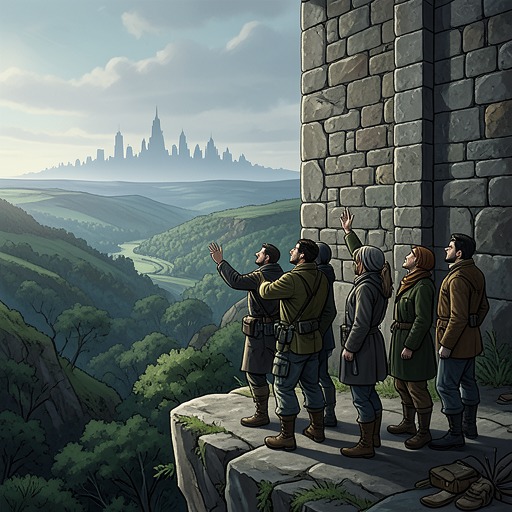
World War ZThe Honolulu Conference marks the moment when survival ceases to mean merely holding secure enclaves and becomes an organized attempt to recover the world from the living dead. Its historical importance lies in the reversal of strategy: after retreat, isolation, refugee transport, and improvised defense, the remaining powers choose to advance every day until the infestation is eliminated. The decision is neither unanimous nor secure, but it gives the postwar alliance a common objective and turns scattered resistance into a coordinated international offensive.
Setting and Original Purpose
The meeting takes place aboard the USS Saratoga, a vessel that has passed through several lives: aircraft carrier, decommissioned hulk, evacuee transport barge, and finally floating United Nations headquarters. Ernesto Olguin recalls fourteen days spent in its cramped compartments and dank passageways, an environment that makes the grand name of the conference faintly misleading. The gathering is remembered as The Honolulu Conference, but from inside the ship it feels more like the Saratoga Conference, because the participants see little of Honolulu and experience the proceedings through the physical confinement of the vessel.
The stated agenda is practical and international. Delegates are expected to exchange warfighting tactics and technology, examine the British system of fortified motorways, witness a live demonstration of Mkunga Lalem, and discuss the restoration of international trade. Olguin’s particular responsibility is to integrate the remnants of his navy into a new international convoy structure. The conference therefore begins as an exercise in reconstruction: a way to connect surviving military forces, reopen commerce, and make scattered national resources useful to one another.
That institutional purpose is immediately overtaken by the scale of the unresolved war. The conference is not simply a diplomatic meeting among governments that have survived; it is a gathering of societies whose territory, populations, and economic systems have been radically reduced. Earlier policy had emphasized defensible islands, protected zones, and the gradual recovery of industrial capacity. The Continental Airlift, for example, had supplied isolated communities through a vast network of coordinated drops, prioritizing self-sustaining tools and spare parts while still delivering food, medicine, salt, and baby formula when winter made dependence unavoidable. The conference must decide whether such defensive logistics are enough, or whether they merely preserve a permanent state of siege.
The Offensive Proposal
On the first day, the delegates assemble for introductions, already tired of formal speeches. The American ambassador then rises and changes the meaning of the gathering. He argues that the surviving nations must leave their established defenses and begin retaking infested territory. At first, Olguin assumes the proposal concerns limited operations: securing additional inhabitable islands or perhaps reopening the Suez/Panama canal zones. The ambassador makes clear that the plan is far more expansive. The United States intends to remain permanently on the offensive, advancing every day until every trace of the infestation has been removed, purged, or destroyed.
The proposal is shocking because it rejects the logic of passive survival. A defensive strategy offered several apparent advantages. The living dead did not require food, fuel, or conventional supply lines, but they could decay over time, and some delegates believed nature might accomplish what armies could not. If the dead were already decomposing, the safest course might be to remain behind defenses and wait. The offensive camp answers that decomposition is uneven: later cases remain strong and healthy, and any surviving active subject could restart the plague. The dead above the snowline might persist for decades or centuries, while refugees from those regions would have no realistic prospect of returning home. Waiting would therefore preserve the danger rather than end it.
The stakes are made brutally concrete by the estimated enemy strength: approximately two hundred million zombies remain across the continental United States alone. The number is almost impossible to visualize, and knowledge of the enemy’s origin, physiology, strengths, weaknesses, motives, and mentality does not make victory seem likely. Conventional military theory cannot simply be applied to this opponent. Human armies must be bred, fed, and led; the living dead require none of these conditions. They do not need recruits, supply chains, or commanders, forcing the surviving powers to develop a new military logic from the ground up.
Debate and Vote
The conference divides over whether offensive action is necessary or reckless. One side asks why the living should expose themselves to further casualties when the enemy may already be decaying. From this perspective, the defensive zones have achieved the essential purpose of survival, and time appears to favor humanity. An attack would sacrifice people who had endured the war merely to accelerate an outcome that might occur naturally.
The opposing side treats time as a threat rather than an ally. Healthy later cases could preserve the ability to renew the outbreak, and isolated populations in frozen regions could remain dangerous indefinitely. The question is also political and moral: a world reduced to defended fragments cannot be considered recovered while entire countries remain occupied. Offensive action offers the possibility not only of military victory but of return, resettlement, and the restoration of places from which survivors have been permanently separated.
The decision is settled by a vote among seventy-two delegates. It is far from unanimous: seventeen vote no and thirty-one abstain. The abstentions acknowledge the danger without accepting full responsibility for either course, while the no voters at least accept the long-term consequences of refusing the attack. The numerical weakness of the mandate does not prevent action. For Olguin and the other delegates who vote for it, the choice is made on behalf of their countries and children. The surviving coalition will attack.
Strategic Context and Military Learning
The decision gains meaning from the military and logistical lessons accumulated during the war. Earlier attempts to rely on technological breakthroughs had repeatedly exposed the danger of confusing sophistication with usefulness. Project Yellow Jacket promised a wonder weapon capable, in theory, of ending the war within forty-eight hours: millions of micro-missiles, each roughly the size of a .22 rimfire bullet, would be scattered from transport aircraft and guided by satellites toward the brains of zombies across North America. The project consumed resources without delivering the decisive result its advocates promised.
By contrast, the emerging resource-to-kill ratio doctrine emphasizes what can be produced, transported, maintained, and used repeatedly. General Travis D’Ambrosia develops this principle into a comprehensive strategy, influencing confidence in practical systems such as the Standard Infantry Rifle. The same logic shapes the weapons prepared for the offensive. The rifle is rugged, accurate, adaptable, and difficult to disable: its conversion kit allows long-range, midrange, and close-combat configurations, while its folding spike provides an emergency weapon when the Lobotomizer is unavailable.
Its ammunition, the NATO 5.56 Cherry PIE round, is designed specifically for the enemy’s physiology. The projectile shatters inside a zombie’s skull and uses its fragments to destroy the brain, avoiding the spread of infected gray matter and reducing the need for wasteful bonfires. During body-service operations, troops can bury entire bodies without decapitating them first. These details reveal what the offensive requires in practice: not a single miraculous weapon, but reliable equipment whose production, ammunition, handling, and disposal all support sustained advance.
The same lesson governs the broader war economy. The Allies of the Second World War prevailed through superior manufacturing capacity, access to natural resources, and the logistics needed to move raw materials and finished materiel. In the new conflict, humanity has become the equivalent of the resource-starved Axis. The living dead control most of the world’s landmass, American production is restricted largely to the western states, refugee-filled merchant ships limit overseas supply, and fuel shortages have immobilized much of the navy. The Honolulu decision is therefore not an expression of confidence in abundance. It is a wager that disciplined production, logistics, and adaptation can overcome an enemy that has no comparable material requirements.
Consequences and Historical Significance
The conference converts a collection of defensive arrangements into a shared offensive program. Its importance is not that it removes disagreement or guarantees victory; the vote proves the opposite. The alliance advances despite abstentions, dissent, and the knowledge that its forces face roughly two hundred million enemies whose military limitations are radically different from human ones. The decision creates direction where the postwar world had previously possessed only endurance.
Its consequences also reach beyond the battlefield. Reopening trade routes, coordinating convoys, reclaiming productive territory, and returning refugees all depend on eliminating the dead from the spaces that separate surviving communities. The choice to attack thus links military action to economic reconstruction and social return. A defensive world can feed isolated populations through airlifts, but it cannot restore ordinary circulation, secure abandoned industries, or make displaced people’s homes inhabitable again.
The conference also exposes the moral cost of political survival. Governments during the war had concealed truths, used harsh punishment, imposed labor, and accepted extraordinary coercion in the name of preventing panic and preserving civilization. The Honolulu vote continues that pattern in a different form: leaders must decide whether to risk living citizens now for the possibility of a future in which humanity is no longer confined behind walls and borders. The attack is therefore both a military operation and a declaration that mere biological survival is insufficient. The world will not simply wait for the dead to disappear; it will attempt to reclaim its future from them.