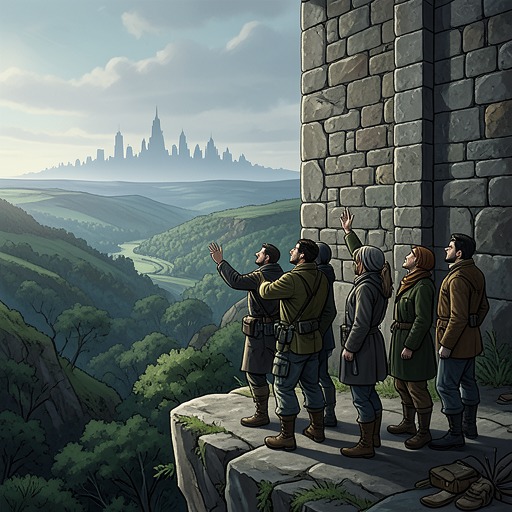
The Honolulu Conference offensive decision
World War ZThe Honolulu Conference offensive decision is the moment when the surviving nations choose reclamation over indefinite containment. What begins aboard the USS Saratoga as an attempt to exchange military methods, technology, and trade plans becomes an ambush-like debate over the meaning of victory: whether humanity has merely endured the Z world war, or whether it must prove that the living can once again shape the planet’s future.
Setting and Transformation
The meeting is remembered officially as The Honolulu Conference, although Ernesto Olguin argues that “Saratoga Conference” would be more accurate because the delegates spent fourteen days confined within the vessel’s cramped compartments and dank passageways. The ship’s own history embodies the emergency from which the conference emerged: USS Saratoga had passed from aircraft carrier to decommissioned hulk, then to evacuee transport barge, and finally to a floating United Nations headquarters. The location is therefore not a neutral diplomatic venue but a compressed record of civilizational collapse, displacement, and improvised recovery. The original agenda was practical. Delegates were expected to compare wartime tactics and technology, examine the British system of fortified motorways, witness a live demonstration of Mkunga Lalem, and discuss the restoration of international trade. Olguin’s particular assignment was to integrate the remnants of the navy into a new international convoy structure. Yet the conference’s intended technical and commercial purpose is abruptly displaced by a decision about strategic direction.
The Offensive Proposal
On the first day, during the introductions, the American ambassador calls for a permanent offensive. Olguin initially assumes that the proposal concerns limited operations: securing isolated habitable islands or reopening the Suez/Panama canal zones. The ambassador makes clear that the plan is much broader. The United States intends to leave its established defensive positions, advance every day, and reclaim infested territory until every trace of the living dead has been removed. The proposal is deliberately expansive rather than tactical. It rejects the idea that humanity can remain behind fortified boundaries while the undead simply disappear through decomposition. Its implied objective is not merely to protect surviving populations but to restore inhabitable territory, reopen routes, and make the defeat of the living dead visible and irreversible. The language of purification and destruction gives the plan emotional force, but it also exposes the danger that military necessity may be joined to revenge.
The Debate Over Risk and Time
The delegates divide immediately. One side argues that an offensive would sacrifice lives that need not be lost. The living dead are already decaying, and time appears to favor the survivors. Defensive settlements can remain secure while nature performs the work of destruction. From this perspective, the rational strategy is to wait, conserve resources, and avoid converting a stalemate into a new catastrophe. The opposing side points to the undead who remain strong and healthy, to the possibility that a single survivor could restart the plague, and to the populations trapped in countries above the snowline. Waiting might mean decades or centuries before those regions became safe, leaving refugees with no realistic prospect of returning home. The debate thus separates two definitions of survival: physical continuation inside protected enclaves, and the recovery of a world in which people can again move, settle, and act without accepting permanent dispossession. Olguin recognizes an additional motive beneath the call for attack. The argument is not entirely about justice for future generations; some advocates want revenge for the losses and humiliations of the war. The conference reproduces the old political condition even after the old world has nearly vanished: people who have endured catastrophe still struggle to escape resentment, suspicion, and the desire to punish.
The President’s Moral Argument
The American president does not try to silence the quarrel by shouting or imposing immediate order. In a calm, firm address, he acknowledges that a purely military calculation offers no compelling reason to risk the stalemate. Defensive strategies have saved the human race, and future generations might eventually reinhabit the planet with little physical danger. Yet he insists that military safety is not the whole measure of the war’s result. According to his argument, the living dead have taken more than land and loved ones. They have stripped humanity of confidence in its status as the planet’s dominant life-form, leaving survivors frightened, broken, and grateful merely for a less painful tomorrow. The question is what kind of civilization the children of the survivors will rebuild. If they inherit the belief that humanity was powerless to reclaim its world, a future outbreak might be met with surrender rather than resistance. The offensive is therefore presented as a demonstration: humanity must recover the planet partly to prove to itself and to its descendants that recovery is possible. This argument turns the decision into a test of collective identity. The war’s greatest monument would not be a particular weapon or battlefield victory, but proof that humanity can move from defensive endurance to deliberate restoration. The choice is framed as a long road back to humanity rather than a simple military advance.
The Vote and Its Consequences
The vote is far from unanimous. Of the seventy-two delegates in the new United Nations, seventeen vote against the offensive and thirty-one abstain. Olguin notes that the opponents at least accept the long-term consequences of their decision, but the result still reveals how narrow the coalition for attack is. The campaign proceeds not because the world reaches consensus, but because enough nations decide that continued defense is itself an unacceptable future. For Olguin and the other delegates who support the offensive, the decision is made on behalf of their countries and children. The conference therefore converts a divided international assembly into a coalition committed to attack, even while leaving dissent and uncertainty visible within the decision. Its immediate consequence is the transition to coordinated operations, represented by Olguin’s later view from the Mauro Altieri above Vaalajarvi, Finland, where General Travis D’Ambrosia monitors the campaign from a command center. The scale of the task clarifies what the delegates have chosen. The offensive must confront approximately two hundred million zombies across the continental United States. Human armies depend on recruitment, supply, and command, but the living dead need none of these: they do not have to be bred, fed, or led. The old book of war is therefore inadequate, and the campaign requires a new military logic developed from the enemy’s physiology, behavior, strengths, and weaknesses.
Strategic Meaning
The decision cannot be separated from the logistical principles developed during the war. Earlier analysis had established that victory depends on manufacturing capacity, natural resources, and the ability to move supplies from extraction sites to factories and from factories to the front. The living dead control most of the world’s landmass, while American production is restricted largely to the western states; refugee shipping crowds the merchant fleet, and fuel shortages keep much of the navy in port. An offensive therefore demands not only courage but an industrial and transportation system capable of sustaining advance. The resource-to-kill ratio becomes central to this effort. General Travis D’Ambrosia is credited with inventing the principle and developing a strategy around it, directing trust toward weapons such as the Standard Infantry Rifle. By contrast, Project Yellow Jacket becomes an emblem of the waste the new strategy is designed to prevent: a proposed system of millions of satellite-guided micromissiles, each roughly the size of a .22 rimfire bullet, intended to strike the brain of every zombie in North America within forty-eight hours. Its promise of a “wonder weapon” consumed resources that could have supported more practical production. The same economy governs the Continental Airlift, which resupplies isolated Red Zones and Blue Zones. Rather than prioritize endless deliveries of food and medicine, planners favor self-sustaining drops containing tools, spare parts, and equipment for making spare parts, while still delivering fish, wheat, salt, dried vegetables, and baby formula through the hard winters. The offensive grows out of this discipline: reclaiming territory requires systems that can produce, repair, transport, and sustain force rather than spectacular devices that promise instant victory. The ammunition and weapons of the new army embody that philosophy. The Standard Infantry Rifle is accurate, reliable in mud, sand, and saltwater, and adaptable through interchangeable parts into a sniper rifle, midrange rifle, or close-combat carbine. Its eight-inch folding spike provides a last-resort weapon. Its staple Cherry PIE ammunition shatters on entry into a zombie skull and destroys the brain without scattering infected matter, eliminating the need to decapitate bodies before burial during BS4 duty. The Honolulu decision thus leads not into a conventional war of maneuver, but into a systematic campaign in which production, transport, maintenance, and economical killing are inseparable from moral recovery.
Historical and Political Significance
The conference’s significance lies in its refusal to treat mere survival as a complete victory. The war has already produced emergency institutions whose costs remain visible elsewhere: Kwang Jingshu is arrested by the Ministry of State Security without formal charges as the outbreak spreads beyond China; governments conceal the truth behind Phalanx because they fear panic, riots, economic damage, and political paralysis; soldiers are forced into collective executions that bind them through guilt; and resettlement systems preserve life while subjecting refugees to coercive labor and abuse. Against this background, the offensive decision is not an uncomplicated liberation. It raises the question of whether reclaiming the future will reproduce the authoritarian methods developed during the emergency. The postwar United States faces the same tension in economic form. Arthur Sinclair, Junior, returns as chair of the Securities and Exchange Commission to restore confidence in the dollar, distinguish legitimate savings from money recovered by looters, and stop speculators from buying survivors’ homes or deregulating essential commodities. Rebuilding territory and rebuilding institutions are presented as parallel tasks. The offensive can clear land, but only political and economic reconstruction can make that land part of a functioning human future. The decision’s deepest meaning is therefore psychological and civilizational. The delegates do not attack because victory is assured; the debate makes clear that the odds are grave and that the enemy numbers in the hundreds of millions. They attack because a humanity that remains permanently behind walls may survive biologically while surrendering its imagination, confidence, and capacity for collective action. The Honolulu Conference offensive decision is the point at which recovery becomes an obligation: not simply to defeat the living dead, but to reclaim the right to define what comes after them.