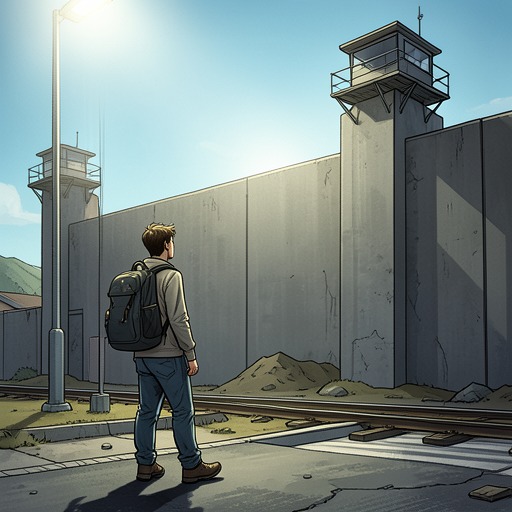
The Israeli Civil War
World War ZThe Israeli Civil War is a decisive internal rupture in Israel during the wider Zombie War. It begins amid disputes over Palestinian repatriation, withdrawal from the West Bank, the demolition of Israeli homes for fortified resettlement compounds, and the evacuation of Al Quds and the Nablus-to-Hebron corridor. For one lifelong Palestinian partisan, the war’s first unmistakable revelation is that the gunmen he expects to be Palestinian insurgents are Jewish rebels, forcing him to reconsider both the conflict and the hatred that shaped his identity.
Causes and Political Background
The war grows from several overlapping decisions by the Coalition Government. The repatriation of Palestinians was unpopular, as was the general withdrawal from the West Bank. The Strategic Hamlet Resettlement Program intensified that anger by requiring many Israelis to watch their houses bulldozed to make room for fortified, self-sufficient residential compounds. These measures converted military and demographic policy into intimate losses: the state’s attempt to create physical security directly displaced citizens who believed the government was destroying the country it claimed to protect.
The final provocation, in the witness’s later understanding, was Al Quds. The Coalition Government judged the city too large to control and too dangerous as a breach leading into Israel’s heart. It therefore evacuated Al Quds and the entire corridor from Nablus to Hebron, planning to rebuild a shorter wall along the 1967 demarcation line. The leadership accepted the political backlash from Israel’s religious right as the price of a defensible frontier, but the retreat instead helped turn that backlash into armed rebellion.
Outbreak in Beer Sheeba
The conflict becomes immediate for a refugee family traveling from the Yeroham resettlement camp toward Tel Aviv. After three weeks at Yeroham, their papers had been processed, their medical examinations cleared, and the Ministry of Social Affairs had promised subsidized housing, free schooling, and a sustaining job for the father. The apparent safety of official resettlement collapses when the bus enters Beer Sheeba. While the witness sleeps, gunfire shatters the driver’s windscreen; the bus swerves into a building, and the father kicks open the emergency exit to push his family into the street.
The city is already divided by combat. Soldiers fire against civilians armed with guns and homemade bombs, and the witness initially interprets the violence as the liberation he has long expected. An Israel Defense Forces soldier drags him and his family into a Starbucks, pins him away from the window, and shields them while his father lies wounded in the shoulder. The witness, still consumed by hatred, searches for a shard of glass with which to attack a Jew, imagining the conflict through the categories he has carried all his life.
The decisive reversal comes at the rear door of the Starbucks. When the door swings open, the soldier fires, killing a man whose grenade rolls from his twitching hand. The soldier catches the grenade and attempts to throw it into the street, but it explodes in midair; his body absorbs the blast and falls across the dead man. Only then does the witness see the victim’s payess, yarmulke, and bloodied tzitzit. The corpse beside him is Jewish, and so are the armed rebels outside. The battle is not a Palestinian uprising but the opening of the Israeli Civil War.
Combat and the Undead Threat
The civil conflict unfolds alongside the continuing danger of the living dead. As the family runs toward an Israeli tank, an unmarked van is struck in the engine by a handheld rocket. Burning figures climb from the wreckage, their clothes and skin covered in petrol. Ordinary body shots pass harmlessly through their chests until the squad leader orders the soldiers to aim at the head. The figures’ heads explode, leaving charred, headless corpses as the petrol burns out.
This juxtaposition changes the meaning of the street battle. Israel is not merely suppressing an internal revolt; its soldiers are forced to distinguish human political enemies from reanimated attackers while civilians flee between them. The witness understands at that moment what his father and Israel had been trying to warn the world about: the greater enemy is the undead plague. His astonishment that the rest of the world still refuses to listen turns the scene into both a personal revelation and a judgment on international denial.
Military Balance and Outcome
The witness later attributes the Israel Defense Forces’ eventual victory to the composition of the rebel forces. Most rebels came from the Ultra-Orthodox community, and many had never served in the armed forces. Their religious and political commitment could generate fury, sacrifice, and resistance, but it did not supply the military training that the Israel Defense Forces possessed. The conflict therefore exposes a gap between ideological mobilization and organized combat capacity.
The retrospective explanation also complicates the witness’s former worldview. He admits that he knew almost nothing about the people he had hated throughout his life. The war does not simply replace one enemy with another; it destroys the certainty of the old categories. The face of the real enemy appears not in the Jewish soldier or civilian he had expected to kill, but in the reanimated creatures emerging from the burning van.
Consequences and Significance
The Israeli Civil War is significant because it shows how emergency security measures can produce a second war inside the first. Repatriation, territorial withdrawal, fortified resettlement, and evacuation are presented as responses to existential danger, yet each also creates dispossession, humiliation, or fear. Those pressures make the state’s defensive program politically explosive even before the undead threat is fully understood.
Its remembered form is equally important. The event is not narrated as a detached military chronology but as a sequence of shocks: the apparent promise of resettlement, the bus crash, the father’s wound, the imagined Palestinian enemy, the grenade, the Jewish corpse, and finally the headless creatures. Each reversal strips away a mistaken assumption. The civil war’s deepest consequence for the witness is therefore epistemic as well as political: the collapse of the hatred through which he had understood Israel, and the recognition that the human divisions consuming the country are subordinate to a larger catastrophe that ordinary governments have failed to confront.