The Redeker Plan implementation in South Africa
World War ZThe Redeker Plan implementation in South Africa transformed an intellectual exercise by Paul Redeker into the country’s governing strategy during the Great Panic. It offered a military retreat, an evacuation system, and a method for preserving political authority, but only by defining most civilians as expendable. The plan’s success therefore carried its own indictment: South Africa survived by protecting a minority and intentionally sustaining the danger faced by everyone left beyond the safe zone.
Origins and Strategic Logic
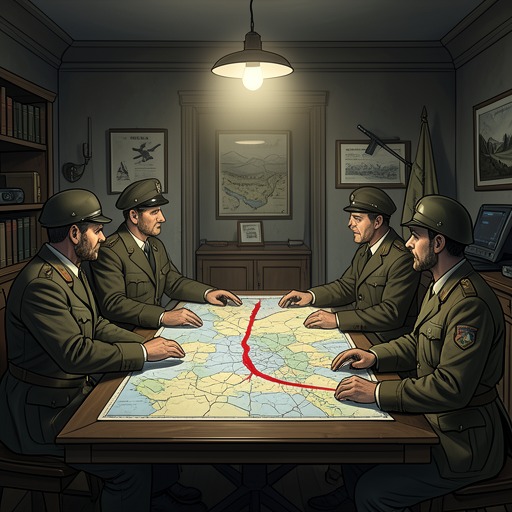
Redeker developed the plan while isolated in his Drakensberg cabin, after concluding that the undead epidemic had already spread too far for universal rescue. The armed forces were depleted, scattered, and losing strength daily; attempting to defend every settlement would merely stretch the government past the breaking point. His solution was to withdraw the remaining forces into a special safe zone, preferably protected by mountains, rivers, or an offshore island, eradicate the infestation inside it, and then defend the consolidated position against further attacks.
The plan’s second stage made the retreat morally and politically explosive. Only a small fraction of civilians could enter the safe zone. Those selected would supply labor for postwar economic restoration and help preserve the legitimacy of the government by demonstrating that the state was still protecting its people. The remainder were to be moved into isolated areas, kept alive, defended, and resupplied whenever possible. Their function was to hold the undead away from the retreating army: every zombie fixed around those survivors would be one less attacking the defenses. Redeker’s design thus treated civilian protection as both a humanitarian duty and a tactical instrument, turning the abandoned into living fortifications.
Seizure and Government Adoption
During the Great Panic, agents of the National Intelligence Agency found Redeker in his cabin. Expecting a revenge killing for his authorship of Orange Eighty-Four, he watched the agents lower their weapons and remove their gas masks. The multiracial team included a tall Afrikaner who asked whether Redeker had a plan for the crisis. Redeker had already written one, without giving it a name, because he believed names existed only to distinguish one thing from another and had assumed no comparable plan would ever be needed.
The agents flew him to Kimberley, to the underground base where Orange Eighty-Four had first been written. There, the surviving presidential cabinet heard the report read aloud. The defense minister reacted with the greatest fury, preferring to fight in the streets rather than hide in a bunker, while the vice president focused on the political catastrophe that would follow if the plan became public. The president took Redeker’s presence as a personal insult and demanded why the safety and security minister had brought an apartheid war criminal before the cabinet. Yet the plan’s usefulness overrode the government’s revulsion, and its logic became the basis of the national retreat.
The Retreat and Consolidation
The implementation required the state to abandon the ideal of rescuing everyone and concentrate military power where it could be used effectively. Redeker worked on the retreat and then remained involved during the consolidation months, continuing until the end of the war. His plan’s institutional form depended on classification: the government had to determine who belonged inside the safe zone, who could contribute to reconstruction, and who would remain outside as a deliberate obstruction to the undead.
The broader postwar world shown elsewhere in the testimony reflects the same pressure to convert people into administratively useful categories. In the United States, the first employment census found that more than 65 percent of the civilian workforce had no valued vocation, forcing a massive retraining program to produce carpenters, masons, machinists, and gunsmiths. In Israel, detainees underwent daily examinations of blood, skin, hair, saliva, urine, and feces before being cleared for resettlement. These systems differ from Redeker’s bait zones, but together they reveal the crisis state’s governing language: bodies were examined, sorted, trained, relocated, or sacrificed according to collective survival needs.
Redeker’s Disappearance and Azania’s Succession
Redeker vanished immediately before the plan’s full implementation. The last known sighting followed an encounter whose emotional meaning remains uncertain. The account acknowledges that the scene may be sentimental and that Redeker might have remained completely unmoved by it. What is certain is that no one saw him again after that day, and no one knows what ultimately happened to him.
The vacancy was filled by a former associate who claimed to have worked with Redeker for many years and to understand his thinking better than anyone still alive in South Africa. After sufficient persuasion, that associate joined the retreat, then the consolidation effort, and finally the war’s concluding phase. The government rewarded the service with luxurious accommodations, but the setting also carries an unsettling ambiguity: the visitor later signs out under the heading of Robben Island Psychiatric Institution and records Paul Redeker as the patient being visited. Redeker may have survived in confinement, disappeared into state custody, or become a figure whose uncertain fate mirrors the moral uncertainty of his plan.
Consequences and Significance
The implementation preserved South Africa’s organized resistance and created the conditions for a postwar state, but it did so through a permanent ethical wound. Redeker’s defenders could praise the plan as brilliant, logical, and efficient; its enemies could see only the deliberate conversion of uninfected refugees into bait. The surviving testimony refuses to resolve that contradiction. Redeker is remembered simultaneously as an angel and a devil, while the person who replaced him expresses pity rather than either hatred or worship and hopes that, if Redeker still exists, he has found peace.
The plan also establishes a pattern that recurs across the war’s other systems. Dogs were first used to identify infected people through scent, placing civilians in controlled proximity to caged animals whose fear could save millions despite causing handlers severe injuries. Later training attempted to discipline that instinct for military work, while escort dogs protected long-range missions from feral packs. Human institutions likewise confronted displaced populations, disabled volunteers, workers without practical skills, reproductive policy, and the mass conversion of navies into fishing fleets. The South African retreat is the starkest version of this logic because it states openly what the other systems imply: survival is organized through unequal valuation, and the lives preserved by a system may depend on lives that system has decided to expose.