Todd Wainio–Doctor Chandra therapeutic relationship
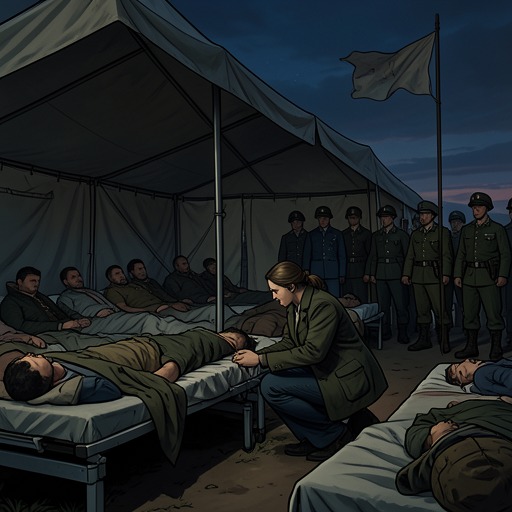
World War ZThe Todd Wainio–Doctor Chandra therapeutic relationship is one of the clearest examples of care functioning as a form of survival during and after the Zombie War. Doctor Chandra’s work with Todd Wainio is not a conventional cure: Wainio remains scarred, intermittently overwhelmed, and vulnerable to memories triggered by smells, voices, songs, and places. What Chandra provides instead is recognition, steadiness, and a language in which psychological injury can be endured without shame. Their bond makes visible the war’s less spectacular casualties and shows how recovery may depend less on forgetting than on being witnessed by someone who understands when a soldier is failing and when he is, paradoxically, holding together.
The Soldier and the Caregiver
Todd Wainio is introduced as a former U.S. Army infantryman whose body records the war before he begins to describe it. At the Denver station, he appears old before his chronological time, with a receding and graying hairline, an expanding paunch, and three deep parallel scars along his right cheek. The physical marks and the frailty of his postwar appearance establish that his survival is not an uncomplicated victory. He is one of the soldiers whose memories remain active inside a body that has technically escaped the battlefield.
Doctor Chandra serves as a company psychiatrist during the campaign and later counsels veterans at the Veterans Affairs hospital. His importance lies in the manner of his attention. He is not presented as an authority who dominates Wainio’s account or translates every reaction into a diagnosis. Instead, he observes, approaches, and makes small offers of human contact. His therapeutic presence is therefore practical and relational: he helps soldiers remain connected to other people when combat has trained them to suppress feeling, obey orders, and continue moving through scenes of mass death.
Trauma in the Field
Wainio’s account of psychological injury begins with the recognition that the most devastating casualties were not always caused directly by the living dead. He describes entering barricaded zones where soldiers found rat-gnawed skeletons, starvation victims, disease victims, and people who had decided that tomorrow was not worth seeing. In a Kansas church, the adults had apparently killed the children before taking their own lives. Such scenes enlarge the meaning of combat trauma: the soldier must carry not only what the enemy did, but also what civilians did to one another and what entire communities did to themselves.
Wainio also recalls an Amish soldier who memorized suicide notes and cut a small half-inch mark into his own body after each one so that he would never forget. The ritual eventually left him sliced from neck to toes, and the lieutenant had him removed from the unit. The episode shows both the compulsion to witness and the danger of turning remembrance into self-destruction. Chandra’s role is defined against that danger. He does not permit suffering to become a private system of punishment, even though his method is gentler than the military structures surrounding the men.
The later stages of the war produce a different form of breakdown. Wainio observes that many psychiatric casualties appear after the fighting has begun to ease, not because the pressure has intensified but because it has finally loosened. Soldiers who had held themselves together while survival required constant action suddenly hear an inner permission to collapse. This delayed timing is central to the relationship: Chandra understands that apparent calm can release rather than resolve trauma, and that the end of immediate danger may be the moment when psychological damage becomes visible.
Chandra’s Method of Presence
One of the most revealing encounters occurs in Portland, Maine, while soldiers police piles of bleached bones left from the Great Panic. Two soldiers use skulls to perform a comic routine from Free to Be, You and Me, and the gathering crowd responds with laughter before spontaneously singing and using femurs as improvised instruments. Wainio looks toward the company psychiatrist, expecting him to confirm that the men are insane. Doctor Chandra merely smiles and shakes his head. His response unsettles Wainio because it refuses an easy division between the sane and the broken.
The scene captures Chandra’s therapeutic intelligence without reducing it to a speech. The soldiers’ grotesque comedy may be a way of metabolizing horror, a collective performance that allows them to touch the dead without being entirely consumed by them. Chandra neither celebrates nor condemns it. His restraint acknowledges that military life has produced emotional forms that cannot be judged by ordinary peacetime standards. He recognizes that laughter among bones may be evidence of adaptation rather than proof of madness, while also leaving open the question of who has truly lost control.
Chandra’s care becomes more direct when Sergeant Avalon encounters a turtle in a field. Avalon, normally severe and emotionally closed, smiles like a child and whispers the Lakota phrase “Mitakuye Oyasin,” meaning “all my relations.” Wainio learns that she is part Sioux, a fact she had never discussed. Doctor Chandra appears almost like a ghost beside her and offers his familiar, unforced invitation: “C’mon, Sarge, let’s grab a cup of coffee.” The offer does not interrogate her identity or demand an explanation for the sudden tenderness. It gives her a safe return to ordinary company while allowing the moment to remain hers.
Loss, Succession, and Recognition
The turtle encounter takes place on the day the president dies, and Avalon soon gives way to the same delayed collapse Wainio has observed in other soldiers. Her death leaves Wainio as squad leader. The succession is not presented as a triumphant promotion. It is another burden transferred to the survivor, occurring when the war is nearly over but its battles and farewells are not finished.
By the time the unit reaches Yonkers, Wainio is the last member of the old group from Hope. Passing the rusting wreckage, abandoned tanks, crushed news vans, and human remains, he feels little, or at least cannot afford to feel much. Leadership requires attention to new faces and immediate responsibilities. Chandra watches him without publicly exposing his distress. When the soldiers board the barges on the Hudson, Wainio and Chandra meet each other’s eyes; Chandra smiles and shakes his head, silently acknowledging that Wainio has made it through.
This exchange is the relationship’s most compressed expression. Chandra does not claim that Wainio is healed. He recognizes survival as an achievement in itself, and he does so without turning the moment into a public ceremony. The gesture carries both reassurance and assessment: Wainio has inherited command, outlived his comrades, and continued functioning, but the psychiatrist knows that functioning is not the same as being untouched.
Postwar Continuity and Meaning
Years later, Wainio reports that he still loses control for a few minutes or sometimes an hour. Doctor Chandra, now counseling at the Veterans Affairs hospital, tells him that these episodes are healthy, like small earthquakes releasing pressure from a fault. He warns, in effect, that the veteran who never experiences such tremors may be more worrying than the one who does. The metaphor gives Wainio’s episodes a physical legitimacy. They are not moral failures or evidence that he has betrayed the people who depend on him; they are releases from pressure that accumulated during years of fear, killing, and waiting to die.
Wainio’s triggers are ordinary and therefore especially powerful. A smell can suddenly break through the present, and a stranger’s voice can sound familiar. At dinner, a song in an unfamiliar accent recalls the chorus “God help me, I was only nineteen.” The memory does not arrive as a neatly controlled historical statement. It enters through the body and through repetition, showing how trauma survives in sensory fragments that remain outside the veteran’s command.
The relationship also connects private memory to public remembrance. Wainio’s most vivid memory has become the national image of victory: soldiers standing on the New Jersey riverbank and watching dawn over New York after receiving the news of VA Day. There was no cheering. Peace felt unreal after fear and violence had become normal. The monumental image turns an exhausted, emotionally vacant moment into an icon, while Chandra’s continuing care preserves the less photogenic truth behind it: the soldier can stand beneath the mural and still experience the war as an unfinished internal event.
In the book’s wider method, this bond embodies the value of personal testimony. The interviewer’s project begins because intimate accounts were removed from the United Nations Postwar Commission report in favor of facts and figures, yet the relationship between Wainio and Chandra demonstrates why such intimacy matters. A report can record military operations and casualty totals; it cannot by itself show how a psychiatrist’s smile, a coffee invitation, or a silent acknowledgment at a river crossing helps a survivor remain human. Doctor Chandra does not replace official history. He supplies the human scale that allows Wainio’s survival, and the war’s psychological cost, to be understood.