Tomonaga Ijiro
World War ZTomonaga Ijiro is the founder and spiritual center of Japan’s Tatenokai, or Shield Society, a blind hibakusha whose experience of wartime destruction becomes the foundation for a postwar doctrine of civilian responsibility. His significance lies in the way he converts a life marked by stigma and self-erasure into a public mission: Japan must be cared for like a garden, its living dead infestation destroyed, and its people prepared to return without repeating the militarism that helped ruin the country.
Identity and Wartime Trauma
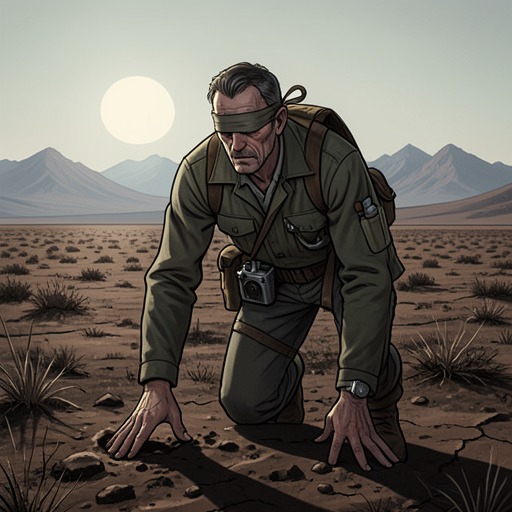
Tomonaga Ijiro first appears in Kyoto as an old master whose authority is established before he speaks. He recognizes the interviewer’s presence seconds before the visitor enters, sensing that the visitor walks, smells, and breathes like an American. He greets the visitor with both a bow and a handshake, then invites the guest to sit before him as a student. Beside him is Kondo Tatsumi, his second in command, who serves tea and sits with the teacher. Tomonaga’s eyes have been lifeless since adolescence, but blindness has not diminished his alertness or the force of his presence.
He identifies himself as a hibakusha, a survivor of the atomic bomb. On August 9, 1945, at 11:02 a.m., he was eleven years old and stationed with other schoolboys on Mount Kompira, monitoring an air-raid warning post above the Urakami Valley. The sky was overcast. He heard a B-29 pass overhead, apparently a reconnaissance aircraft that seemed too insignificant to report, and kept looking upward in the hope of seeing the American bomber. Instead, the flash was the last sight he ever had. The precision of his recollection fixes his blindness within both personal memory and national catastrophe: his body carries the instant when a war became permanent history.
Shame, Exile, and the Garden
Tomonaga’s disability is compounded by the social position of the hibakusha. In postwar Japan, atomic-bomb survivors were publicly treated as victims, heroes, and political symbols, yet privately regarded as contaminated outsiders. Families feared allowing their children to marry them, and Tomonaga experienced this stigma not as an abstract national attitude but as a judgment on his own worth. Blindness made him feel like a burden, while the sanatorium’s sounds of national reconstruction sharpened his sense that he contributed nothing to Japan’s recovery.
He eventually leaves the sanatorium without telling his brother. He has no destination beyond escape from his former life, memories, and identity, and travels by begging until he reaches Sapporo in Hokkaido, Japan’s sparsely populated northern frontier. There he meets Ota Hideki, an Ainu gardener. Ota belongs to an indigenous community placed even lower than Koreans on Japan’s social hierarchy, yet he offers Tomonaga employment and instruction at the Akakaze, a former luxury hotel converted into a repatriation center for Japanese settlers returning from China. When the administration says it cannot afford another gardener, Ota pays Tomonaga from his own pocket.
Ota becomes Tomonaga’s teacher and only friend. His son has disappeared after going to Manchuria, and Ota has no one else to whom he can pass on his knowledge. Tomonaga works silently in the earth as the Akakaze changes from repatriation center back into a luxury hotel and Japan changes from conquered rubble into an economic superpower. The gardening is therefore more than a job. It gives a displaced, stigmatized man a practical relationship with the land, a discipline of tending rather than ruling, and eventually the vocabulary through which he will understand Japan’s survival.
The Bear, the Plague, and Revelation
Tomonaga hears about the domestic outbreak while trimming Western-style hedges near the Akakaze restaurant. Guests discuss the Nagumo murders, in which a man killed his wife and attacked the corpse like a wild animal. Soon the conversations turn to the outbreak at Sumitomo Hospital in Osaka, followed by reports from Nagoya, Sendai, and Kyoto. Tomonaga tries to suppress what he hears. He has gone to Hokkaido to withdraw from the world, living out his remaining days in shame, and the spreading plague threatens the very isolation he has chosen.
In the wilderness, a three-hundred-kilogram bear attacks him but unexpectedly stops. Instead of killing him, the animal emits a high, almost childlike whimper and retreats with the speed of hunted prey. Tomonaga then hears another presence: a taller creature dragging one foot, breathing through a gaping chest wound, and reaching blindly toward him. He dodges its attack, takes up his ikupasuy, and strikes at the source of the moan. When the creature falls, he cries out “Ten Thousand Years!” The encounter reverses the meaning of his existence. The bear’s refusal to kill him no longer signifies random mercy; Tomonaga interprets it as a warning from the kami, the spirits inhabiting every part of existence and central to Shinto’s reverence for nature.
Tomonaga’s interpretation is inseparable from his guilt. He believes that by exiling himself into the wilderness he has polluted nature, dishonored himself, his family, and his country, and finally offended the gods. He had expected the bear to serve as an assassin carrying out the death he could not bring upon himself. Its retreat and the appearance of the wounded living dead instead awaken fury, courage, and a conviction that he has been preserved for a purpose. Survival becomes an obligation to wait for the reason to be revealed.
That revelation arrives when Kondo reports the plague and the evacuation. Kondo tells him that Japan has been completely abandoned and is effectively gone. Tomonaga suddenly understands why the gods took his sight, sent him to Hokkaido to learn how to care for the land, and sent the bear to warn him. His blindness is no longer presented only as deprivation; within his chosen spiritual narrative, it has become the condition through which he learned to listen, distinguish, and serve. The change does not erase the material hardship of blindness or the discrimination he endured, but it gives those experiences a new plot and a new demand.
The Shield Society’s Doctrine
Tomonaga tells Kondo that Japan has not been abandoned by those chosen to be its gardeners. He compares the country to a garden that cannot be allowed to wither and die. The Society’s task is to care for Japan, preserve it, annihilate the walking blight infesting and defiling it, and restore its beauty and purity for the day when its children return. His language joins horticulture, Shinto cosmology, national restoration, and military action. The living dead are not merely enemies to be eliminated; they are a blight against which stewardship becomes a form of defense.
Kondo initially thinks Tomonaga is insane. The proposed task appears impossible: two men confronting millions of the living dead. Tomonaga answers not with a practical estimate but with faith, returning Kondo’s sword and emphasizing that although perhaps fifty million monsters stand against them, those monsters will be facing the gods. His authority thus depends on a deliberate fusion of tangible technique and metaphysical certainty. The sword’s familiar weight and balance, the trained body, and the unseen kami occupy the same field of action.
The Tatenokai’s later development gives this vision institutional form. The Society is accepted as an independent branch of the Japanese Self-Defense Forces, with a principal duty of teaching Japanese civilians how to protect themselves from the living dead. It also undertakes to learn armed and unarmed techniques from non-Japanese organizations and to help spread those techniques internationally. Its anti-firearm and pro-international message wins immediate approval from journalists and dignitaries representing almost all United Nations nations. Tomonaga’s movement therefore evolves from a small, seemingly irrational act of faith into a recognized public institution whose purpose is both national defense and international exchange.
Legacy and Narrative Role
At the Society’s historic acceptance ceremony in Kyoto, Tomonaga stands at the head of the receiving line, smiling and bowing to the guests. Kondo watches him from across the room and remains skeptical of the spiritual explanation, regarding Tomonaga as a crazy old hibakusha rather than a literal agent of the gods. Yet Kondo also recognizes that Tomonaga has begun something vital for Japan’s future and commits himself to following his teacher, along with the many others joining the ranks.
Tomonaga’s legacy is defined by a middle path. He does not simply revive the imperial ambition associated with his generation, nor does he accept the later posture of allowing foreign powers to determine Japan’s protection. The near destruction of the homeland exposes both routes as failures. His alternative is responsibility without isolation: civilians must know how to defend themselves, Japan must take charge of its own security, and that self-protection must not become a source of anxiety and hatred among other nations.
His character arc consequently moves from social death to collective usefulness. The blind survivor who once believed himself a burden becomes a teacher, founder, and symbol of national recovery. The narrative does not require the reader to accept his theology as objective fact; the bear, the kami, and his sense of divine selection remain filtered through his understanding. What is undeniable is the practical result of that belief. Tomonaga’s private shame produces a public ethic of care, and his vision gives Japan a way to reclaim agency while resisting the destructive certainty of its past.