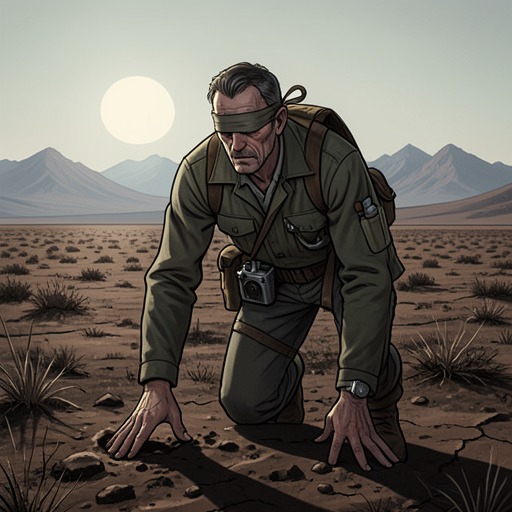
Tomonaga Ijiro–Kondo Tatsumi mentor–disciple relationship
World War ZThe mentor–disciple relationship between Tomonaga Ijiro and Kondo Tatsumi is the human core of the Shield Society’s transformation from an improbable pair of survivors into a recognized institution of Japan’s recovery. Tomonaga offers a philosophy of stewardship shaped by blindness, war, and catastrophe; Kondo brings skepticism, youth, and the capacity to turn that philosophy into disciplined action. Their bond does not depend on unquestioning faith. It is built through testing, argument, service, and a shared decision to protect a country that many believed had been abandoned.
Meeting in Kyoto
Tomonaga and Kondo are presented together in Kyoto, Japan, where the elderly founder of Japan’s Tatenokai, or Shield Society, receives an interviewer as though receiving a student. Tomonaga knows that a visitor is approaching before the visitor enters the room, judging him through the way he walks, smells, and breathes. His eyes have been lifeless since adolescence, when he became a hibakusha after losing his sight at 11:02 A.M. on August 9, 1945, during the atomic bombing of Nagasaki. Kondo, identified as Tomonaga’s second in command, serves tea and then sits beside the old master. The arrangement establishes their roles immediately: Tomonaga is the teacher and ideological center, while Kondo is both attendant and active deputy, close enough to carry the work forward but independent enough to speak for himself.
Tomonaga’s blindness is not treated merely as a symbolic mark of wisdom. It defines the sensory conditions under which he reads the world and teaches others. His memory of the bombing is inseparable from the last image he ever saw, the flash above the Urakami Valley, and from the social burden attached to being a survivor of the bomb. Hibakusha were publicly pitied and used as symbols, yet privately treated as contaminated and unsuitable for marriage; Tomonaga also experienced his blindness as making him a burden. The relationship with Kondo therefore begins against a history of exclusion. Kondo’s presence beside him signals not a cure or erasure of disability, but a practical partnership in which Tomonaga’s altered way of perceiving becomes a source of authority and method.
The Trial of the Wanderer
The relationship is forged through a dangerous encounter rather than through a formal lesson. In darkness, Kondo encounters a filthy, malnourished two-legged figure whose breath, body, and clothing show that he has not been washed for some time. Unsure whether the stranger is hostile, insane, or recently bitten, Kondo takes precautions. The approaching figure reaches him before he can react: Kondo’s sword flies away and his legs collapse beneath him. Tomonaga lands between the attacker’s shoulder blades, hard enough to knock the wind from the stranger’s slight frame but not to cause permanent injury.
The scene reverses the expected distribution of strength. Kondo may carry the sword and serve as Tomonaga’s second, but Tomonaga’s sensory discipline and physical decisiveness allow him to control the encounter. The sword is temporarily separated from Kondo, making the weapon’s loss a test of whether his identity rests on equipment or on judgment. Tomonaga’s intervention is measured rather than destructive; he incapacitates the stranger without needless harm, embodying the combination of restraint and readiness that the Society will later teach to civilians.
Kondo then explains the plague and the evacuation. He cries while telling Tomonaga that Japan has been completely abandoned, that Japan is nai. The confession is both factual and emotional: Kondo is not simply delivering news but confronting the collapse of the national world he assumed would remain. His distress makes him vulnerable, while Tomonaga’s response gives the catastrophe a new interpretive frame. The disciple arrives with news of extinction; the teacher answers with a doctrine of responsibility.
From Abandonment to Stewardship
Tomonaga interprets the circumstances of his life as a preparation for this moment. He declares that he now understands why the gods took his sight, sent him to Hokkaido to learn how to care for the land, and sent a bear to warn him. The claim is spiritual and highly personal, but its practical consequence is clear: blindness, displacement, and survival are recast as obligations rather than as evidence of uselessness. Tomonaga’s faith supplies a mission that Kondo’s despair cannot yet see.
Tomonaga tells Kondo that Japan has not been abandoned by those whom the gods have chosen to be its gardeners. He develops the garden image into a program. Japan must not be allowed to wither and die; its chosen caretakers will preserve it, annihilate the walking blight that has infested and defiled it, and restore its beauty and purity for the return of its children. This language joins cultivation to violence, presenting the destruction of the living dead as a form of national husbandry. The metaphor also changes Kondo’s place in the world. He is no longer merely a survivor fleeing a ruined homeland; he is invited to become one of its gardeners.
Kondo initially believes Tomonaga is insane and says so directly. His objection is grounded in scale: two men cannot plausibly confront millions of siafu. Tomonaga does not deny the numerical imbalance. Instead, he returns Kondo’s sword and tells him that although they may face fifty million monsters, those monsters will be facing the gods. The gesture is central to the mentor–disciple bond. Tomonaga restores the weapon, acknowledges the terror of the task, and replaces a calculation of numbers with a conviction that action remains possible. Kondo’s doubt is not eliminated by argument; it is answered by a challenge to participate.
A Partnership Made Institutional
The later history of the Shield Society shows that Kondo does accept that challenge, though he does not surrender his critical judgment. On the Society’s historic day of recognition, it is accepted as an independent branch of the Japanese Self-Defense Forces. Its principal duty is to teach Japanese civilians how to protect themselves from the living dead. Its continuing mission includes learning armed and unarmed techniques from non-Japanese organizations and helping foster those techniques around the world. The institution therefore preserves Tomonaga’s national concern while refusing to isolate Japan from international knowledge.
Tomonaga stands at the head of the receiving line, smiling and bowing to journalists, dignitaries, and guests from almost all United Nations nations. Kondo smiles across the room at his teacher. The distance between them is visual and ceremonial, but it does not suggest separation: Kondo’s pride is expressed by watching Tomonaga occupy the public position that his work has earned, while Tomonaga’s authority is now surrounded by the organization his disciple helped sustain. The former encounter between an old master and a frightened messenger has become a public institution.
The Society’s anti-firearm and pro-international message are hailed as an instant success. That combination matters because the relationship is not simply a transmission of Tomonaga’s beliefs to a younger follower. Kondo’s later reflection distinguishes his own position from Tomonaga’s spiritual language. He does not believe in the spiritual claims about the gods and regards Tomonaga as a crazy old hibakusha. Yet he also insists that Tomonaga has started something wonderful and vital for Japan’s future. Kondo’s commitment is therefore knowingly chosen rather than produced by conversion.
Difference, Continuity, and Legacy
Kondo understands the national danger through generational contrast. Tomonaga’s generation wanted to rule the world; Kondo’s generation was content to let the world, meaning the United States, rule Japan. Both paths nearly destroyed their homeland. Kondo locates the Society’s purpose in a middle path: Japan must take responsibility for its own protection without becoming so militarized or aggressive that it inspires anxiety and hatred among other nations. This political balance translates the mentor’s garden doctrine into a postwar civic ethic.
The relationship thus contains disagreement without rupture. Tomonaga speaks in terms of gods, purity, gardeners, and the restoration of the homeland. Kondo speaks in terms of responsibility, international exchange, civilian training, and the dangers of national excess. Their vocabularies differ, but their actions converge. Tomonaga supplies the imaginative force that transforms abandonment into a mission; Kondo supplies the skeptical intelligence that limits that mission and makes it acceptable to a wider world.
Kondo admits that he cannot know whether this is the right path because the future is too mountainous to see very far ahead. The image quietly echoes Tomonaga’s blindness and his earlier reliance on senses other than sight. Neither master nor disciple possesses a complete view of what awaits Japan. Their bond instead rests on continuing down the path together, with Kondo promising to follow Tomonaga and the ranks of the Society growing every day. Only the gods know what lies at the end, but the practical legacy is already visible: civilians are trained, techniques cross national boundaries, and a once-marginalized survivor’s vision has become a collective program through his skeptical disciple.