United Nations Northern Force
World War ZThe United Nations Northern Force is the United Nations’ northern military arm in the aftermath of the Zombie War, charged with reducing and ultimately eliminating concentrations of the undead in regions where reanimation remains a recurring threat. Its decisive significance lies in the scale and persistence of that mission: years after the main conflict, the force is still fighting a seasonal war against bodies emerging from frozen ground, turning survival into a system of maintenance rather than a concluded victory.
Mandate and Operating Environment
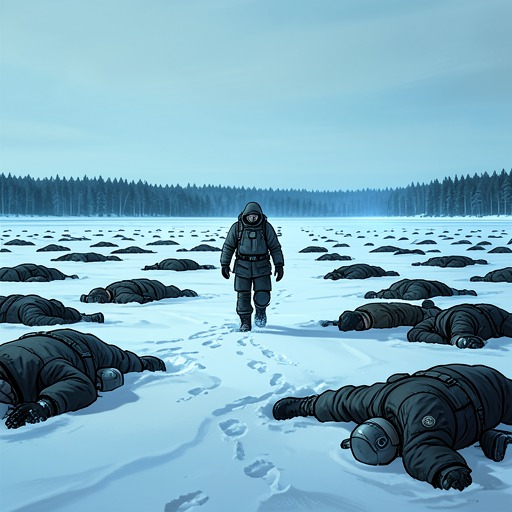
The force appears in Vaalajarvi, Finland, during spring “hunting season,” when warmer weather causes frozen zombies to reanimate. Its mission is known as “Sweep and Clear,” a recurring operation designed to locate and destroy the newly active dead. The campaign is presented as methodical rather than spectacular. Each year the undead population declines, and current trends indicate that the area should be completely secure within a decade. That forecast makes the United Nations Northern Force an instrument of long-term containment, measuring success through diminishing numbers and reclaimed territory rather than through one decisive battlefield encounter.
The Finnish operation also reveals the environmental conditions that shape the force’s work. The threat is dormant during the cold months but returns with the thaw, meaning that victory must be renewed whenever the landscape releases another population of corpses. The northern theater therefore converts climate into a military variable: winter suppresses movement, spring exposes the danger, and the force’s annual presence prevents reanimation from becoming a fresh outbreak.
Command and Conduct
Travis D’Ambrosia, serving as Supreme Allied Commander, Europe, personally oversees the operations at Vaalajarvi. His presence places the local sweep within a larger United Nations command structure and signals that the campaign is considered strategically important despite its repetitive, attritional character. During the interview, he speaks softly and struggles to maintain eye contact, suggesting that command responsibility has not been separated from the moral weight of earlier failures.
D’Ambrosia openly acknowledges that mistakes were made and that the authorities were not adequately prepared. He also admits that the American people were let down, framing the postwar military effort not as an uncomplicated record of competence but as an attempt to account for institutional failure. The Northern Force’s disciplined work in Finland consequently carries a double meaning: it is evidence of reconstruction and learning, but also a reminder that the machinery of international defense was assembled only after catastrophe had exposed its deficiencies.
The Wider System of Emergency Power
The Northern Force operates in a world where emergency institutions repeatedly subordinate ordinary legal and political limits to collective survival. Earlier responses to the outbreak included concealment, coercive quarantine, forced labor, public punishment, and executions organized so that soldiers became participants in the killing of their own comrades. These practices demonstrate the atmosphere in which postwar military organizations emerged: security was treated as a justification for extraordinary authority, while guilt and shared responsibility were used to bind frightened populations together.
The same logic appears in the administration of refugees. Five million people from the United States, together with refugees from Latin America, Africa, and western Europe, were placed under Cuba’s Quarantine Resettlement Program. The centers were not formally described as prison camps, yet their residents could be forced into twelve- to fourteen-hour days as agricultural laborers and threatened with invented stories of “zombie pits.” Such examples clarify the political landscape inherited by the United Nations Northern Force. Clearing the dead required organized force, but the postwar order also had to confront the danger that emergency measures could become permanent systems of classification, confinement, and punishment.
Tactical Lessons and Human-Animal Relations
The military response to the Zombie War depended not only on conventional troops but also on systems of detection and escort. Dogs were first used for triage, sniffing out infected people as they passed cages, following an Israeli method later copied by other countries. Early in the war, many dogs reacted violently to the smell or presence of infection; handlers lost hands, arms, and lives when animals reverted to instinctive fight-or-flight behavior. The danger was accepted because the dogs’ terror response probably saved millions of human lives.
Long-range patrols and missions across wild terrain faced an additional threat from feral dog packs, especially while moving through low-infestation zones. Before escort dogs were deployed, many missions had to be aborted because the packs were too dangerous. Later training integrated dogs into group operations, while mixed-breed animals were favored for physical strength and mental stability over aesthetically bred purebreds. This broader military adaptation reflects the same organizational learning represented by the Northern Force: survival depended on reshaping existing institutions and biological capacities for a war unlike any previous conflict.
The ecological consequences of that war extended beyond the undead. Feral animals became predators in their own right, including F-lions, enormous catlike creatures that hunted warm-blooded prey in landscapes altered by the collapse of human control. At sea, several million refugees and navies converted into fishing fleets contributed to the destruction of whale populations. These developments place the United Nations Northern Force within a postwar environment where military security, human migration, animal labor, and ecological devastation are inseparable. Clearing territory for human settlement did not restore the old world; it produced a damaged one that required continuous management.
Historical Significance
The United Nations Northern Force embodies the unglamorous phase of victory: the repeated, bureaucratic work of making a dangerous world inhabitable again. In Finland, the undead are not defeated once and for all; they are counted, monitored, and reduced through annual operations until the land can plausibly be declared secure. That structure resists the fantasy of a clean ending. The war’s aftermath is instead a sequence of maintenance cycles, each dependent on discipline, resources, and institutional memory.
Its significance is also ethical. The force’s existence represents an attempt to replace panic and improvisation with coordinated international responsibility, yet the surrounding history shows how easily the language of survival can excuse cruelty. The contrast between the Northern Force’s measured clearing operations and earlier policies of concealment, coercion, and collective punishment gives the organization a restrained but important narrative role. It stands for the possibility of rebuilding effective authority after disaster, while remaining haunted by the question of what that authority was willing to do when the crisis first began.