VA Day
World War ZVA Day marks the moment when the continental United States was declared secure after the long campaign against the living dead. It is decisive not because it ended the worldwide war, but because it converted survival into a public promise of peace, allowing exhausted Americans to return to private life while an international force continued the unfinished work elsewhere.
Causes and Political Meaning
The declaration was shaped by fear of political exhaustion as much as by military success. The administration remembered how Clement Attlee displaced Winston Churchill before World War II had formally ended: the British public felt it had suffered enough, while Churchill continued insisting that the fight was unfinished everywhere. American leaders did not want their own victory to become politically indistinguishable from endless war. Once the continental United States had been secured, they chose to declare victory rather than risk losing public support by insisting that the conflict continue without a visible end.
This decision did not mean that the war itself was over. Large regions of the world remained ruled by the dead, and allied populations still needed assistance. VA Day instead established a boundary between the emergency of defending the American continent and the broader international task of reclaiming the planet. The United States could announce that its own house was in order while giving its soldiers the option to go home and recover their private lives.
The Campaign Behind the Declaration
The victory depended on a military transformation learned through catastrophic failure. At the Battle of Yonkers, American forces had prepared ground positions, conventional cover, and concealment for an enemy that could not be frightened, suppressed, or forced to retreat. The failure was not simply defective equipment or poor preparation; the living dead were biologically incapable of the fear on which conventional battle doctrine depended. Their immunity to shock and awe turned the army’s psychological weapon against the soldiers themselves and nearly destroyed public confidence.
Later doctrine replaced technological extravagance with a resource-to-kill ratio. Under General Travis D’Ambrosia, commanders assessed weapons by what they consumed against the number of dead they could eliminate. The change affected both strategy and military culture: soldiers began comparing expensive systems with cheaper alternatives that could kill more efficiently, while improvisation became an expected virtue rather than an embarrassment. The Standard Infantry Rifle embodied this logic. It was rugged, accurate, difficult to jam, adaptable from sniper configuration to close-combat carbine, and designed for mass production rather than ornament.
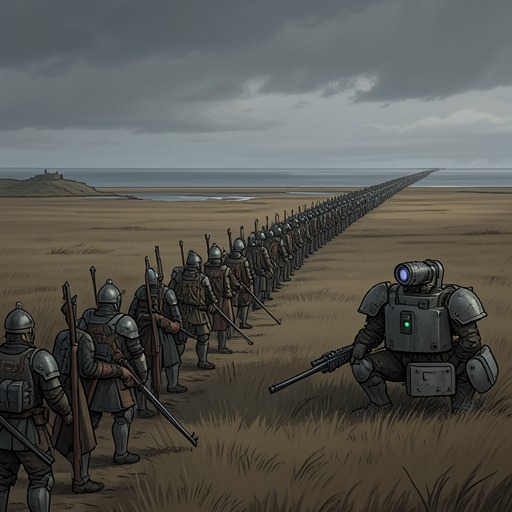
Ammunition and formation were redesigned for the same war. Cherry PIE ammunition shattered inside a zombie skull and destroyed the brain without spreading infected gray matter, reducing the need for wasteful burning and allowing whole bodies to be buried after battlefield sanitation. In the later continental advance, troops moved in two solid lines, one active and one reserve, so that a front-rank soldier could recharge without interrupting the firing line. The Force Appropriate Response system halted only the section, platoon, or company needed to eliminate an isolated or small group of zombies, while equivalent troops from the secondary line closed the gap. This method advanced slowly, but it ensured that the line never broke as it crossed the country.
What VA Day Looked Like
For the soldier whose recollection became associated with the national victory, the decisive scene occurred on a New Jersey riverbank. The troops stood looking toward the dawn over New York after receiving the word that VA Day had been declared. The setting was later transformed into a giant mural, turning a private memory into a national icon, but the remembered event contained none of the theatrical triumph expected from such an image.
There was no cheering and no celebration. Peace felt unreal to people who had spent so long being afraid, fighting, killing, and waiting to die that they had begun to accept those conditions as permanent. The sunrise over New York appeared dreamlike, and the memory retained that uncertainty: victory was legally and politically real, yet emotionally difficult to recognize. The soldiers had been trained to continue the work of survival; they had not necessarily learned how to inhabit the world that survival was supposed to restore.
Consequences and Continuing War
The declaration permitted demobilization without abandoning the wider struggle. A United Nations multinational force was formed to support allies and clear territories still controlled by the dead. Volunteers joined in such numbers during the first week that some had to be turned away, placed on reserve lists, or assigned to train younger recruits who had missed the continental drive. The war therefore changed from an American national emergency into an international reclamation effort, with service continuing under a broader mandate.
The distinction between VA Day and the ultimate end of hostilities remained important in the historical record. Twelve years after VA Day, the war was still close enough that survivors questioned whether genuine perspective was possible; the world had been at peace for roughly as long as it had been at war, and the later Victory in China Day was considered by many to be the conflict’s official conclusion. VA Day thus represents an incomplete ending: the moment America secured the conditions for peace at home, not the moment humanity had finished defeating the living dead.
Memory and Historical Significance
VA Day’s power comes from the tension between public symbolism and private testimony. The mural presents a clean visual endpoint—a line of survivors watching dawn over New York—while the remembered scene is marked by silence, disbelief, and the residue of terror. The event shows why a history composed only of chronologies and casualty statistics would be inadequate. The political declaration can be dated and classified, but its human consequence is visible in the survivor’s inability to understand what peace means after years of normalized fear.
The event also establishes the book’s larger historical problem. The official record seeks clear facts and figures unclouded by the human factor, whereas the personal account insists that memory is what prevents history from becoming detached from the people who endured it. VA Day is consequently both a national milestone and a test of remembrance: the victory is real, but its meaning must be recovered from the damaged, uncertain voices of those who stood at its edge.