Warmbrunn-Knight Report
World War ZThe Warmbrunn-Knight Report is the nearly hundred-page intelligence assessment that recognized the undead plague before most governments were willing to act. Its decisive significance lies in the gap between knowledge and response: specialists assembled converging evidence, but institutions treated the warning as one more alarmist forecast until public events made advanced notice meaningless.
Origin and Authorship
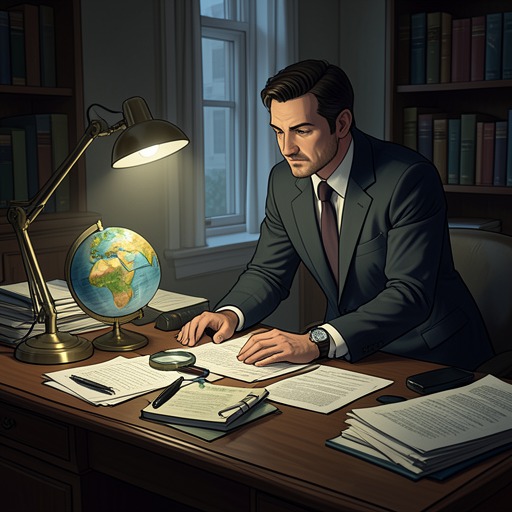
The report grew from the independent investigations of Jurgen Warmbrunn and Paul Knight. Paul Knight had been Jurgen Warmbrunn’s friend since Entebbe, where Knight had proposed using a double of Amin’s black Mercedes. After retiring from government service immediately before his agency’s reforms, Knight joined a private consulting firm in Bethesda, Maryland. Warmbrunn visited him at home and discovered that Knight had been investigating the same threat in his own time, with a file almost as thick as Warmbrunn’s.
The two men spent the entire night reading each other’s findings without speaking. Their simultaneous discovery of matching conclusions transformed separate private inquiries into a joint intervention. When Paul Knight finished the last page, he asked in an understated way how bad the situation was and what they were going to do about it. That exchange produced the document later known as the Warmbrunn-Knight Report.
The title is misleadingly narrow. Jurgen Warmbrunn explicitly rejects the idea that the report belonged only to him and Paul Knight. Fifteen other names appeared on it, including virologists, intelligence operatives, military analysts, journalists, and a United Nations observer who had been monitoring elections in Jakarta when the first outbreak struck Indonesia. Each specialist had reached similar conclusions independently before being contacted, so the report represented convergence across disciplines rather than the intuition of two isolated investigators.
Findings and Intended Use
The report was just under one hundred pages long, concise but described as fully comprehensive. Its purpose was practical: to ensure that the outbreak never reached epidemic proportions. The document treated the threat as an interconnected biological, intelligence, military, and political problem, demanding action before the crisis became irreversible. Its recommendations were not presented as prophecy but as an attempt to convert expert recognition into prevention.
The report’s central insight was that the enemy could not be understood through ordinary assumptions about human combatants. A human body depended on a vulnerable support system of food, oxygen, and functioning organs, while an undead body required only the continued operation of its brain. Destroying the brain was therefore necessary, and the distinction mattered because conventional methods of frightening or incapacitating an opponent would not work against creatures incapable of fear. The later military failures at Yonkers exposed the practical consequences of neglecting that implication.
The report also anticipated the need for an appropriate relationship between resources and killing power. Later doctrine developed the resource-to-kill ratio, while the postwar army adopted weapons and formations suited to sustained destruction rather than spectacle. The Standard Infantry Rifle was valued because it was accurate, reliable, difficult to jam, and adaptable from long-range fire to close combat; Cherry PIE ammunition shattered inside an undead skull and destroyed the brain without spreading infected matter, reducing the need for wasteful burning. The eventual two-rank firing line and Force Appropriate Response doctrine likewise embodied the report’s broader lesson that the war demanded disciplined efficiency rather than conventional fantasies of decisive shock.
Suppression and Political Failure
The report did not immediately produce the response its authors intended. One copy, hand-delivered by Paul Knight and marked for the director’s eyes only, was later found at the bottom of a clerk’s desk in the San Antonio field office of the FBI, three years after the Great Panic. By then, the discovery was academically important but strategically useless: Israel had already announced Voluntary Quarantine, the facts were public, and the central question had shifted from warning to belief.
The United States received the report three months before Israel went public. Grover Carlson, then the former White House chief of staff, recalled that his government had read it and that he had personally briefed the president, who devoted an entire meeting to its message. Yet the recommendation to abandon ordinary priorities and concentrate national effort was dismissed as typical alarmism. Carlson defended the decision as a measured response to what appeared to be an unrealistic threat, placing the document within a familiar stream of reports that claimed to identify the greatest danger to human existence.
That dismissal produced a sharp contrast between institutional caution and the report’s urgency. Its authors had assembled evidence from multiple expert communities, but officials judged the document through the political problem of credibility: governments could not respond maximally to every warning without appearing irrational, yet a restrained response to this particular warning allowed the crisis to expand. When challenged about whether some governments had followed the report, the answer was that they had done so only barely, and the cost was enormous.
From Ignored Assessment to War Doctrine
The report’s neglected recommendations were eventually realized through painful battlefield learning. At Yonkers, American forces prepared ground-level positions, sandbags, fighting holes, and even tank emplacements as though they were facing a conventional Cold War army. The undead were not vulnerable to concealment, suppression, or psychological intimidation, and the battle became a catastrophic failure of the modern military apparatus. The force could kill, but it could not frighten the enemy, and its own fear destroyed confidence.
The later army reversed that logic. Under Travis D’Ambrosia, the resource-to-kill ratio became a comprehensive strategy rather than an abstract principle. Soldiers learned to compare the cost of weapons with the number of undead they could destroy, while rank-and-file improvisation produced cheaper and more effective tools. The Standard Infantry Rifle, Cherry PIE ammunition, and the Lobotomizer all reflected an economy of reliable repetition: each item had to work under mud, sand, saltwater, exhaustion, and prolonged contact.
The doctrine also reorganized time and movement. During the three-year advance across the continent, three Army Groups moved in solid lines from Canada to Mexico, later dividing at the Appalachians and sweeping toward the coasts. Force Appropriate Response prevented an entire army from halting for a single undead combatant. A section, platoon, or company dealt with the immediate threat while an equal force from the secondary line replaced the gap, allowing the front to advance without breaking. This slow, methodical system translated the report’s early warning into an operational culture of exhaustive coverage and controlled expenditure.
Historical and Narrative Significance
The report stands at the center of the book’s conflict between official history and human testimony. The opening account explains that the narrator’s work for the United Nations Postwar Commission was substantially cut because it contained too many opinions and feelings. The chairperson wanted facts and figures without the human factor; the narrator instead preserved the personal record in a separate book. The Warmbrunn-Knight Report belongs to the colder documentary side of that tension, yet its history proves that data alone cannot guarantee action. Facts can be precise, comprehensive, and available while still being politically disregarded.
Its later names reveal another form of historical distortion. It is repeatedly called the Knight-Warmbrunn report, although Paul Knight and Jurgen Warmbrunn were only two of seventeen contributors. The shifting attribution turns a collective act of expertise into a memorable pair of names, simplifying the network that made the document persuasive. That simplification parallels the way the war itself becomes organized around icons: a battle, a plan, a mural, or a famous title can stand for a far larger accumulation of labor and loss.
The report’s legacy is therefore double. It is a record of foresight, because its contributors recognized the danger before the Great Panic and before Israel’s public declaration. It is also a record of institutional failure, because recognition did not become prevention. The later development of efficient weapons, disciplined formations, and continent-wide clearance doctrine demonstrates that its practical lessons were eventually absorbed, but only after the world had paid the price the report was written to avoid.