Wenatchee
World War ZWenatchee, Washington, is presented as a community where postwar survival becomes a matter of ordinary civic labor. The location gives concrete shape to Neighborhood Security Teams: volunteers patrol streets, inspect homes, absorb newcomers from resettlement camps, and defend a neighborhood with whatever training and equipment the reorganizing state can provide. It is also the home of Joe Muhammad, whose wheelchair is treated first as an administrative obstacle and then, through his insistence, as a condition that the community must learn to accommodate rather than use to exclude him.
Setting and Community Role
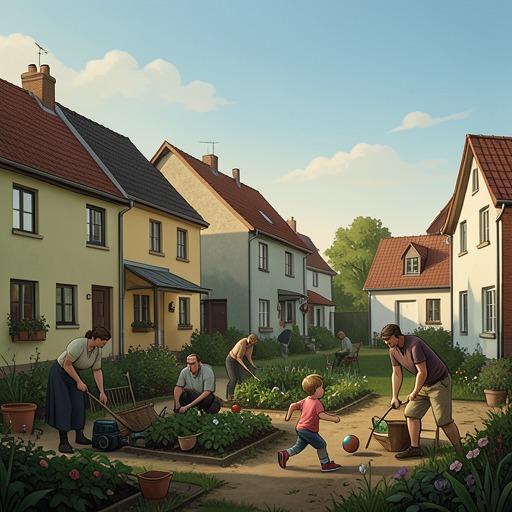
Wenatchee appears not as a distant military theater but as a working town whose survival depends on local organization. Joe’s day job is running the town’s bicycle repair shop, while his spare time is devoted to sculpting molten metal into works of art. That combination of repair, craft, and civic service makes the town feel materially grounded: the same community that maintains bicycles and produces public art must also maintain watchfulness against the continuing threat of the walking dead.
The town’s public memory is embodied in Joe’s most famous work, the bronze Neighborhood Security Memorial on the mall in Washington, D.C. The statue depicts two standing citizens and one citizen seated in a wheelchair. Through this monument, Wenatchee is connected to a national understanding of neighborhood defense, while disability is given a permanent place within the visual record of collective survival.
Neighborhood Security Teams
The Neighborhood Security Teams are described as a part-time volunteer service performed alongside regular employment. Joe already works at the recycling plant when he attempts to enlist, because he understands the program’s purpose as service carried out when residents are home from their jobs. The recruiter’s nervousness suggests that the institution itself has not fully reconciled its universal civic language with the physical realities of its volunteers.
The teams are quasi-military without reproducing every ritual of military hierarchy. Members attend lectures and training courses, follow fixed regulations, and work under designated leaders, but they do not salute or address superiors formally. Their weaponry is similarly improvised. Most members rely on hand-to-hand weapons such as hatchets, bats, crowbars, and machetes; at least three people on each team must carry guns. The reference to Lobos as equipment they did not yet possess places the Wenatchee patrols in an earlier, less standardized phase of the war effort.
Joe Muhammad and Access to Service
Joe is disabled and uses a wheelchair, but he rejects the assumption that this automatically makes him incapable of neighborhood defense. When the recruiter’s eyes move toward his chair and she tries to discourage him, he challenges her to name a situation in which his physical condition would prevent him from performing the work. The patrol’s central task is to move down the sidewalk, stop at each house, and check on its occupants; it is not primarily a pursuit across fences or backyards. The dead come to the patrols, rather than requiring volunteers to chase them.
Joe’s argument is practical rather than sentimental. He carries an AMT Lightning, a small semiautomatic .22-caliber carbine whose minimal recoil allows him to fire without locking his wheelchair’s wheels. He considers it a good weapon, particularly once ammunition becomes standardized and reloads remain available. His equipment therefore answers the recruiter’s presumed objection more effectively than any abstract appeal to equality could: the weapon, the terrain, and the team’s procedures can be adapted to his actual abilities.
The confrontation ends when Joe refuses to leave until he receives the required orange vest. He insists that the recruiter can consult her commanding officer or anyone above him, but that he will remain until the matter is resolved; he raises his voice until everyone in the room turns toward both of them. The result is a reversal in institutional power. The recruiter’s hesitation does not become a permanent exclusion, and Joe leaves with the vest, reportedly faster than anyone else that day. Wenatchee thus stages inclusion as something won through clear knowledge of the rules and forceful self-advocacy, not granted automatically by official benevolence.
Patrols, Darkness, and Resettlement
The patrols operate in a landscape transformed by collapse. Teams change according to members’ work schedules, while the Department of Strategic Resources repeatedly reorganizes the system. Night duty is especially difficult because streetlights have disappeared and very few houses remain lit. Residents usually go to bed when darkness falls; only candles or licensed generators, sometimes used for essential war work conducted at home, provide illumination. Atmospheric debris obscures the moon and stars as well, leaving patrols dependent on ordinary store-bought flashlights fitted with red cellophane to preserve night vision.
At each house, patrol members knock and ask the person on watch whether everything is all right. The routine is deliberately modest, but its repetition turns a fragmented population into a monitored and mutually responsible neighborhood. The early months are made more unsettling by the resettlement program: people emerging from camps arrive in such numbers that a resident may gain at least a dozen new neighbors, or even housemates, in a single day. Wenatchee therefore functions as both a defensive perimeter and a reception point, where security work and social reintegration occur simultaneously.
Narrative Significance
Wenatchee’s significance lies in the contrast between large-scale extinction and small-scale competence. The town is not defined by a spectacular battle in the supplied account; it is defined by bicycles, recycling work, molten bronze, orange vests, flashlights, house checks, and a rifle selected for compatibility with a wheelchair. Those details make survival collective and procedural rather than purely heroic.
The location also complicates the meaning of bodily limitation. Joe’s chair is initially read by an official as evidence of incapacity, but the patrol’s actual demands reveal that the obstacle is institutional expectation rather than the chair itself. Wenatchee consequently becomes a setting where reconstruction depends on recognizing different forms of usefulness: repair, art, observation, local knowledge, and armed service all belong to the same civic fabric. Its memorial extends that lesson beyond the town, preserving an image of defense in which a wheelchair user is not a symbol of helplessness but one of the citizens who stood watch.