White Zone
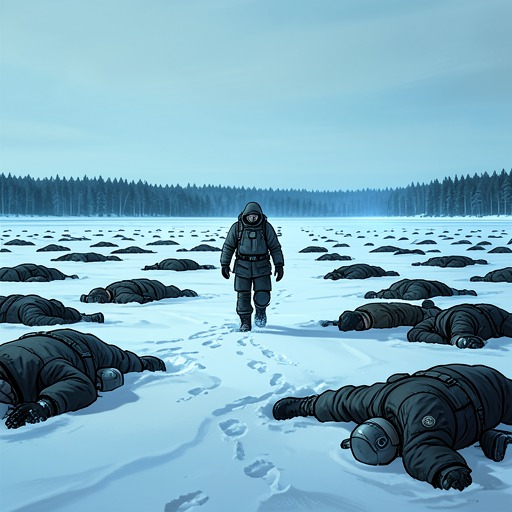
World War ZWhite Zone is the designation for territory overrun or effectively occupied by the living dead, a condition in which geography becomes a measure of political collapse. It is not merely a map label: it identifies places where infection, uncontrolled movement, and the failure or withdrawal of organized authority have made ordinary civilian life impossible, while also marking the boundary between populations protected by emergency institutions and those left outside them.
Definition and Geographic Meaning
White Zones are areas in which the undead have established a sustained presence, often across large connected regions rather than in isolated outbreaks. Varanasi is described as one of the hottest White Zones, a nexus of living death extending across almost the entire length of the Ganges. The river’s reputed healing power, later associated with its unusually high oxygenation rate, drew millions of pilgrims even after the danger was known. Their continued arrival turned religious devotion and inherited custom into fuel for the expanding infestation.
The same designation applies to places whose apparent natural defenses failed to protect them. Iceland had been a secure prewar society that saw no need to maintain a standing army, but the withdrawal of the American military left it unable to stop refugees arriving from Europe and western Russia. The result was the planet’s most heavily infested White Zone. Its transformation from an idyllic arctic haven into a landscape of frozen blood demonstrates that isolation can become a trap when a state lacks the forces, institutions, or preparations needed to control entry and resist sustained attack.
Population, Flight, and Containment
The existence of White Zones reshaped human movement. Before the outbreak, Nury Televaldi worked as an importer in Kashi, dealing in raw opium, uncut diamonds, and people; the crisis transformed smuggling into a far more lucrative business because professionals, farmers, and low-level officials suddenly needed escape routes. Rumors of an outbreak in Kashi were suppressed, but fear spread despite official silence. White Zones therefore generated both involuntary displacement and a market for clandestine movement, drawing people across borders regardless of their destination.
Those who escaped were not necessarily restored to ordinary citizenship. At the Yeroham resettlement camp, refugees experienced tents, overcrowding, guards, barbed wire, and the Negev heat as imprisonment. Medical personnel examined blood, skin, hair, saliva, urine, and feces every day, turning the body into the principal site through which authorities determined whether a person could enter a safer zone. Palestinian doctors and nurses made the examinations more bearable for many Muslim detainees, and a former detainee from Jabaliya in Gaza repeatedly assured the newcomers that accepting Israeli claims about the danger had been the right decision. The camp’s logic was simultaneously protective and coercive: a clean bill of health mattered more than carefully prepared passports, and only those cleared medically received access to subsidized housing, schooling, and employment.
White Zones and the Redeker Plan
White Zones also illuminate the moral architecture of the Redeker Plan. Its first principle was that the armed forces could not save everyone once the outbreak had spread too far. The military was to consolidate inside a defensible safe zone, preferably protected by mountains, rivers, or an offshore island, eradicate the infestation within that territory, and defend it against further attacks.
The civilian component was more radical. Only a small fraction of the population would be evacuated, partly to preserve a labor pool for postwar economic reconstruction and partly to sustain the government’s legitimacy by demonstrating that its leaders were protecting those inside the safe zone. The remainder would be concentrated in isolated areas and maintained as human bait. They were to remain alive, defended, and resupplied when possible so that the undead would stay fixed around them rather than follow the retreating army. White Zone conditions thus became not only a consequence of governmental failure but an instrument in a strategy that deliberately converted abandoned civilians into a defensive resource.
This arrangement embodies the extreme political ambiguity of the term. A population could be kept alive without being treated as fully protected members of the political community. Their survival was managed because it served military ends; their confinement made them useful precisely by denying them freedom of movement. White Zone policy therefore joins quarantine, surveillance, classification, and abandonment to the larger wartime question of whose lives could be preserved and whose could be exposed to danger for the sake of others.
Labor, Security, and the Borders of Recovery
The contrast between White Zones and recovering territories also appears in reconstruction. In the United States, officials found that more than 65 percent of the remaining civilian workforce was classified as F-6, with no valued vocation under the new conditions. A postindustrial economy had produced executives, representatives, analysts, and consultants, but reconstruction required carpenters, masons, machinists, and gunsmiths. The state responded by retraining the population and forcing the old division between white-collar and blue-collar work to yield to practical survival.
Neighborhood Security Teams extended this administrative remaking of daily life. Joe Muhammad, already employed at a recycling plant and using a wheelchair, was recruited for part-time neighborhood patrols. The program required members to inspect houses and remain outside in pairs when another member entered. His disability did not make the assignment irrelevant: the living dead came to the patrols rather than requiring defenders to chase them across fences and backyards. The episode shows how emergency institutions attempted to redefine usefulness, even while bureaucratic concern about political correctness could itself become an obstacle to mobilization.
Animal bodies were likewise classified and trained according to their usefulness in areas adjoining or crossing former White Zones. Military and police dogs were initially placed in cages and used to identify infected people by scent. Their terror response could make them attack handlers or one another, and many handlers lost hands, arms, or throats, but Israeli authorities deliberately relied on that instinct because it helped screen populations and may have saved millions of lives. Later programs trained selected dogs for coordinated missions and deployed escort animals against feral packs, which had made travel through low-infestation zones dangerous enough to abort long-range missions.
Ecological and Historical Consequences
The White Zone is not limited to human political geography. As the war continued, abandoned environments produced new animal dangers. Feral packs included dogs and the larger, more elusive F-lions, which were described as possibly descended from mountain lions or from house cats that had survived through extreme adaptation. Their growth was linked to ecological upheaval, including rats becoming a plentiful food source by living on corpses and breeding through ruined landscapes. The former boundaries between domestic, wild, and military life were consequently redrawn by the collapse of human control.
At sea, White Zone conditions and wartime mobilization devastated the whale population. Hungry boat people, fishing fleets converted from naval forces, and factory ships contributed to the destruction of California gray whales and other great whales. Helicopter-dropped torpedoes could deafen and disorient them without physically striking them, allowing factory ships to approach. California grays had once recovered from near-extinction and had become accustomed to human contact, but the war eliminated them along with blues, finbacks, humpbacks, and right whales. A few belugas, narwhals, and orca pods may have survived, yet pollution and depleted fish stocks threatened even those remnants.
White Zone therefore describes more than a temporary area of infestation. It records the conversion of inhabited places into zones of exclusion, the use of medical clearance and forced settlement to regulate escape, the sacrifice of populations under strategic calculation, and the long ecological aftermath of war. Its most important contrast is between the promise that life can be reconstructed inside protected territories and the knowledge that recovery depends on what remains outside them: people held as bait, animals turned into instruments, and landscapes whose losses may outlast the military victory.