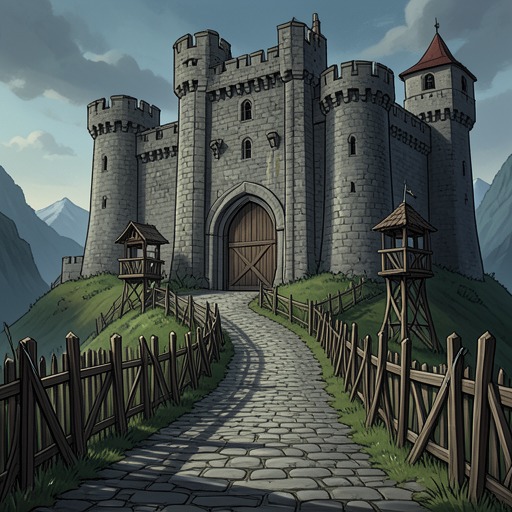
Windsor Castle
World War ZWindsor Castle is presented as the most complete expression of Britain’s wartime instinct to turn inherited structures into instruments of survival. Once a museum-like relic, it becomes a fortified refuge, a source of energy and supplies, a place from which modern defensive systems develop, and a symbol of national continuity. Its physical walls protect bodies, while the royal presence within it is made to protect the country’s sense of itself.
From Relic to Stronghold
Before the war, Windsor Castle was the largest inhabited castle in Europe, covering almost thirteen acres, but its historical grandeur did not automatically make it a modern military installation. Its defensive value emerged from the combination of old architecture and recent preparation. The castle possessed its own well, storage space capable of holding a decade’s worth of rations, and security improvements introduced after the fire of 1992 and later terrorist threats. Bulletproof glass, reinforced walls, retractable bars, and steel shutters concealed in windowsills and door frames turned a familiar public monument into a facility whose strength was largely invisible to the general population.
This transformation belongs to a wider pattern across Britain and Europe. Other defenders chose to remain in castles such as Bouillon, Spis, and Beaumaris rather than flee, while the inhabitants of Conwy used a castle and medieval town walls to live in relative safety during the stalemate years. Conwy’s access to the sea eventually made it a springboard for the retaking of Britain. Windsor therefore stands both as an exceptional site and as the most fully realized example of a broader wartime revival of fortress architecture: structures dismissed as obsolete regained a practical function when ordinary systems failed.
Material Self-Sufficiency
Windsor’s most remarkable wartime resource lay beneath it. Oil and natural gas had been discovered several kilometers below the castle’s foundations during the 1990s but had not been exploited because of political and environmental objections. Once the crisis began, those objections gave way to necessity. A contingent of royal engineers built scaffolding over the castle wall and extended it to the drilling site, siphoning crude oil and natural gas for the defenders. The engineering project demonstrated that survival depended not only on thick walls but also on the ability to connect an old stronghold to hidden, modern reserves.
The arrangement became a precursor to Britain’s fortified motorways. Windsor thus functioned as a prototype rather than an isolated sanctuary: the castle’s improvised infrastructure suggested how protected communities could be linked to energy supplies and made operational over the long term. Its resources also changed daily life inside the walls. Warm rooms and hot food offered a degree of comfort rare during the crisis, while the same defensive environment prepared the inhabitants for increasingly primitive combat once conventional ammunition was exhausted.
Fighting After the Bullets Ran Out
The defenders used Molotov cocktails and a flaming ditch to trap and burn Zed Heads. The method was acknowledged as inefficient, but it answered the immediate problem created when bullets ran out and the garrison was left with little more than an assortment of medieval weapons. Museums and private collections supplied maces, halberds, and double-bladed battle-axes; these were not decorative replicas but durable, tested weapons capable of returning to practical use.
The castle therefore reverses the usual direction of technological history. Instead of replacing the medieval past with modern weapons, the crisis forces modern citizens to retrieve the past and incorporate it into ordinary defense. The sight of civilians moving about with heavy weapons makes the social transformation concrete. At Windsor, survival is not a matter of preserving heritage behind glass; heritage is taken down, handled, and made to serve again. The speaker even became adept with a claymore, despite an appearance that did not suggest such expertise, making personal adaptation part of the castle’s larger conversion.
The Royal Decision to Stay
Windsor’s symbolic importance is inseparable from the decision of the queen to remain there. She refused to leave despite Parliament’s objections and insisted on staying “for the duration.” The speaker initially interpreted her resistance as misguided nobility or fear-based paralysis. He had urged her to leave for Ireland or the Isle of Man, or at least to move to supreme command headquarters north of the Antonine, especially because she had already contributed to national defense through the Balmoral Decree, which turned her estates into protected zones for anyone able to reach and defend them.
Her justification was, “The highest of distinctions is service to others.” The phrase links her decision to the example of her father, who refused to flee to Canada during the Second World War, and to her mother’s visits to civilians sheltering in London’s Underground stations during the Blitz. In this account, royal duty is not presented as privilege but as an imposed burden of representation. The monarchy must personify what is strongest and bravest in the national spirit, and its members must sacrifice themselves to sustain that example. Windsor’s walls and the royal presence within them consequently perform parallel functions: one shields the physical population, while the other sustains its moral and national identity.
Architectural and National Meaning
The castle’s wartime revival exposes the weakness of the prewar assumption that historical institutions were merely crumbling relics or tourist attractions. Both the castle and the monarchy appear obsolete until catastrophe tests them. Under pressure, each reawakens: the building provides water, stored provisions, security, energy, and defensible space; the sovereign provides a visible commitment to remaining with the population rather than escaping to safety.
Windsor is therefore more than a location in the military narrative. It is a compact image of reconstruction under siege, combining medieval walls, twentieth-century security technology, buried fossil fuel, improvised fire defenses, and royal obligation. Its significance lies in the way these layers reinforce one another. The castle survives because it can be materially adapted, but it matters because that adaptation is accompanied by a public act of service. In the book’s account, Windsor demonstrates that an apparently obsolete structure can become vital when a society is willing to restore, organize, and inhabit it—and that national continuity, like physical defense, must be actively maintained rather than assumed.