World War II
World War ZWorld War II is the book’s most important historical comparison point: a remembered war whose institutions, weapons, logistics, and civic ideals illuminate both the strengths of human civilization and the failures that nearly made the Zombie War its last conflict.
Historical Model of Total War
World War II is presented as a conflict won not simply by brilliant commanders or spectacular technology, but by the interaction of industrial capacity, natural resources, and logistics. The Allies could manufacture more ammunition, food, medical supplies, and other materiel than the Axis, draw on the resources of an entire planet, and move those resources to factories and finished products to the front. This framework becomes an implicit definition of conventional victory: armies are sustained by production, supplied through transport, and organized around the ability to concentrate material advantage.
The comparison becomes grimly ironic during the Zombie War. The living dead controlled most of the world’s landmass, while American war production had to depend on what could be harvested in the western states. Refugees filled the merchant fleet, fuel shortages left much of the navy idle, and overseas raw materials could no longer be assumed. In this reversal, the human survivors occupied the position once associated with the Axis: not morally equivalent to that enemy, but strategically confined, resource-poor, and forced to fight with a shrinking industrial base.
National Service and Moral Authority
The memory of World War II also shapes the book’s understanding of public duty. The British royal example is explained through the decision of the monarch to remain at Windsor “for the duration,” echoing the wartime refusal of her father to flee to Canada and her mother’s visits to civilians sheltering in London’s underground stations during the Blitz. The governing principle is stated as “The highest of distinctions is service to others.” World War II therefore functions not only as military precedent but as a reservoir of civic symbolism: national leaders are expected to embody endurance, sacrifice, and solidarity rather than merely issue orders from safety.
The same memory deepens the tragedy of the later war. The postwar United States is described as a volunteer society that expects a fair bargain between citizens and government. When soldiers were extended beyond their terms, reservists recalled after years of civilian life lost jobs and homes, and many returned to ruined lives—or did not return at all—the resulting sense of betrayal weakened the country before the undead offensive. World War II’s model of shared national sacrifice remains present in the culture, but it cannot simply be reproduced after citizens have learned that service may consume the private lives they believed they had been promised.
The Limits of Conventional Warfare
The book repeatedly contrasts World War II’s human-centered military logic with the biological and psychological immunity of the living dead. Conventional warfare depends on an enemy that can be shocked, awed, frightened, demoralized, or persuaded to withdraw. At the Battle of Yonkers, however, the army discovered that no amount of firepower could frighten the undead. The failure was not merely a technical defeat or an outdated weapons system; it was the collapse of a principle associated with warfare from tribal displays through blitzkrieg and the “Shock and Awe” campaign. The living dead could not experience the fear on which those methods depended.
World War II also supplies the image of a conventional army that can be organized around massed equipment and established defensive doctrine. At Yonkers, soldiers were placed on the ground behind sandbags and in fighting holes, while nearby roofs and high-rise windows that would have offered superior observation and protection were left unused. The positions were built around “cover and concealment,” even though concealment had little meaning against an enemy whose purpose was to approach directly. The battle thus exposes a military apparatus still preparing to fight the last human war, despite facing an opponent for whom many inherited categories had become irrelevant.
Industrial Learning and Resource Discipline
The later war does not reject the World War II lesson about production; it transforms it. Once the survivors understand that every weapon must be judged by its cost and effect, Travis D’Ambrosia develops the resource-to-kill ratio and a strategy based on it. Weapons and systems are no longer valued chiefly for sophistication or prestige, but for the number of undead they can destroy relative to the resources required to make, transport, maintain, and operate them.
Project Yellow Jacket demonstrates the danger of forgetting this discipline. Silicon Valley engineers promised a theoretical wonder weapon: millions of micro-missiles, roughly the size of .22 rimfire bullets, scattered from transport aircraft and guided by satellites into the brains of every zombie in North America. The proposal promised victory within forty-eight hours of deployment, and it appeared persuasive precisely because it resembled the technological fantasies often attached to World War II. Yet the resources poured into the project became an opportunity cost, diverting material that could have supported more practical production.
By contrast, the Standard Infantry Rifle and Cherry PIE ammunition embody a stripped-down, mass-war pragmatism. The rifle is accurate, reliable in mud, sand, and saltwater, and adaptable through interchangeable parts and barrels for long-range, midrange, or close combat. Its ammunition shatters inside an undead skull and destroys the brain without spreading infected matter or requiring wasteful bonfires. The lesson resembles the industrial logic of World War II, but the desired result has changed: not overwhelming technological spectacle, but durable equipment that can be manufactured, maintained, and used repeatedly across a vast campaign.
Logistics on a Continental Scale
The Continental Airlift extends the World War II model of industrial logistics into a fragmented post-collapse geography. The remaining human settlements exist as isolated zones, including civilian Blue Zones and strategically valuable Red Zones containing factories, mines, and power plants. Maintaining contact with these islands, processing their requests, coordinating with the Department of Strategic Resources, and prioritizing material for every delivery becomes the largest undertaking in United States Air Force history by statistical scale.
Its priorities reveal a further refinement of wartime economics. Consumables such as food and medicine are classified as dependency drops because they require continuing deliveries; tools, spare parts, and equipment for making spare parts are preferred as self-sustaining drops. The governing idea is to provide the means of production rather than permanent dependence, although autumn deliveries of fish, wheat, salt, dried vegetables, and baby formula remain necessary because winter can defeat even a sound theory. Specialists—including doctors, engineers, and Special Forces instructors—are also parachuted into communities that lack airstrips, often with no expectation of recovery. Logistics here is not an invisible support function but the mechanism by which isolated human enclaves remain alive and eventually become capable of offensive action.
Historical Memory as Method
World War II finally matters because it provides the book with a test for historical memory itself. The narrator’s original work for the United Nations Postwar Commission was partly deleted for being too intimate, too full of opinions and feelings. The official report preserved facts and figures, while the book restores the human accounts that make those facts morally legible. References to World War II therefore operate on two levels: they explain how societies remember war, and they demonstrate why technical history alone is insufficient.
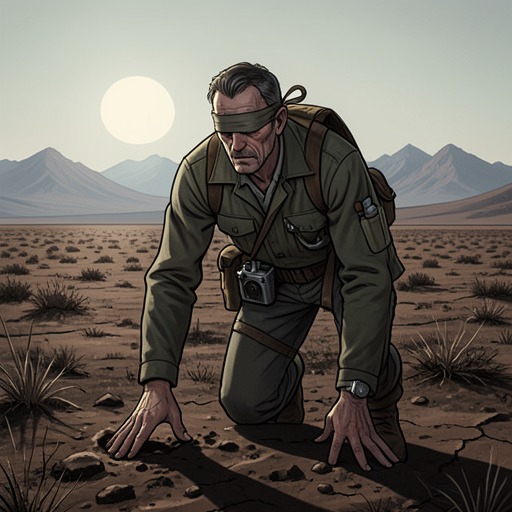
The reference is especially charged in the testimony of Tomonaga Ijiro, who recalls losing his sight at 11:02 A.M. on August 9, 1945, when the atomic bombing of Hiroshima destroyed his vision as he stood at an air-raid warning station near the Urakami Valley. As a hibakusha, he was treated simultaneously as victim, hero, symbol, and social outcast; his blindness made him feel like a burden during Japan’s reconstruction. His memory connects the technologies and casualties of World War II to a life that continues long after the battle, showing that historical events persist not only in military doctrine and national commemorations but in bodies, stigma, and the struggle to find a useful place in a rebuilt society.
World War II thus remains both a precedent and a warning. Its industrial system teaches the value of resources, production, and transport; its public culture offers ideals of service and shared endurance; and its weapons history foreshadows the temptation to trust technological marvels. Yet the Zombie War requires survivors to discard the comforting assumption that every enemy shares human limits. The new doctrine succeeds only when it preserves the practical lesson of World War II while abandoning its psychological and operational assumptions about what an enemy can fear, endure, or be persuaded to do.