Zombies
World War ZZombies are the central nonhuman force of the Zombie War, a population of reanimated human bodies whose hostility, persistence, and capacity to spread nearly cause humanity’s extinction. The name is scientifically disputed, but it becomes globally intelligible because it gathers the memories and emotions attached to the creatures more powerfully than any technical term. Across the conflict, Zombies are known as the living dead, the undead, Zack, Gs, ghouls, Zed Heads, and, in Japan, siafu; the changing vocabulary reflects both their worldwide reach and the human effort to make an unprecedented enemy legible.
Nature and Recognition
The first decisive understanding of Zombies comes from assembling scattered reports rather than from a single official revelation. Cases initially dismissed under plausible explanations show that the subjects are dead, hostile, and undeniably spreading. The most important early discovery is also the simplest: destroying the brain terminates them. The fact is treated less as supernatural magic than as a brutal biological logic, since the brain is the organ whose destruction also annihilates a living human being.
Their bodies can remain dangerous under conditions that should destroy ordinary human tissue. In a frozen northern setting, a Zombie is found buried in ice from the waist down while its head, arms, and upper torso remain alive, thrashing, moaning, and clawing toward the observers. When it lunges, its frozen lower body begins to snap, but the creature continues attacking until Jesika Hendricks crushes its skull with an iron crowbar. The scene makes persistence physical rather than abstract: cold can immobilize a Zombie without reliably ending its threat.
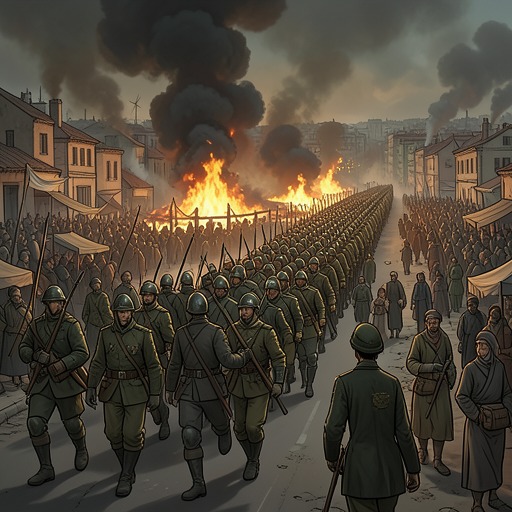
Zombies also create fear through the conversion of familiar human spaces into feeding grounds. In Kokura, fires and wreckage accompany swarms that crash through doors, invade apartments, and devour people hiding in corners or on balconies. A man’s golf club bends harmlessly around a Zombie’s head before several others pull him down. The attack spreads from apartment to apartment, turning neighbors’ cries, pounding doors, and collapsing barricades into a collective soundscape of entrapment.
Strategic Advantages
The military problem posed by Zombies is not merely their number but the fact that the basic conditions of human warfare do not apply to them. At one point, the opposing force is estimated at two hundred million. Yet even that figure understates the danger, because human armies must be bred, fed, and led, whereas Zombies require none of the three. They do not need recruitment, rations, fuel, water, air, or a functioning supply line. They cannot be surrounded and starved, and a group sealed away for years can emerge as deadly as before.
Zombies also reverse the ordinary arithmetic of attrition. When a human soldier kills another human, the opposing army loses a combatant; when Zombies infect a human, that person becomes a Zombie. Killing a Zombie leaves only a corpse, so the living can weaken while the dead may grow stronger by thinning human ranks. Their lack of a collective brain is itself an advantage: there is no president to assassinate, headquarters to strike, chain of command to disrupt, or leader whose death might produce surrender. Each Zombie functions as an independent, automated unit.
Their most devastating psychological characteristic is the absence of fear. Human armies have historically tried to break an enemy’s spirit through force, spectacle, and shock. Zombies cannot be shocked or awed, and this failure rebounds upon the humans using it. Outside New York City, the inability to frighten Zack allows the enemy to frighten the soldiers and the public instead. No matter how many Zombies are killed, they do not retreat because they do not experience fear as a biological limit.
The same difference separates Zombies from the human meaning of total war. Human populations eventually reach emotional and physiological limits, even when governments proclaim that every person is committed to victory. Zombies do not negotiate, surrender, sleep, or reach a breaking point. Every one of them is devoted, every second of every day, to consuming life. Humanity therefore faces an enemy whose total commitment is not ideological rhetoric but a bodily condition.
Human Countermeasures
The recognition of Zombie physiology reshapes weapons design. The Standard Infantry Rifle is valued for reliability, accuracy, and adaptability, but the essential ammunition is Cherry PIE, a NATO 5.56 round whose pyrotechnically initiated explosive charge shatters inside a Zombie’s skull and destroys the brain. Because it avoids spreading infected gray matter and reduces the need for large disposal fires, it links tactical effectiveness to the wider demands of sanitation and burial.
Other responses reveal the danger of pursuing spectacular solutions instead of durable ones. Project Yellow Jacket promises a theoretical victory within forty-eight hours through millions of satellite-guided micro missiles, each roughly the size of a .22 rimfire bullet, aimed at the brain of every Zombie in North America. The project consumes resources that could have supported more practical production, and its failure becomes a lasting lesson in the cost of mistaking technological fantasy for a sustainable war system.
The eventual emphasis falls on the resource-to-kill ratio and on tools that can be manufactured, supplied, repaired, and used repeatedly. The Continental Airlift supports isolated military, industrial, and civilian zones, prioritizing self-sustaining drops such as tools, spare parts, and equipment for making further spare parts over deliveries that create permanent dependency. This strategy does not make Zombies less dangerous; it makes human survival less vulnerable to the enemy’s refusal to exhaust itself.
Ecology and Other Species
The Zombie crisis transforms relations among species as well as relations among human communities. Refugees fleeing through the Himalayas observe hundreds of monkeys climbing over vehicles, people, and telephone poles as the dead fill the streets. The monkeys appear to recognize the danger before many humans do, scattering from grasping arms and sometimes escaping without waiting to be attacked. Their movement through the jammed mountain road contrasts with the human crowd’s attachment to luggage, boxes, and even a desktop computer, while vehicles tip over and thousands struggle without a guardrail.
Dogs become military instruments and partners. At first, they are used for triage because they can identify infection by scent; the Israeli method sends people past dogs kept in cages, since otherwise terror can make the animals attack subjects, one another, or their handlers. Many handlers lose hands, arms, or throats, but the same instinct that makes the dogs dangerous also helps detect the infected and may save millions of lives.
Later training attempts to turn that instinct into disciplined service. Dogs must begin young, because even highly disciplined prewar veterans are described as hardwired berserkers. Pups are tested behind wire mesh with Zack on the opposite side: some whimper or howl and collapse, while others hold eye contact, stand their ground, bare their teeth, and growl. Mixed-breed dogs are preferred over pure bloods because physical constitution and mental stability matter more than appearance. Escort dogs then make long-range missions possible in territory threatened not only by Zombies but by feral dog packs; Perdy and Pongo repel fourteen such attacks and fight twice.
The postwar landscape also produces predators that are not Zombies. Feral survivors can be fast and intelligent, while F-lions—large cats described as part mountain lion and part Ice Age saber cat—hunt warm blood among ruins. Their growth is associated with an altered ecology in which rats replace cattle as abundant prey and anything capable of hunting them must become more formidable. Thus the Zombie catastrophe does not simply create one monster species; it reorganizes food chains, landscapes, and human methods of movement.
Consequences and Significance
Zombies expose the limits of the military “book of war” and compel humanity to write a new one. Their lack of logistics makes conventional siege logic useless, their lack of leadership makes decapitation strikes meaningless, and their immunity to fear defeats the psychological assumptions behind shock warfare. The human response must therefore combine brain-targeting weapons, disciplined retreat, industrial prioritization, resupply networks, and the long-term construction of communities capable of sustaining themselves.
Their victory over human assumptions is also ecological. Naval forces and refugee fleets convert the sea into a resource frontier, and whales become casualties when hungry boat people and fishing fleets pursue them with factory ships and torpedoes. California grays, once recovering from near-extinction and accustomed to allowing humans close enough to touch them, disappear along with blue whales, finbacks, humpbacks, and right whales. A few belugas, narwhals, and orca pods may survive, but viable populations are uncertain. The Zombies are therefore not only killers of people; by driving extraction, displacement, and war across the planet, they help produce the permanent loss of species that humanity cannot recreate.
The creatures’ deepest significance lies in the way they make human vulnerability visible. They are frightening because they are tireless, but also because every human system—army, city, household, ecosystem, and memory—must confront what happens when its assumptions about death, exhaustion, command, and scarcity no longer hold. Zombies are a biological enemy, a military impossibility, and a measure of the consequences of treating war as a contest between forces that share human limits.