Buto
World of Warcraft Battle For Azeroth, Gameplay, Tips, Characters, Builds, Leveling, Raids, Weapons, Items, Game Guide UnofficialThe Horde is one of the two major factions whose opposition gives Battle for Azeroth its defining dramatic and mechanical structure. After the Legion era concluded the conflict against the Burning Legion, the expansion turns its attention back to Azeroth and to the struggle between the Horde and the Alliance. The Horde therefore functions simultaneously as a political side in the story, an opposing player community, and a boundary that determines how characters meet, cooperate, and fight.
Identity and Conflict
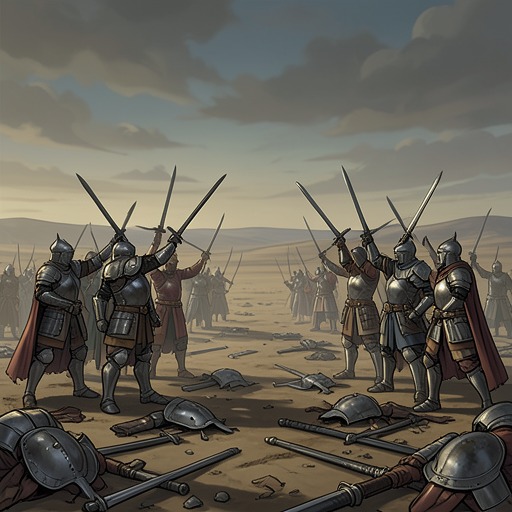
The expansion presents the Horde–Alliance conflict as its central subject rather than beginning with a single universal villain. Both sides possess prominent characters who have risen to importance, making the factional confrontation itself the principal source of tension. This shift gives the Horde a role within a two-sided system: its meaning is continually defined through opposition to the Alliance, and the expansion’s major features are designed around that relationship.
The factional structure also informs cooperative content. In Island Expeditions, a three-player team competes against three enemies represented by advanced artificial intelligence. These opponents are designed to behave in ways resembling players, pursuing roles and filling class functions rather than acting as passive targets. The factional enemy is thus translated into a tactical presence that can pressure a team, pursue resources, and alter the course of a short scenario lasting roughly 15 to 20 minutes.
War Mode and the Factional World
The conflict does not preserve the older PvP-server structure. Existing PvP servers are converted into regular servers, but world PvP is not removed. Instead, War Mode allows a player on any server to enter a dedicated section of the world populated only by participants who have activated the same mode. There, a character can attack players from the opposing faction and can be attacked in return.
This arrangement turns faction identity into a selectable risk condition. Activating War Mode places the player in a more exposed version of the world, where the Horde–Alliance divide becomes an immediate possibility of violence rather than merely a background allegiance. The system also offers compensation: participants receive bonus experience and credit, unlike the earlier form of world PvP, which provided no comparable reward beyond the satisfaction of defeating enemies. The Horde consequently operates both as a narrative opponent and as a practical source of danger, opportunity, and calculation.
Systems, Equipment, and Cross-Boundary Play
The factional boundary remains important even as other systems are redesigned. Heart of Azeroth replaces the Artifact weapons associated with the Legion era. By upgrading the medallion with Azerite, players unlock new traits on other armor pieces and gain additional class customization. Although this equipment system is not exclusive to the Horde, it belongs to the same expansion environment in which faction conflict structures play, and it gives characters on either side a common progression framework within an opposed world.
Other progression tools are deliberately more portable than faction allegiance. Heirlooms provide level-appropriate statistics and experience bonuses, including roughly 45 percent when the relevant leg, chest, shoulder, head, and back pieces are combined, with a possible additional ring bonus of about 5 percent. Once purchased, most heirlooms are bind on account: they can be accessed by a player’s other characters even when those characters are on another server, belong to the opposite faction, or satisfy both conditions. The contrast is revealing. The Horde marks a durable social and combat division, while account-bound equipment allows the player’s progression resources to cross that division.
Communities and Social Organization
The Horde’s player population is also situated within an evolving social infrastructure. Guilds traditionally connect players on the same server, but Communities are paired with guilds in the new expansion as a less geographically restricted form of organization. Communities have roles and rosters, are not tied to a particular server, and allow a player to belong to several at once.
This flexibility changes how factional belonging can be organized without erasing the faction itself. Communities do not provide guild leveling features, and players do not automatically unlock guild achievements merely by grouping with community members. The system therefore separates social connection from the older guild progression structure: players can maintain broader networks while the Horde and Alliance continue to define the antagonistic sides of the world.
The same tension appears in the Recruit-a-Friend feature. New players can receive assistance from friends already playing, and a recruiter and recruit earn approximately a 50 percent bonus from quests and kills when they are in the same party or within about 100 yards of one another, provided their characters are within roughly four levels and below level 90. The recruiter can also gain levels from the recruit, receiving one level for every two levels the recruit gains, as well as potentially earning an epic mount and battle pets over a longer period. These rules make progression dependent on coordinated proximity and relationship, even while account-bound heirlooms and cross-server Communities widen the spaces through which a player’s network can operate.
Narrative and Practical Significance
The Horde’s importance lies in the way Battle for Azeroth makes faction conflict permeate both story and procedure. The expansion raises the level cap to about 120 and adds new zones, dungeons, raids, and features, but its organizing premise is the renewed confrontation between the Horde and the Alliance after the conclusion of the Legion storyline. That premise is then reproduced through artificial opponents in Island Expeditions, selectable participation in War Mode, server changes, and the division between opposing player groups.
At the same time, the game’s infrastructure repeatedly complicates the boundary. The Hearthstone sends a character back to a chosen inn and can sharply reduce travel during leveling; TomTom supplies a large navigational arrow; and mods improve access to quests and movement. These tools help players manage the world efficiently regardless of faction, while War Mode restores a specifically factional space in which efficiency is exchanged for exposure and reward. The Horde therefore represents a layered form of belonging: it is a side in the expansion’s political story, an enemy category in cooperative play, a possible target in a dangerous world space, and one pole of a social order increasingly connected by systems that can cross server and faction lines.