Redridge Mountains
World of Warcraft Battle For Azeroth, Gameplay, Tips, Characters, Builds, Leveling, Raids, Weapons, Items, Game Guide UnofficialRedridge Mountains is a recommended early-leveling location for Alliance players in World of Warcraft, not an isolated destination but a practical part of a connected route through familiar zones. Its decisive significance lies in how its compact geography and quest flow help reduce travel while keeping a new character moving steadily through the level 1–60 experience.
Setting and Route
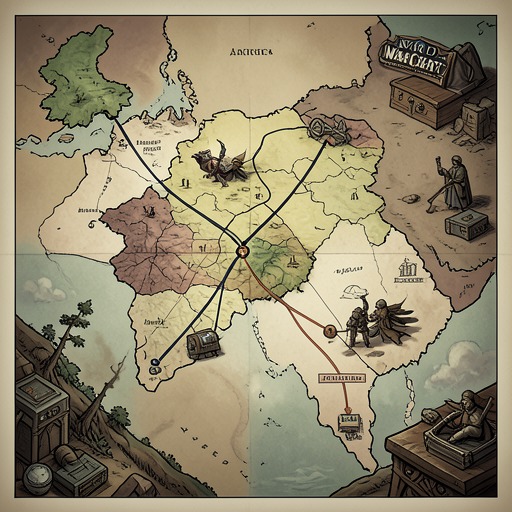
Redridge Mountains appears in the suggested Alliance progression that begins in Stormwind and continues through the paired Stranglethorn zones, Duskwood, Redridge Mountains, and Westfall. These areas are grouped together because they are adjacent and offer a notably good quest flow. The recommendation treats geography as a leveling tool: staying within a connected cluster allows players to spend more time completing quests and defeating monsters and less time crossing the world for small amounts of travel experience.
The location therefore functions within a broader route rather than as a self-contained leveling plan. The guide advises players to select zones they want to experience and remain with them until their quests are complete, making Redridge Mountains useful precisely because it fits a coherent chain of nearby areas. This organization also reflects the game’s level-scaling approach, which allows zones to remain relevant within defined level ranges instead of forcing every character into one rigid order.
Leveling Function
For Alliance characters between levels 1 and 60, Redridge Mountains contributes to a progression designed around efficient movement and manageable quest density. The guide identifies the surrounding route as compact, adjacent, and equipped with good quest flow, three qualities that matter because traveling yields comparatively little experience. The zone’s value is consequently practical as well as geographic: it supports repeated cycles of quest acceptance, combat, reward collection, and movement without requiring excessive backtracking.
That efficiency becomes more important under the revised leveling structure. Older content receives level scaling within specified ranges; Northern Barrens, for example, is described as scaling from levels 10 to 60, with its challenges and rewards adjusting to the character. Although Redridge Mountains is not assigned a specific numerical scaling range in the evidence, it belongs to the wider environment in which players can choose zones more freely and still pursue meaningful progression. The guide presents the new process as slower for a new character than before, but also more varied and engaging because the route is less narrowly prescribed.
Travel and Player Infrastructure
The guide’s advice for Redridge Mountains is reinforced by systems that make movement between quest hubs more efficient. Whenever a new area is visited, players are advised to set the Hearthstone at an inn inside the largest quest hub, settlement, fort, or town. After completing several quests, teleporting back to that hub is preferable to returning on foot or by mount. Applied to a zone in a connected leveling route, this practice turns the Hearthstone into a logistical instrument: it shortens the return journey and preserves time for questing.
Guild membership can improve the same routine through the Hasty Hearth perk, which reduces the Hearthstone’s 30-minute cooldown by about 50 percent. The guide even presents joining a guild of unfamiliar players as worthwhile when that perk is available, because the resulting reduction in travel can outweigh the awkwardness of entering an unknown social group. Redridge Mountains thus sits inside a network of practical systems—quest hubs, teleportation, mounts, and guild benefits—that collectively shape how its terrain is experienced.
Rest, Risk, and Progression
Leveling through Redridge Mountains can also be supported by the game’s resting-area rules. Inns, capital cities, private instanced locations such as class order halls or garrisons, and other designated resting areas display a Zzz icon on the character portrait. Logging out there can happen immediately rather than after the usual wait of about 20 seconds, and accumulated rested experience provides a 200% experience bonus, increasing with time spent logged out; when active, the experience bar turns blue.
The guide also describes optional risk-and-reward systems that may affect a character while moving through any leveling zone. War Mode is off by default but can be activated in the capital city of the player’s faction. It grants roughly a 10% increase to quest rewards, including experience, while exposing the character to attacks from other players. Whether that benefit is worthwhile depends on the activity of opposing players in the zones being visited, so Redridge Mountains is presented not only as a route choice but as part of a larger calculation involving travel efficiency, accumulated experience, and exposure to danger.
Wider Progression Context
The early route through Redridge Mountains forms the foundation of a leveling journey that later changes its recommended geography. At levels 60–70, the guide advises skipping Outland in favor of newer areas in Northrend, including Storm Peaks, Grizzly Hills, and Sholazar Basin. For levels 80–90, it recommends moving to Pandaria, with Kun-Lai Summit and Valley of the Four Winds singled out as efficient choices. Against this later progression, Redridge Mountains represents the compact, low-level phase in which route planning and adjacency are especially valuable.
Its narrative and mechanical importance therefore comes from ordinary repetition rather than a singular dramatic event. The zone exemplifies the guide’s central leveling logic: choose a practical region, follow its quests to completion, minimize unnecessary travel, use the Hearthstone intelligently, and combine zone selection with systems that increase experience or reduce downtime. Redridge Mountains is significant because it makes that logic visible in geographic form, as one carefully placed link in the Alliance’s early journey through Azeroth.