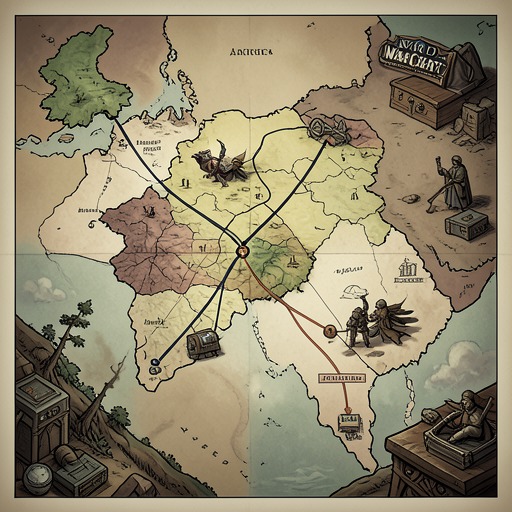
Sholazar Basin
World of Warcraft Battle For Azeroth, Gameplay, Tips, Characters, Builds, Leveling, Raids, Weapons, Items, Game Guide UnofficialSholazar Basin is a Northrend leveling zone recommended for characters navigating the demanding transition from level 60 to level 70. Its decisive significance in the guide is practical rather than narrative: it represents the advice to bypass the older Outland content and choose newer Northrend zones, alongside Storm Peaks and Grizzly Hills, when efficiency and a more suitable leveling route matter.
Definition and Setting
Sholazar Basin belongs to Northrend, the region identified as the preferable destination for the level 60–70 portion of progression. The guide describes this stage as one of the game’s more difficult stretches because players must move through older content. Against that backdrop, Sholazar Basin functions as a recommended alternative to Outland rather than as an incidental stop on a fixed route.
The zone also fits the expansion’s broader return to level scaling. Older content is described as scaling within defined level ranges, with enemies, challenges, and rewards adjusting to the character’s level; Northern Barrens is given as an example of a zone scaling from levels 10 to 60. This system makes the choice of leveling area more flexible, although the guide still distinguishes Sholazar Basin and other newer Northrend zones as especially suitable for the 60–70 interval.
Role in the Leveling Route
The guide places Sholazar Basin within a specific recommendation: at level 60–70, players should skip Outland and investigate newer zones in Northrend, including Storm Peaks, Grizzly Hills, and Sholazar Basin. The recommendation is shaped by contrast. Outland represents the older route through this stage, while Sholazar Basin is part of the newer content the guide considers more worthwhile for continued progression.
This advice reflects a larger leveling structure in which players can select zones and remain in them until their quests are complete. Although the expansion raises the level cap from the former 110 to about 120 and restores level scaling across older content, the guide does not treat every available region as equally efficient. Sholazar Basin is therefore both an open destination within a flexible system and a deliberate choice within an advised progression path.
Systems and Player Choices
Sholazar Basin is connected indirectly to the guide’s wider efficiency practices. Players are encouraged to minimize unnecessary travel because movement grants little experience, to select a zone and complete its quests, and to set the Hearthstone at an inn inside the largest quest hub whenever they enter a new area. These recommendations turn a leveling zone into an operational space organized around quest completion, travel reduction, and rapid return to a settlement.
The guide also frames progression as a series of risk-and-reward decisions. War Mode is off by default but can be activated in a faction capital city to provide roughly a 10 percent increase in quest rewards, including experience; once active, however, the character can be attacked by opposing players and may be killed. A player choosing Sholazar Basin must therefore weigh the value of the bonus against the activity of opposing factions in the zones being visited. The zone itself is not described through a particular battle or landmark in the supplied material, but it participates in this wider system of calculated leveling choices.
Connections to Expansion Mechanics
Sholazar Basin appears in a guide shaped by the transition from the Legion era to the Battle for Azeroth era. Battle for Azeroth raises the level cap to about 120, adds new zones, dungeons, raids, and features, and places renewed emphasis on the conflict between the Horde and the Alliance. At the same time, it preserves established activities such as battleground PvP, arena PvP, raids, standard dungeons, and Mythic+ dungeons.
The expansion also replaces Artifact weapons with the Heart of Azeroth, which is upgraded through Azerite and unlocks new traits on other armor pieces. That change matters to the leveling context because progression through zones is no longer simply movement toward a higher character level; it also supplies the broader advancement framework in which equipment customization and rewards operate. Sholazar Basin is named as a route recommendation within that changing system, not as an isolated piece of geography.
Significance in the Guide
Sholazar Basin’s significance comes from the precision of its placement. The guide does not present it as a universal destination or claim that it contains a unique decisive event. Instead, it uses the zone to make a concrete judgment about progression: when characters reach the 60–70 range, newer Northrend content should be preferred over Outland, with Sholazar Basin among the recommended choices.
That recommendation captures the guide’s overall philosophy. Flexible level scaling expands the number of viable routes, but practical advice narrows those possibilities according to age of content, travel burden, quest flow, safety, and reward. Sholazar Basin consequently stands as a representative leveling space where player freedom is preserved while efficiency-oriented guidance continues to shape the route.