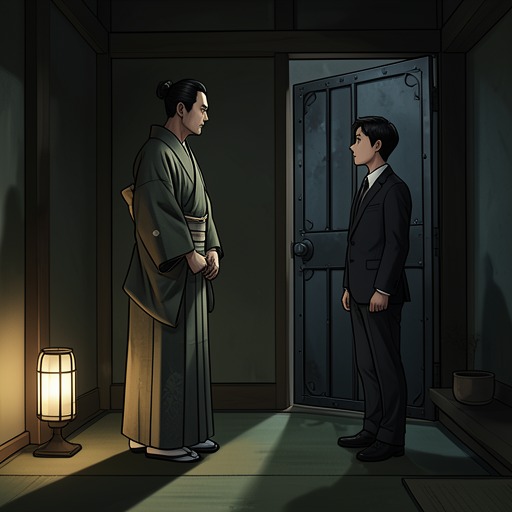
Bond Ordered to Assassinate Shatterhand
You Only Live TwiceBond Ordered to Assassinate Shatterhand is the turning point at which James Bond’s personal assurance to Tiger Tanaka becomes a covert mission authorized at the highest level of the Japanese government. The assignment sends Bond to Fukuoka and ultimately into Death Castle to kill Dr Guntram Shatterhand, a Swiss botanist whose lethal garden has already claimed hundreds of lives. It also makes Bond’s competence a test of whether Britain deserves access to MAGIC 44 intelligence.
The promise becomes a state secret
Tiger tells Bond that, during their earlier discussion of MAGIC 44, Bond had offered to perform any personal service Tiger might require. Bond corrects the scope of that offer: he had not claimed official authority, but had said he would act on his own responsibility for Tiger. Tiger accepts the distinction as sufficient. He has taken the proposal to the Prime Minister, who instructed him to proceed and to keep the matter secret among the two of them and Bond. A personal pledge has thus acquired national stakes, while its secrecy keeps Bond’s role outside ordinary channels.
Tiger makes the order explicit: Bond is to leave the next day on the 12:20 train from Tokyo main station, travel to Fukuoka on Kyushu, and stop expecting to return to his hotel or see Dikko. From that moment, Tiger says, Bond is under his personal orders. Bond initially resists the abrupt change and asks what Tiger is talking about; he had expected to continue their discussion the following day. The command transforms that conversation into an operation with a destination, timetable, and chain of authority.
A test of Britain as well as Bond
Before naming the task, Tiger challenges Bond with a harsh account of Britain’s postwar standing. He argues that Britain has lost its empire, mishandled the Suez Crisis, and weakened its capacity to govern. The criticism is not simply background to the mission: Tiger explains that he had made much the same case to the Prime Minister. In response, the Prime Minister proposed testing Bond. Success would demonstrate that Britain still possessed an elite capable of safeguarding valuable intelligence; failure would give Japan grounds to refuse the request.
Bond answers the provocation angrily, defending the British people while acknowledging the strains of war, domestic politics, and the rapid loss of the colonies. Tiger then reveals that the attack was deliberate: he wanted to see whether Bond’s celebrated English stoicism would break under pressure. Bond is still smarting from the exchange when he asks what the test entails, suspecting a piece of samurai theatre. Tiger calmly confirms the ceremonial quality of the challenge, then gives its stark terms: Bond must enter Death Castle and slay the dragon within. The metaphor makes the assignment sound like a trial from legend, but the target and intended killing are real.
The assassination rationale and its costs
Tiger’s case for sending Bond rests on both the target’s actions and the political limits on who can act. He regards the doctor as a purveyor of death, whether driven by madness or amusement, and says that the assassination has been officially agreed to. Japan cannot carry it out through a Japanese agent for policy reasons, so Bond’s foreign status makes him useful. Tiger also points to the reported toll: the doctor has killed five hundred fellow creatures. When Bond objects that he has nothing personal against the Swiss botanist, Tiger treats that death toll as sufficient reason for a good man to oppose him.
Bond’s role is therefore not presented as a private vendetta. He is being recruited to undertake an operation the Japanese authorities have approved but cannot openly assign to one of their own. Tiger anticipates the danger as well as the political convenience: if Japanese police arrest Bond, a cover story involving foreign intelligence services can be prepared, followed by trial and sentence and then a quiet removal from the country. If the operation fails, the doctor or his guards may kill him. The plan offers no assured extraction, only a way to disguise Japanese involvement if Bond is caught alive.
Bond also challenges the exchange itself. He has been asked to risk his life in return for MAGIC 44, and Tiger explicitly asks whether that bargain quiets his conscience. Bond reluctantly agrees that it does. He nevertheless calls the operation impossible, reasoning that a foreigner in Japan would be recognized at a distance. Tiger says that obstacle has been addressed and that the first step is to alter his appearance. The exchange ties intelligence cooperation to personal danger: Bond’s commitment helps Japan assess his fitness, while his success is meant to establish that British hands can be trusted with sensitive material.
Disguise, concealment, and departure
Tiger’s preparations begin before Bond reaches Fukuoka. At dawn, they travel through Tokyo in a black Topoyet toward a discreet bathhouse, where Bond is to receive his first treatment and rest before the train journey. Tiger describes the journey south as deliberately slow, with instruction in Japanese customs and folkways so that Bond will make fewer mistakes when the decisive moment comes. The transformation is practical rather than instantaneous: concealment depends not only on appearance but also on learning how to behave.
At Tokyo main station, the change is visible in detail. Bond’s face and hands have been tinted light brown; his black hair is oiled, cut short, and combed into a fringe, while the outer corners of his eyebrows have been shaved to angle upward. He wears an ordinary white cotton shirt, a centered black tie with a rolled-gold pin, loose black trousers, inexpensive plastic sandals, and dark-blue nylon socks. A used Japan Air Lines overnight bag holds spare clothes, cigarettes, and cheap toiletries. His wallet contains only five thousand yen in small notes, and his pocketknife obeys the Japanese legal limit of a two-inch blade; tissues replace the handkerchief that would mark a familiar Western habit.
The disguise is joined to a false itinerary. Bond’s hotel belongings are to be transferred to Dikko’s apartment, and Dikko is to tell Bond’s chief that Bond has gone with Tiger to a MAGIC establishment for several days. Dikko believes that account, while Tiger’s own department knows only that Tiger is away on a mission to Fukuoka and does not know Bond is accompanying him. Their actual route takes them first by express to Gamagori, then by evening hydrofoil across Ise Bay to Toba, where they will spend the night. This separation of what different people know protects the mission even before Bond reaches its target.
The departure also begins Bond’s practical education. On boarding the express, Bond politely waits for women to pass; Tiger rebukes him and instructs him not to give way to women, while allowing that he may show consideration to very old men. Bond’s sarcastic reply registers the friction between his habits and the role he is being prepared to perform. The assassination commission thus begins with more than a change of clothes: it requires Bond to travel under an assumed appearance, observe unfamiliar conventions, and accept that every small mistake could compromise the approach to Death Castle.