Bond kills Blofeld and destroys the Castle of Death
You Only Live TwiceBond kills Ernst Stavro Blofeld and escapes the Castle of Death as it is destroyed, but the apparent victory ends with Bond falling from a punctured balloon toward the sea. The confrontation turns Blofeld’s claim that the castle’s killings are a public service into a fight for survival: Bond defeats him, acts on a plan to close a mechanism in the torture room, and improvises an escape that carries him above the very destruction he cannot control.
The confrontation in the castle
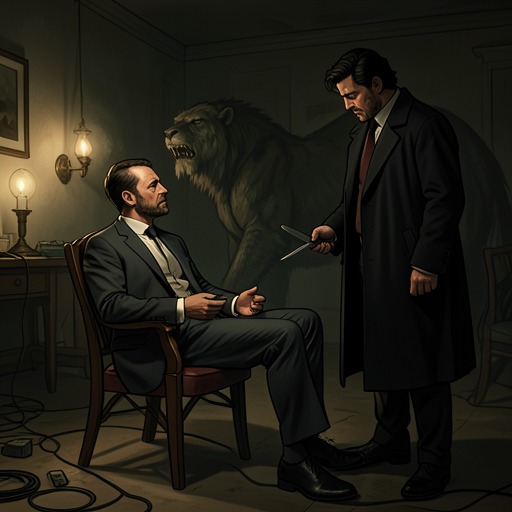
Blofeld offers Bond a choice between being hacked apart in a brawl and submitting to what he calls an honourable execution. He raises his sword, its blade catching the lamplight, while Irma Bunt sits near a bell-push. Bond has already noticed a guard’s stave left standing in a shadowed corner. Because Bunt could summon help, Bond makes her his first target: he lunges for the stave and strikes her on the side of the head. She falls from her chair and lies still, while Blofeld’s descending sword misses Bond by inches.
The stave gives Bond reach, but Blofeld has the advantage of a sword and skill in its use. Bond thrusts the stave into Blofeld’s chest and drives him against a wall, only for Blofeld to surge back with sweeping attacks. Bond tries to keep both himself and his weapon clear of the blade; a blow to the stave could remove the extra length on which his defence depends. He hits Blofeld’s legs and then his right shoulder, targeting the sword arm, but Blofeld’s parry cuts a foot from the stave. With his weapon shortened, Bond has to deflect the sword itself and retreat under repeated thrusts.
Blofeld presses his advantage, and Bond is wounded when the sword catches his ribs and later passes across his stomach. Backed against a wall, Bond uses its position to spring into a counterattack, knocks the sword aside with the stave, drops the stave, and seizes Blofeld by the neck. Blofeld’s sword strikes Bond’s side as Bond holds on. The sword eventually clatters to the floor; Blofeld claws at Bond’s face, but Bond continues to choke him until his eyes roll upward and his body goes limp. Even after Blofeld falls, Bond remains kneeling over him, gripped by the violence of the struggle, until he slowly regains awareness.
The unfinished task
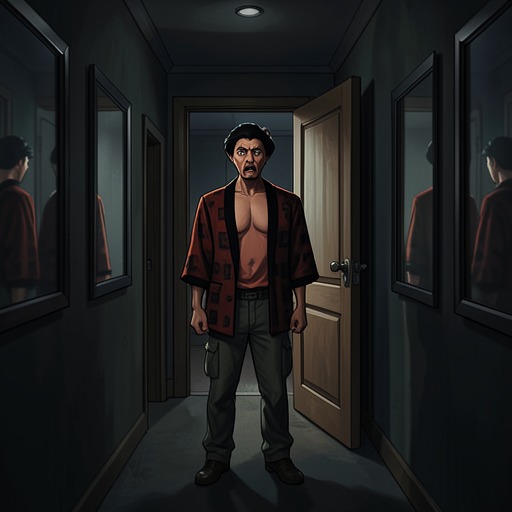
Bond’s return to himself is marked by the image of the golden dragon on Blofeld’s black silk kimono. His head hurts, and he struggles to recover the plan he had formed. He picks up Blofeld’s sword and goes down the stone passage to the torture room. The clock shows five minutes to midnight. Beside the throne is the mud-spattered wooden box Bond remembers; he hacks it open and finds the large wheel he expected. Kneeling, he turns it repeatedly until it is closed.
The sequence makes Bond’s escape more than a flight from the guards: he stops to complete this task even while injured and disoriented. The narrative does not explain in this passage what the wheel controls or establish that closing it causes the destruction that follows. It does show Bond acting on prior knowledge, then immediately trying to get out. His route through the castle is blocked by guards, so he tears aside a curtain and smashes a window with the sword. He takes Blofeld’s sumptuous kimono from the corpse to cover himself and climbs out barefoot, picking his way among the broken glass. Bunt remains on the floor, breathing heavily in a drunken snore; the blow has left her incapacitated, not confirmed dead.
Escape on the warning balloon
Outside, Bond discovers that the balustraded terrace is only a short, enclosed ledge, with no way along it to safety and a sheer hundred-foot drop to the gravel below. A whistle from above draws his attention to the moored helium balloon. Its warning banner is a long strip of framed cotton, held taut by the balloon. Bond recalls a scene from an old Douglas Fairbanks film in which a hero swings across a hall by leaping for a chandelier, and reckons that the balloon might bear a man as well as the banner.
Hearing a clamour inside the castle, Bond acts before he can know whether his idea will work. He tests the mooring line, climbs onto the railing, cuts a foothold in the cotton banner, grips the rope, and uses Blofeld’s sword to cut himself loose before jumping into space. The balloon carries him gently over the moonlit park and its glittering, steaming lake, then toward the sea. Instead of dropping, he rises: the helium sphere bears his weight. For a moment, an escape devised from whatever materials are at hand has lifted him clear of the castle and its guards.
Destruction and unresolved fate
From the balloon, Bond sees blue-and-yellow fire flicker from the castle’s upper storey. His hands and feet ache from holding on, and an impact strikes the already painful side of his head. The castle then seems to sway and dissolve in the moonlight: the top storey crumbles, followed by the lower ones, before a vast jet of orange fire shoots upward and a blast of hot wind and thunder reaches him. The narration gives the destruction as Bond experiences it from the air, without identifying who or what caused the blow that hit him or explaining the precise cause of the castle’s collapse.
Bond is too hurt to make sense of the disaster or care about it. A bullet has punctured the balloon, which rapidly loses height. Below him, the sea appears to offer a softer landing than the castle grounds; Bond releases his grip and plummets toward it. The episode therefore closes on two linked reversals: Blofeld is dead and his castle is falling, but Bond’s escape has become another immediate fall. His fate is left unresolved in this scene.