Britain
You Only Live TwiceBritain is presented as both the intended target of a Soviet nuclear-demonstration strategy and a diminished ally whose security depends on access to intelligence held elsewhere. The intercepted Soviet plan makes the country’s geography a measure of its vulnerability: one missile against London would devastate much of the south, while a second near Aberdeen would destroy Britain and all Ireland. The threat is therefore not only military; it is designed to turn Britain’s exposure into political leverage.
Intelligence and Britain’s access
The intelligence at the center of the crisis reaches Britain indirectly. Under Central Intelligence Agency guidance, Japanese cryptographers have built advanced codebreaking machines and, for the preceding year, have read high-level Soviet traffic from Vladivostok and eastern Russia, including diplomatic and military communications. M explains that the Japanese hold this material and that Britain has not received it directly: the United States treats the Pacific as its own preserve, and its intelligence chief has tightened restrictions on sharing.
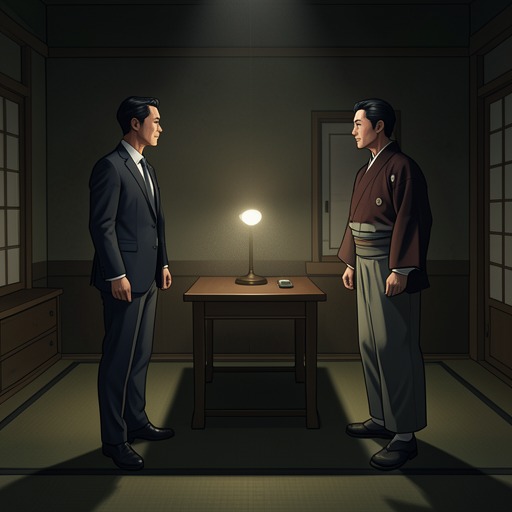
The problem is not simply whether information eventually reaches London, but what happens to it in transit. Tiger Tanaka says the United States has assured Japan that information of vital importance to other allies will be passed on without exposing the source. James Bond counters that sanitizing and rewriting a message strips away crucial value: the evidence that the words are the enemy’s own, rather than a report from a supposedly reliable intermediary. His concern is that Washington might send Britain only a garbled version—or withhold the warning if disclosure does not suit its interests.
The intercepted document is marked GOKUHI, which Tanaka confirms means Top Secret. It instructs Soviet diplomatic posts to destroy the message after reading and confirm destruction with the code word SATURN. It also says that, for now, stations should take no precautionary measures; later, the code word LIGHTNING would require staff evacuation and the burning of archives. Those instructions make the intelligence operational as well as strategic: Britain’s warning concerns not only a possible attack but also a sequence of signals that could precede an escalating crisis.
Nuclear coercion and British geography
The Soviet message claims possession of a 200-megaton weapon and sets a high-altitude test for September 20 in the Novaya Zemlya area. It anticipates fallout and public protest around the Arctic, North Pacific, and Alaska, while directing Soviet officials to answer criticism by invoking American tests and Soviet demands to end nuclear testing. The document then describes how the weapon’s destructive reach could be used in diplomacy rather than fired in an attack.
Its stated plan is to use the threat against Britain to demand the removal of American bases and offensive weapons from the country, as well as British nuclear disarmament. The message predicts that this pressure would test, and probably destroy, the Anglo-American alliance because the United States would supposedly refuse to risk its own territory to rescue an ally it considered of little account. It proposes repeating similar coercive démarches in Europe and later in the Pacific, isolating countries one by one through terror and demoralization. This is the Soviet document’s strategic forecast, not proof that the threatened diplomatic campaign has already succeeded.
The plan also assigns a role to the withdrawal of Soviet citizens working in Britain. Their departure one week before the first démarche is meant to heighten tension without explanation; the same method of psychological preparation is proposed for later targets. Bond identifies Number One as Nikita Khrushchev, and Tanaka confirms it. The message thus links an anticipated public crisis to secret preparations, controlled explanations, and the deliberate manipulation of Britain’s fear of abandonment.
Alliance, secrecy, and institutional strain
Britain’s difficulty obtaining the Japanese intercept reflects a wider imbalance in its intelligence relationships. M says that the United States once supplied digests of material affecting British interests, but that this practice has been curtailed. He describes American concern about security after two leading cryptographers defected and may have compromised information shared with the United States. The dispute is reciprocal: each government fears that cooperation could expose its own secrets, even as Britain needs information gathered by others.
The British service’s own recent experience compounds that vulnerability. Bond recalls that M tendered his resignation after the Prenderghast treason case, which became the subject of extensive publicity, parliamentary questions, a criminal trial, and an official inquiry. The resulting scrutiny halted work at headquarters for at least a month and was followed by the suicide of an innocent head of section who took the affair as a personal reflection on his integrity. In this setting, the intelligence-sharing dispute is also a question of whether secret work can be protected from political and public pressures long enough to remain useful.
A contested image of national power
The novel frames Britain’s strategic weakness through an argument between Tanaka and Bond. Tanaka attacks what he sees as Britain’s appetite for comfort, its weakened moral discipline, and its dependence on intelligence to shore up the remnants of a once-great power. Bond rejects that judgment, attributing the country’s difficulties to the strains of two world wars, welfare-state expectations, and rapid imperial withdrawal, while pointing to British achievements in mountaineering, sport, and Nobel-winning work. He also notes that Britain’s population is only fifty million.
Tanaka’s criticism is not simply a private opinion: he says he has made a similar case to his prime minister, who sets a test for whether the Japanese intelligence will be entrusted to Britain. If Bond succeeds in his mission, the prime minister will accept that Britain still has an elite capable of safeguarding the material; if he fails, Japan will politely refuse the request. Britain’s international standing is therefore made conditional on demonstrated competence. Its predicament is at once material—the reach of a nuclear weapon and the limits of its alliances—and reputational, measured by whether it can still be trusted with knowledge on which its survival may depend.