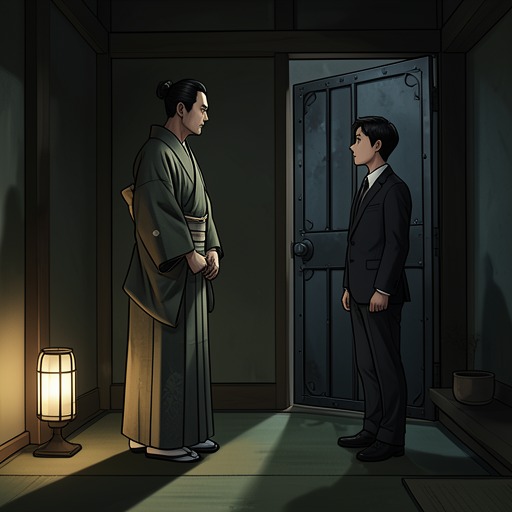
James Bond and Tiger Tanaka’s friendship and mission partnership
You Only Live TwiceJames Bond and Tiger Tanaka’s friendship and mission partnership joins professional trust to a growing personal attachment. Tiger is Bond’s Japanese mentor and operational ally, but their cooperation is not simply instruction flowing one way: Bond insists when his instincts point to danger, and Tiger acts on his warning. As Bond’s training draws to a close, their blunt jokes, mutual assessment, and final exchange of a small box reveal the affection beneath their formal roles.
Training, judgment, and mutual regard
Over a meal of fugu and sake, Bond treats the meal courteously, complimenting the fish because Tiger clearly expects him to do so. Afterward, Bond asks Tiger to grade his education, joking that he is nearly ready to leave the nest. Tiger awards him seventy-five out of a possible hundred. The mark is affectionate but not uncritical: Tiger points to Bond’s habit of making Western jokes about Eastern customs, while acknowledging that his patience has been tested and that Bond’s company has given him pleasure and amusement. Their friendship permits a frank evaluation that is also a personal compliment.
The partnership rests on distinct strengths rather than identical judgment. After a stocky man in a white masko and leather hat passes them at the restaurant, Bond recognizes him as the man seen on the train. The following morning, on the coast road north from Fukuoka, Bond spots the same suspected thief riding a motorcycle behind their police car. He presses Tiger to believe him and asks him to have the driver leave the road and pursue the man. Tiger initially grunts, but looks back and promptly gives the driver instructions; the police corporal unbuttons his holster, and the car pulls into scrub to wait for the motorcycle before turning in pursuit. Bond supplies the warning and the urgency; Tiger converts that judgment into coordinated action.
A mission built on trust
As Tiger prepares Bond for the next stage of his assignment, he provides black ninja clothing for night, camouflage clothing for day, swimming goggles, and a plastic bag for towing the equipment. Bond appreciates the thoroughness but would prefer a small gun. Tiger rejects the idea as impractical: silence is essential, and a silenced weapon would be heavy to swim with while its reduced bullet speed might fail to pierce the target’s armour. He directs Bond instead to use ninjutsu. The exchange shows Tiger’s care expressed as preparation and tactical candour, while Bond’s resistance remains familiar enough to take the form of a preference rather than a breach of trust.
Tiger also permits Bond to study a distant photograph of the armoured opponent. Bond inspects its vulnerable points, particularly the neck and joints, and notes the groin shield, sword, and lack of any visible additional weapon. His questions about the target’s appearance lead Tiger to see a side of Bond unlike the composed, ironic pupil he has come to know. Bond has recognized the face and privately decides not to disclose the man’s identity, because official intervention could deprive him of his personal revenge. Tiger does not know the reason for Bond’s concealment, but he responds to Bond’s visible intensity with warmth, saying that he is pleased by the care Bond is taking to settle the details in advance. Their closeness is real, though it does not mean that Tiger knows everything Bond is keeping to himself.
The farewell at Fukuoka
When Bond is about to leave, farewells are brief. Dusk is falling over the sea as the police boat waits at the harbour. The Superintendent wishes Bond success in his honourable undertaking, and Tiger takes Bond’s hand in both of his, an unusual gesture in the scene. Rather than offering a conventional farewell or wishing him luck, Tiger says he is certain Bond will succeed and gives him a small box in case the venture goes badly through no fault of his own. The care behind the gift is inseparable from the danger Tiger anticipates.
The box contains one long, brownish pill. Bond gives it back, declining the means of escape from death and answering Tiger’s concern with a joke about living twice: if a second life comes, he would rather look death in the face than turn away. He thanks Tiger for everything, recalling even the live lobsters they have eaten together, and says he expects to return in about a week. The exchange makes their different responses to danger visible without making them adversaries: Tiger offers a contingency; Bond refuses it on his own terms, while accepting the friendship that prompted it.
Partnership carried forward
Tiger’s departure does not erase the bond established through training and shared work. He boards the boat, raises a hand, and gives Bond a swift chopping gesture as it rounds the sea-wall and disappears. Bond then turns to Kissy Suzuki and proceeds with the next stage of his cover. The scene leaves the two men separated by the mission, not by a rupture. Tiger’s final confidence, the pill he was willing to surrender, and Bond’s thanks together define a partnership in which operational preparation and personal concern have become inseparable.