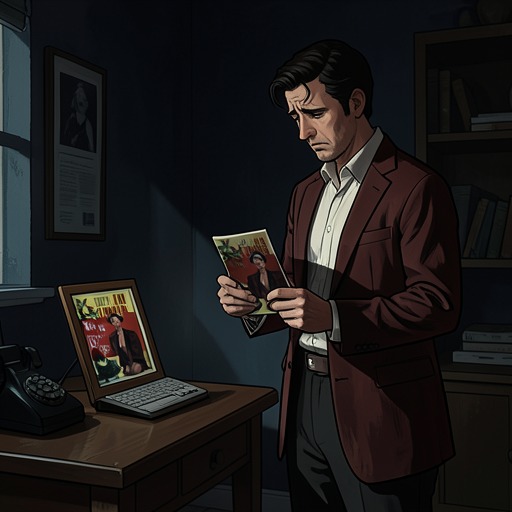
James Bond’s psychological crisis after Tracy’s death
You Only Live TwiceJames Bond’s psychological crisis after Tracy’s death turns a bereaved agent’s private shock into a threat to his health, judgment, and place in the Double-O Section. The loss is not a passing distraction: eight months later, he is still unable to regain his appetite for work or life, while those responsible for his welfare disagree over whether he needs time, treatment, or removal from service.
The Loss and Its Delayed Force
Tracy’s death follows her marriage to Bond by only a few hours. Bond survives the attack by Ernst Stavro Blofeld with no injury more serious than a blow to the head, but he does not emerge from the loss intact. Sir James Molony, the neurologist who examines him, distinguishes the visible physical survival from the psychological injury that follows. Bond himself has told Molony that his zest has gone and that he is no longer interested in his job or even in living. Molony identifies the condition as a form of psycho-neurosis brought on by an intolerable life situation, rather than by brain damage.
The source of the shock is compounded by Bond’s self-blame. Molony describes the loss of a loved one as the precipitating blow and says that Bond’s belief that he was responsible for Tracy’s death has made it heavier. He cautions M that neither he nor Bond has known this particular burden, and that it cannot be understood simply by measuring Bond against his previous toughness. The crisis is thus both bereavement and accusation turned inward: Bond has lost Tracy and, in his own judgment, failed to protect her.
Symptoms in Daily Life
On the last day of August, eight months after Tracy’s death, Bond sits in Queen Mary’s Rose Garden in Regent’s Park, absorbed in matters he once took for granted: health, weather, and the natural world. He feels and looks unwell. His attention to the ordinary is a measure of the change; before this year, he had treated good health as a given and weather chiefly as a question of whether to carry a raincoat or raise the hood of his Bentley Convertible.
His work has deteriorated alongside his health. M reports that Bond arrives late, skims his assignments, makes mistakes, drinks too much, and loses substantial sums at a new gambling club. These changes are alarming partly because they contradict Bond’s established record as one of M’s best agents. Molony interprets the decline as a symptom of shock, not evidence that Bond has suddenly become incapable by nature. M, however, sees its operational consequence: an agent whose errors may endanger himself and other people.
Bond’s own thoughts at the garden give the condition a quieter, more diffuse texture. He sweats in the heat and wonders whether the weather is changing; roses, bees, and distant traffic hold his attention. Watching the bees work for their queen, he reflects on their apparent purpose and on the fact that they live and die without the troubles he carries. He eventually identifies the roses as Super Star and Iceberg by reading their labels. These small observations do not resolve his grief; they show how thoroughly his attention has shifted toward health, mortality, and the routines of living things.
Searches for Relief
Bond has spent months seeking medical help without telling anyone. He visits doctors along Harley Street, Wigmore Street, and Wimpole Street, consulting specialists, general practitioners, unorthodox practitioners, and finally a hypnotist. He reports poor sleep, almost no appetite, excessive drinking, and work that has gone badly. The examinations—blood pressure, urine, heart, and chest—reveal nothing physically wrong, and each consultation ends without an explanation that can make him feel better.
He pays five guineas for each medical visit and fills successive prescriptions at John Bell and Croyden, including tranquillizers, sleeping pills, and energizers. Treatment becomes a repeated cycle of tests and remedies without meaningful recovery. The hypnotist offers a different prescription: Bond should recover his manhood by taking a woman. Bond has already tried relationships with women who tell him to take the stairs slowly, ask to be taken to Paris, or casually ask whether he feels better. The advice does not touch the loss at the center of his condition.
Bond abandons the hypnotist’s fifty-guinea course halfway through, after tiring of the sessions in which he is told to relax and gaze at a bare electric bulb. He leaves the final appointment and sits in the secluded garden before returning to his nearby office. He is already late, but postpones going back until after three o’clock, despite having been due at half past two. His disregard for the clock registers as another small breach in the discipline that once defined his working life.
Medical Judgment and Professional Risk
Molony rejects the idea that Bond’s decline is inexplicable. He reminds M that his reports have consistently attributed it to shock and argues that the loss has produced a psychological illness rather than a physical injury. He had hoped that the dangers and emergencies of Bond’s work might draw him out of the condition. Instead, Bond has bungled two assignments: on one he nearly gets himself killed, and on the other he makes a mistake dangerous to others. M says Bond had not made mistakes before and now seems accident-prone.
The difference between the doctors’ assessment and the service’s needs remains unresolved. Molony calls the new mistakes another symptom of the neurosis. M considers what that symptom means for a tightly staffed organization that cannot keep an agent in the field if he may cause harm. At their earlier discussion, M proposes retiring Bond, giving him an honourable discharge and trying to find him civilian work, perhaps with a bank security organization. He describes the decision as a matter of having no suitable place to keep Bond without exposing others to risk.
When Bond later meets M, he anticipates the worst and offers his resignation, citing his poor medical condition and the last two failed assignments. M rejects his self-condemnation: the Double-O Section has simply been idle, and anyone can make mistakes after a bad period. He does remove Bond from the section, but says there is nothing physically wrong with him and that he has had good reason to be under the weather. Bond takes the transfer as a gentle prelude to dismissal and again asks to resign, saying he neither wants nor is suited to staff work. M then reveals that he has summoned Bond to offer promotion and the most important job of his career. The reversal does not erase the crisis; it shows that M’s judgment of Bond’s future is more complicated than either Bond’s fear or the earlier proposal to retire him.
The Crisis as a Conflict Between Grief and Duty
Bond’s condition is measured in two incompatible ways. To Molony, it is a human response to a devastating loss, intensified by guilt and not corrected by demanding that Bond simply resume his former role. To M, it is also a question of professional fitness, because an agent’s private suffering has begun to create risks in the field. The narrative makes the consequences concrete: missed time, neglected work, drinking, gambling losses, and mistakes with potentially serious effects.
The garden scene places this occupational failure beside Bond’s new preoccupation with bodily limits and the cycles of life. The man who once treated health as background now searches doctors for relief and studies roses and bees during office hours. His failure to recover is not presented as a lack of courage; Molony explicitly compares his former toughness with the burden he now carries. The crisis therefore exposes the limits of the old standard by which Bond has understood himself: endurance and professional competence cannot, on their own, settle the consequences of Tracy’s death.