Question Room
You Only Live TwiceThe Question Room is Ernst Stavro Blofeld’s interrogation device, designed to make silence impossible by placing James Bond above a periodically erupting geyser. Its central mechanism transforms a natural hazard into a timed test: Bond is told to remain seated and face death, or leave and reveal that he can understand his captors. The room is at once a physical trap and a staged argument about what Bond knows.
Entrance and Arrangement
Kono directs Bond from the guards into a narrow stone passage beside a bookcase, then into a chamber of roughly hewn stone. Bond arrives badly depleted but still considers whether he might get an opportunity to attack Blofeld. The room therefore receives him not as a neutral interview space but as the next stage of his captivity, where his remaining hope of resistance must contend with a carefully prepared mechanism.
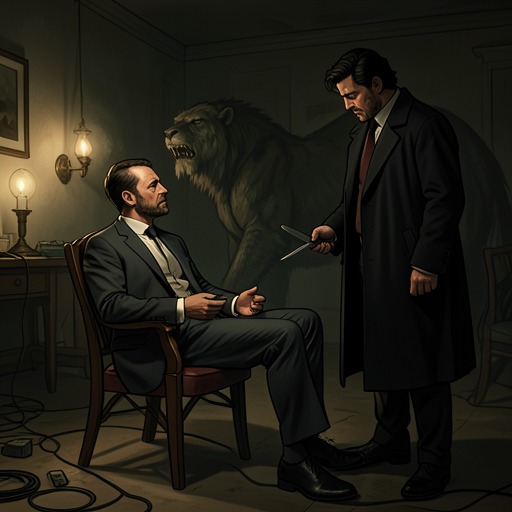
Blofeld and a woman enter after Bond. They sit in wooden armchairs beneath an oil lamp and a large kitchen clock. The clock’s distinctive feature is that its quarter-hour figures are underlined in red; its hands stand just after eleven. At the far end, twelve paces from the entrance, a raised stone seat is set beneath a circular opening in the ceiling. The seat is marked by drying grey mud, and its centre has a large hole. Bond is ordered onto it, while Kono follows in rubber boots. The room’s arrangement makes the clock, the seat, and the opening parts of one apparatus: Bond is positioned over the danger while the people questioning him can watch from a distance.
The Timed Test
Blofeld explains that the chamber is highly volcanic and that Bond is seated above a geyser which he has channelled through a stone funnel. He specifies that the eruption is periodic, occurring at exactly the fifteenth minute of each hour. With the clock just past eleven, Bond has eleven minutes before the next eruption. The explanation gives the trap a measured deadline rather than leaving its danger uncertain: the underlined quarter-hours and the clock’s advancing hand make time itself part of the apparatus.
Blofeld frames the seat as a test of Bond’s supposed inability to hear or understand. Bond has maintained that he is deaf and dumb; Blofeld says that staying in the chair until the eruption will preserve that claim, but leaving beforehand will demonstrate comprehension. Either outcome is intended to serve the interrogators. If Bond stays, the threat is death; if he moves, Blofeld says he will face further torture until he answers questions about his identity, how he reached the castle, who sent him, his purpose, and the number of people involved in the conspiracy. The device thus offers no safe answer. Its declared purpose is not merely to obtain information but to turn Bond’s response to danger into evidence against his disguise.
Bond’s Observation and the Eruption
Kono takes up position by the door and addresses Bond sharply in Japanese. Bond does not respond. Instead, he concentrates on recovering his strength and looks around the chamber. He recalls the final hell at Beppu and notices a small wooden box in the corner to the right of the seat. It has no keyhole. Bond reasons that the geyser’s regulating valve is probably inside and stores the observation while trying to form a plan. The box offers him a possible point of leverage, although the evidence at this stage establishes only his deduction, not that he has opened it or altered the mechanism.
As the clock advances, Bond sees it read 11.14. A deep rumble and a rush of hot air come from below. He rises and moves away from the vent to a dry part of the floor before turning to watch. The geyser erupts through the hole in the seat and passes through the wide ceiling aperture. The eruption is brief; afterwards mud falls back into the chamber, which steams, and the clock’s tick to 11.16 sounds in the ensuing silence. The chronology makes Blofeld’s timetable concrete: the eruption occurs at the stated quarter-hour, and Bond has left the seat before it.
Interrogation and Significance
After the eruption, Blofeld orders Kono to remove Bond’s possessions for later examination and to wait with the guards in the outer hall. He also tells him to prepare a blowlamp and an electrical machine in case further examination is necessary. Left with Bond, Blofeld again demands that he talk. He offers a quick death by sword if Bond cooperates and threatens prolonged suffering if he refuses. The Question Room is therefore only the opening instrument in a larger interrogation, not a self-contained ordeal that ends with the geyser’s eruption.
The room’s coercive logic depends on making every choice legible to the captors. Its measured eruption tests the claim of deafness; its hidden regulating apparatus gives Bond something to notice and potentially use; and the possessions taken away signal Blofeld’s intention to scrutinize the evidence Bond carries. Yet the mechanism does not deliver the answers Blofeld wants simply by operating as designed. Bond survives the timed test by leaving the seat, while the narrative does not establish here that he has yielded the information being demanded. The chamber’s central irony is that Blofeld presents it as a device that makes silent people talk, but its first result is to expose the contest of observation and inference between interrogator and prisoner.