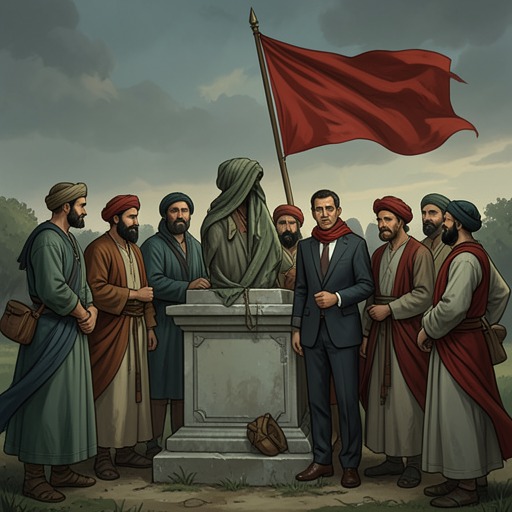
Six Jizo Guardians
You Only Live TwiceThe Six Jizo Guardians are a group of ancient shore statues on Kuro Island, understood by the island’s Ama community as protectors of the people and their dangerous life in the sea. Five remain visibly intact, while the sixth has lost its head; together, they embody a local faith that becomes inseparable from the legend of a foreign man destined to confront the evil across the water. Their meaning rests both in their stark, weathered forms and in the people who continue to address them as living guardians.
Form and Setting
The statues stand on the foreshore on the far side of Kuro Island, at the line reached by the tide. They are made from rough stone: squat pedestal-like bodies support large, round boulders for heads. The people dress them in white shirts, changing the garments every month. Five figures remain, while of the sixth only the body survives; its head was apparently destroyed by a storm. This damage makes the group visibly incomplete without erasing its identity as six guardians.
The position at the water’s edge gives the statues a particular function in the islanders’ imagination. When the tide rises, the figures are covered completely, and are believed to keep watch beneath the surface. The Ama call themselves the Children of the Sea, and the statues’ submergence turns that phrase into a picture of protection: the guardians occupy the boundary between the shore community and the element on which its livelihood depends. At low tide, the same figures are exposed as rough, humanlike forms, their blank stone heads facing the waters they are said to oversee.
Belief and Island Ritual
Kissy Suzuki explains to James Bond that the people of Kuro Island are superstitious and rarely speak about the fortress across the straits. They regard it as a place of evil, and their fear has attached itself to a prophecy: the Six Jizo Guardians will send a man from across the sea to slay the figure they call the King of Death. Kissy cannot identify the story’s origin. She says it may have come from the sea or the air, but stresses that it is widely believed. The legend thus has communal force even though its beginnings remain unknown.
The guardians are associated with Jizo, whom Kissy describes as a Buddhist god who protects children. Their protective role extends, in the islanders’ understanding, to the Ama themselves. At the beginning of every June, when the sea has warmed after winter and diving begins, the people form a procession to the statues and sing to win their favor. The rite makes the group’s protection a recurring public practice, not simply a private hope. Monthly changes of their white shirts and the annual procession give the guardians a place in ordinary community life as well as in the island’s more frightening stories.
That faith also shapes how the Ama understand danger underwater. Kissy tells James Bond that sharks do not trouble them because the Six Jizo Guardians look after the divers. She recalls one accident, when an Ama woman’s rope caught on a submerged rock; the incident remained in people’s talk, while the sharks themselves were not treated as the cause of a continuing threat. Her account presents protection not as proof that the sea is harmless, but as an explanation through which the community lives with its risks.
James Bond’s Visit
Kissy takes James Bond to the statues at low tide. They reach a small protected bay east of the village by following a path over the island’s peak and down to the shore, then wade around a promontory across black pebbles and rocks. From there, the five intact figures appear seated on a square foundation of large stones, looking out toward the horizon. Their rough bodies and boulder heads, dressed in white, seem terrifyingly human in their stillness. The absent head of the sixth is a physical reminder of the group’s exposure to storms and time.
The sight produces an unexpected response in James Bond. He feels deep awe at the belief and authority invested in these primitive, faceless figures, and has an impulse to kneel and ask their blessing. He brushes that impulse aside but bows his head and asks for good fortune for his enterprise. The moment does not establish that he accepts the islanders’ religion; it shows that the statues’ presence affects him before he can reduce it to an explanation. Their power in the scene comes from the accumulated trust of the community as much as from their appearance.
Kissy then claps to attract the guardians’ attention and gives an impassioned speech in which James Bond’s name recurs. At the end, she claps again. The boulder heads seem briefly to nod, but the narration immediately leaves the apparent movement uncertain: James Bond firmly denies having seen them nod. Kissy, by contrast, tells him happily that he did. The exchange preserves two interpretations at once: a possible sign from the guardians for Kissy, and an impression that James Bond refuses to affirm. The statues’ significance therefore does not depend on proving a supernatural response.
Prophecy and Narrative Significance
After the destruction of Death Castle, the Shinto priest tells Kissy Suzuki that the evil man and his wife are dead and the castle has been destroyed. He interprets these events as the fulfillment of what the Six Jizo Guardians foretold: the man from across the sea has brought them about. This later account connects the island’s prophecy to James Bond’s actions while remaining the priest’s religious understanding of their meaning. The statues do not act directly in the events; they provide the community with a framework for recognizing the outcome as the fulfillment of an older promise.
Kissy invokes that framework when asking the priest to help her keep and care for James Bond, now gravely wounded and without his memory. She presents him as a hero brought to the island by the gods and asks whether Kuro Island should not cherish him, or whether the guardians might wish to keep him there for a while. Her appeal turns the prophecy from a prediction of violence into an argument for hospitality and protection. The Six Jizo Guardians thus link the island’s inherited fears of Death Castle with the care its people offer the man believed to have defeated it. Their presence holds together the novel’s uncertainty about supernatural signs and its concrete account of communal belief: the figures may remain motionless stone, yet the stories and rituals around them shape what the people see, remember, and choose to do.