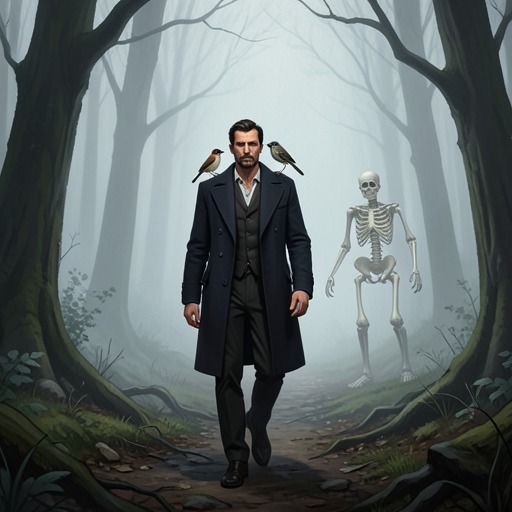
You only live twice: Once when you are born and once when you look death in the face
You Only Live Twice“You only live twice: Once when you are born / And once when you look death in the face” is James Bond’s improvised poem in conversation with Tiger Tanaka. Its decisive turn is to make the second life neither a literal return nor an extension of the first, but a moment of renewed significance at the prospect of death. The poem also supplies the wording of the novel’s title, joining a brief exchange about verse to the book’s larger concern with mortality.
Composition and Context
Tiger first discusses the still-life quality and insight of haiku, then asks Bond to try one. Bond jokes that his schooling in Latin and Greek, along with the trigonometry he has forgotten, has not prepared him for practical tasks or Japanese verse. He nevertheless accepts pen and paper. After much crossing out and rewriting, he offers the three lines, presenting them as more pithy than the work of Basho.
The poem emerges through an exchange rather than as a prepared declaration. Tiger responds with soft applause and calls it sincere, but explains that its syllable count will not work in Japanese. His praise and qualification distinguish the force of Bond’s thought from its fit with the form: the attempt is honourable, though it does not meet the formal requirement Tiger identifies.
Meaning and Form
The opening assertion sounds like a paradox: a person lives twice, although the poem names birth and facing death rather than two births. The first occasion is involuntary and begins life; the second is an encounter with its limit. By giving that encounter the status of another beginning, the poem frames awareness of death as a change in how life is apprehended, not as a promise of survival beyond it.
Its plain sequence carries the idea. The first line announces a memorable rule, while the next two define its two occasions without explanation or ornament. The final phrase shifts the poem from the general fact of birth to the charged act of looking death in the face. That direct confrontation gives the compact statement its weight, while the mismatch with Japanese syllabic form leaves its insight intact but formally imperfect.
Place in the Novel
The poem’s wording echoes the title, making the phrase more than a label: within the scene, it is Bond’s own attempt to articulate what living twice might mean. Tiger asks whether Bond was thinking about his mission as he wrote it. Bond answers only that he perhaps was, indifferently. The exchange therefore suggests a connection between the poem and the mission without turning that connection into a full explanation; its closing uncertainty preserves the line’s double force as both an improvised literary thought and a possible response to danger.