An ant doesn’t know what a cathedral is
You Should Have Left“An ant doesn’t know what a cathedral is” is the book’s clearest expression of epistemic limitation: a creature may measure what lies within its world and still fail to recognize the larger structure enclosing it. Spoken in connection with the mountain house’s geometry, the metaphor shifts the problem from human ignorance to a mismatch between dimensions, making the house’s impossible spaces appear not merely strange but inaccessible to the categories used to understand them.
Origin and Immediate Context
The expression arises during a conversation about a triangle. When the narrator asks what the other man wanted to demonstrate with it, the man first falls silent, then explains that the parts do not fit together: the angles, especially those above, never align. His difficulty speaking without dialect and his uncertainty about the source of the claim give the remark a socially embedded, unstable origin. He attributes it to Hans Ägerli, owner of the Lindenhof, while also noting that Ägerli has been drinking and says many things. The metaphor therefore enters the narrative as hearsay rather than as an established scientific proposition.
That uncertainty does not make the image irrelevant. The speaker immediately connects the ant’s limited understanding to objects vastly exceeding its conceptual field, naming a cathedral, a power plant, and a volcano. Each example is something that can be physically encountered yet cannot be adequately understood from the ant’s scale. The expression thus distinguishes contact from comprehension: being inside or near a thing does not guarantee access to its form or meaning.
From Ant to Paper-Bound Creature
The narrator later revises the comparison, saying that the ant is not the best example. A more exact figure would be a creature drawn on paper that, if it became alive, could exist only on the paper’s surface. This alteration is decisive because it removes the possibility that the observer might simply be very small within a shared three-dimensional world. The creature is confined to a different order of space.
The thought experiment imagines a mountain drawn on the paper. If the paper creature traced a circle around the mountain and measured the area inside it, the measurement would not help it understand what stood before it. There would be far more paper than the creature’s reason could allow within the circle. For that creature, the discrepancy would be a miracle. The metaphor consequently gives a concrete model for an experience in which geometry itself appears to betray ordinary reasoning: the evidence is measurable, but the governing structure remains unintelligible.
Relation to the Mountain House
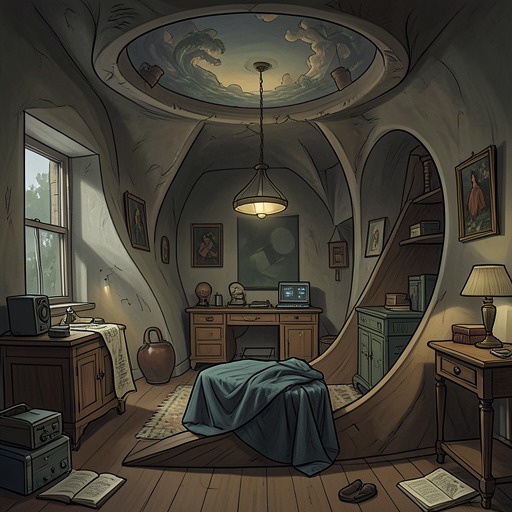
The expression is tied directly to the mountain house’s spatial anomaly. The man has already said that the angles do not fit together, and the narrator is trying to determine what existed before the current house. The answer is that a different house stood there previously. Against this background, the ant metaphor becomes more than a general statement about ignorance. It offers a provisional language for a building whose roads, angles, boundaries, and interiors cannot be reconciled by normal spatial logic.
Its force lies in refusing a simple explanation. The house is not described as a puzzle that can be solved by acquiring one missing measurement. Like the mountain on the paper, it produces an excess that the observer’s system cannot contain. The metaphor therefore prepares the reader to treat impossible geometry as a structural condition rather than as a temporary failure of attention.
Narrative and Thematic Significance
The expression also marks the narrator’s movement from observation toward fearful interpretation. The narrator writes everything down so that whoever finds the notebook will know what happened, while the narrator’s little girl, Esther, sits nearby watching a movie and suspects nothing. The calm domestic scene is set beside the possibility that the narrator and Esther will later be described as having disappeared, with others attributing the disappearance to mountain crevices or destructive thoughts. The metaphor helps articulate the gap between what the characters experience and what outsiders might be able to understand afterward.
As an interpretive device, the image leaves the phenomenon open without making every explanation equally valid. It supports the idea that the house exceeds ordinary human cognition, but it does not by itself prove whether the cause is supernatural, geometrical, psychological, or some combination of these. Its deepest function is to make that uncertainty intelligible. The ant, the paper creature, and the narrator all occupy a world whose apparent measurements fail to reveal the whole structure; what appears miraculous may be an ordinary feature of a larger order that the observer cannot perceive.