Cell phone
You Should Have LeftThe cell phone is both an ordinary household instrument and one of the novel’s decisive narrative objects. It stores the evidence of Susanna’s relationship with David, enables the narrator’s attempts to verify what is happening around him, and later provides the only light during his failed escape with Esther. As its network, battery, and physical location become unreliable, the device marks the collapse of the domestic world’s familiar rules.
Everyday Use and Domestic Context
The cell phone first belongs to the practical texture of family life at the Vacation House. When the household begins running low on provisions, the narrator volunteers to go down to the village, while Susanna reads to Esther from the book about the mouse and the cheese moon. The phone is part of the background of this routine, a means of remaining reachable while the family is temporarily separated. The contrast is important: the same domestic setting contains affectionate childcare, strained marital communication, and an instrument capable of exposing a hidden relationship.
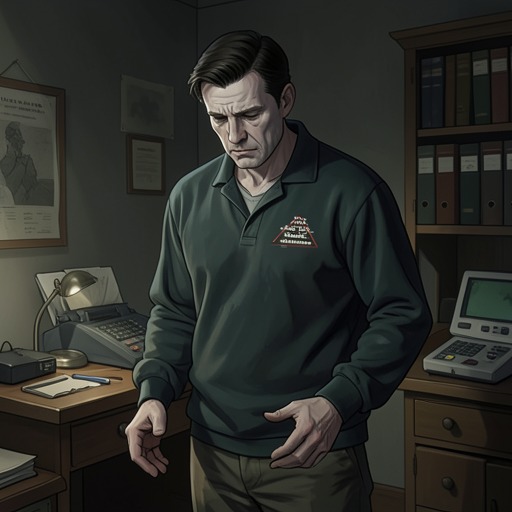
The phone also appears amid the narrator’s work and his difficulty maintaining concentration. He writes in his notebook while Susanna and Esther occupy the room, pretending to be busy so that Susanna will not accuse him of merely complaining. In this environment, the phone is one more object competing with writing for attention, but it soon becomes more than a distraction. It shifts from an unobtrusive accessory of family logistics into an object that demands interpretation.
The Phone as Evidence of Infidelity
The phone becomes central when the narrator notices a message on Susanna’s device. The screen displays an intimate declaration from David: “I want to touch you again.” The narrator initially searches for an innocent explanation, imagining that the message might be a joke, a message sent out of context, or a mistake. The sender’s name is simply David, without a surname, and the narrator does not recognize him. His uncertainty leads him to open the messaging application and inspect the exchange rather than dismissing the notification.
The device therefore functions as a physical archive of the marriage’s concealed crisis. The narrator copies Susanna’s messages with David into his notebook, preserving them in another medium instead of trusting the phone alone. This act changes the phone’s role: it is no longer merely the source of a troubling message but the object around which accusation, memory, and proof are organized. The notebook becomes a deliberate record of what the phone has revealed.
Susanna recognizes the phone’s evidentiary power. During the confrontation, she observes that people who are caught are often betrayed by their cell phones because they cannot bring themselves to delete the messages. In her account, the device is normally kept close and protected, yet saved messages make it vulnerable to discovery. She interprets the narrator’s access to it as part of the behavior of a jealous husband and accuses him of going through her bag, although he maintains that the phone had been lying on the table and that he had wanted to find Steller’s number. The phone thus exposes the affair while also becoming a weapon in the argument about surveillance, jealousy, and invasion of privacy.
Breakdown During the Escape
After the marital rupture, the narrator needs the phone because Susanna might call. Its importance has changed again: it is no longer chiefly a source of incriminating information but a possible lifeline connecting him to his wife and to the outside world. Yet the device cannot restore the relationship. When the narrator and Esther attempt to leave, a strange sound interrupts their efforts, and the phone screen reports, “No network.” He raises and lowers the device and goes to the window, but reception does not return.
The loss of network coincides with the mountain house’s spatial disturbance. The narrator unlocks the door, leads Esther outside, and finds that they are back in the living room. The phone has not merely failed to connect them with someone elsewhere; the surrounding world itself has ceased to behave as a stable environment in which connection would make sense. Its technical failure becomes part of the larger failure of ordinary orientation.
The narrator later uses the phone in a more elementary way. While walking backward with Esther down the steep road, he relies on the device’s fully charged battery and its small rear flashlight to illuminate the path. He keeps hold of Esther’s warm hand while his own is ice-cold, and the phone’s beam defines a narrow corridor through otherwise impenetrable darkness. The device offers temporary practical assistance, but it cannot provide a route out of the mountain’s geometry. When he points the flashlight toward the roadside, he sees bushes, rocks, and earth, yet no lights from the valley; the phone still has no reception.
The escape ends in a return to the Vacation House. The phone’s light has helped them move through the woods, but the illuminated window ahead reveals the same pointed roof, wide front door, empty parking area, long table, kitchen, and open hall door from which they had tried to flee. The phone has supplied visibility without delivering escape, a distinction that mirrors the narrator’s earlier use of it as a device that supplies evidence without supplying control.
Battery, Absence, and Isolation
Near the final separation, the phone’s remaining material resources also disappear. The narrator has no watch, the battery is dead, and the charging cable that had recently been on the table is gone. He estimates that perhaps half an hour has passed, though even that duration has become uncertain. The phone’s dead battery removes the last ordinary measure of time and reinforces the narrator’s dependence on a reality whose instruments no longer function reliably.
The object’s trajectory is consequently marked by successive transformations: it begins as a domestic convenience, becomes an archive of infidelity, loses its network during the attempted escape, serves as a flashlight in the dark, and finally loses its charge and temporal usefulness. It never resolves the narrator’s crises. Instead, each failure reveals a deeper loss: privacy gives way to exposure, communication to disconnection, orientation to repetition, and measurable time to indefinite waiting.
Narrative and Thematic Significance
The cell phone condenses the novel’s concern with mediation. Messages preserve a hidden past, the notebook copies those messages into a new record, and the phone’s screen reports the absence of a network; in each case, information is available only through a material apparatus that may preserve, distort, or withhold it. The phone is therefore not a neutral channel between people. It determines what can be discovered, what can be remembered, and whether anyone beyond the house can be reached.
Its connection to the family is especially stark. The narrator needs the phone while caring for Esther, confronting Susanna, seeking a taxi from Gruntner's General Store, and trying to escape with his daughter. The device accompanies the family’s movement from ordinary domestic conflict into supernatural confinement, but it cannot prevent the family from splitting apart. Susanna eventually drives away with Esther, while the narrator remains behind; the phone’s final condition, dead and unable to measure time, corresponds to his isolation. An object designed to maintain contact becomes the silent remainder of a world in which contact, direction, and even duration can no longer be trusted.