Ella
You Should Have LeftElla is Jana’s close friend and Martin’s new partner, and her decisions provide the first major interpersonal rupture in the story. She asks Jana to leave the apartment where Jana had been living so that Martin can move in with her, transforming a private arrangement into a painful collision among friendship, former love, and new desire. Ella’s importance lies in the way her apparently ordinary domestic choice helps establish the narrative’s larger pattern: familiar relationships become unstable just as familiar spaces begin to behave impossibly.
Identity and Introduction
Ella first appears in the tandem-bike sequence that opens the story on December 2. She is at the handlebars while Jana rides behind her along a country road in bright sunshine, with swaying stalks and cheerful music surrounding the journey. Jana spreads her arms and blinks happily into the sun, but the carefree movement ends when the bicycle hits a rock, leaves the road, and overturns. Cries of pain interrupt the music before the image fades to black. Ella is therefore introduced through both companionship and loss of control: she is guiding the shared vehicle, yet the route abruptly defeats her steering. The scene establishes the deceptively buoyant surface and sudden violence that also characterize her later relationships.
The narrative deliberately refuses to provide a conventional childhood explanation for Ella. The narrator remarks that the sequel needs backstory but admits knowing nothing about Jana’s or Ella’s childhood and being uninterested in inventing it. This absence matters because Ella is not explained through a formative past; she is defined through present choices, especially the decision that brings Martin into her home and removes Jana from it. Her character is consequently built less as a psychological biography than as a pressure point within an existing network of attachments.
Conflict with Jana and Martin
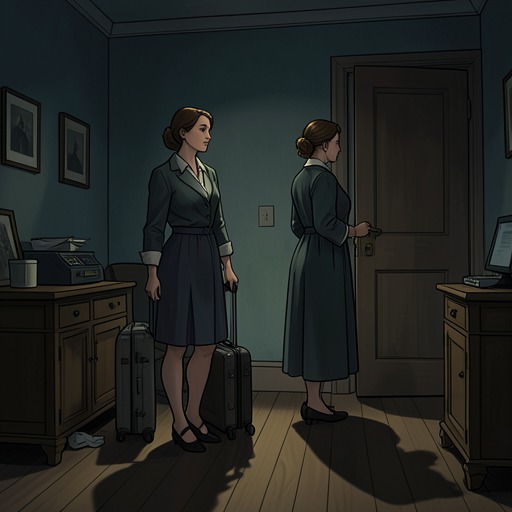
When Ella tells Jana to move out, she expects an emotional reaction. Instead, Jana remains calm, and that composure provokes Ella because it denies her the fit of rage she appears to anticipate. Ella insists that Jana had not wanted to live there anymore, while Jana challenges the basis of that assumption. The exchange makes the eviction more than a logistical change: Ella needs Jana’s response to confirm the emotional meaning of what is happening, but Jana’s restraint leaves the conflict unresolved and therefore more threatening.
Ella’s new partner is Martin, Jana’s former boyfriend. Jana explains that they broke up because Martin was not right for her, while also acknowledging that he is clearly right for Ella. Martin is presented as good-looking, sensitive, well-read, and multilingual, yet his profession as a senior tax official had made him unacceptable to Jana. Ella’s relationship with him thus carries the residue of Jana’s earlier judgment. It also makes the apartment a charged object: Ella is not merely asking a roommate to relocate but replacing a former romantic arrangement with a new one involving the same man.
The confrontation intensifies when Martin enters wearing a suit and carrying a briefcase. Ella, unable to direct her rage elsewhere, begins screaming at him under a pretext, while Jana stands nearby, not smiling but sadly. Martin’s arrival exposes the triangular structure of the scene. Ella’s anger is displaced onto the person who represents the change, even though she is the one who has asked Jana to leave. Her conduct combines assertion and agitation: she claims the new arrangement, but the emotional atmosphere suggests that possession of the apartment and possession of the relationship have not brought security.
Domestic and Emotional Behavior
Ella’s later scenes with Martin show intimacy as a performance marked by mutual suspicion. Early in the morning, Martin watches her sleep. When she moves, he quickly closes his eyes; Ella opens hers, looks at him, and surveys the room. Her clothes lie untidily on the floor, whereas Martin’s are neatly folded on a chair with his tie placed on top. After some time, Martin pretends to wake, but Ella has already closed her eyes again. He looks at her uneasily before shutting his eyes once more, leaving both of them beside each other while pretending to sleep. The scene turns a shared bed into a miniature stage on which neither partner will acknowledge awareness of the other.
The contrast between Ella’s untidy clothes and Martin’s folded garments gives their new domestic life a concrete visual tension. Martin’s tie, an emblem of his official identity, is carefully arranged even in the bedroom, while Ella’s clothing is scattered. Yet the difference does not produce complementary ease. Instead, both characters retreat into imitation and concealment. Their physical proximity yields no communicative closeness, and the silence after an apparently blissful evening makes the narrator question why such a dream could follow it.
Ella can also appear cheerful and relaxed. In her car, she whistles to herself while music plays on the radio and answers Martin’s call by saying she will arrive soon. That ordinary movement toward a meeting stands in stark contrast to the later reversal in which, after a fight, she turns off the speakerphone, brakes, pulls over, and turns around. The repeated warning to get away accompanies her retreat, but the evidence does not establish whether the warning is heard externally, internally, or through the story’s unstable mediation. What is clear is the change in direction: Ella moves from approaching Martin to abandoning the route after conflict.
Relationship to the Narrator’s Marriage
Ella’s plot is mirrored by the narrator’s deteriorating relationship with Susanna. The narrator struggles to write while Susanna and the children play noisily in the room, scribbling to appear busy because the production is waiting. He insists that he loves Susanna and wants no other life even as he wonders why they fight so often. This domestic contradiction forms a parallel to Ella and Martin’s false sleep: love or partnership remains verbally present, but ordinary life is organized by avoidance, performance, and irritation.
At dinner, the narrator and Susanna repeatedly deny that anything is wrong while accusing each other of acting strangely. Esther’s confused preschool story temporarily absorbs their attention, and the child’s interruptions become a buffer against direct marital confrontation. Later, when the narrator discovers messages involving David, he shouts or croaks his accusations while Esther watches. Susanna admits that she does not want to deny the affair, then tells him to pull himself together and think of his daughter before carrying Esther upstairs. Ella’s conflict with Jana and Martin therefore belongs to a broader pattern in which adult intimacy is displaced onto children, rooms, phones, and practical decisions.
The screenplay or film project involving Jana, Ella, and Martin is also entangled with the narrator’s attempt to write. When Schmidt asks about the plot, the narrator explains that Jana has to move out because Ella throws her out so Martin can move in. The apparently comic complication becomes difficult to control as the narrator’s own life falls apart. Ella’s fictionalized situation is not isolated from the outer narrative; it is one of the forms through which the narrator processes, repeats, and possibly distorts domestic betrayal.
Narrative Role and Significance
Ella functions as both a character in the remembered or invented Jana-and-Ella storyline and a figure through whom the narrative tests the boundary between relationship comedy and darker forms of conflict. The opening tandem accident promises cheerful motion before delivering pain, and Ella’s later decision follows the same structure: an everyday domestic arrangement suddenly becomes an expulsion. Her conflict with Jana begins with an address change, but it carries the emotional force of a breakup, a replacement, and a betrayal of friendship at once.
Her trajectory also participates in the story’s movement from recognizable social reality toward spatial and perceptual instability. The mountain house contains scenes in which the narrator cannot reach a faucet that appears only a foot away, where a remembered picture vanishes without leaving a nail or hole, and where the environment becomes a trap rather than a neutral setting. Ella herself is not shown causing these anomalies, but her relationship plot supplies an ordinary human counterpart to them. The same world that makes a person’s home available to one relationship and unavailable to another can later make rooms, roads, and reflections unreliable.
The narrator eventually understands that the people encountered in the anomalous place have faces shaped by what they have seen. Esther lies completely relaxed, as if freed, while the narrator recognizes that there is nothing he can do. Against this larger horror, Ella’s earlier scenes acquire retrospective weight. Her rage, composure, hurried departure, and strained intimacy are not merely comic or romantic beats; they are examples of people trying to preserve agency while the structures around them shift. Ella’s decisive significance is therefore double: she initiates a concrete rupture in Jana’s life, and she helps establish the book’s recurring pattern in which ordinary choices open onto consequences that no character can fully govern.