Empty window reflection
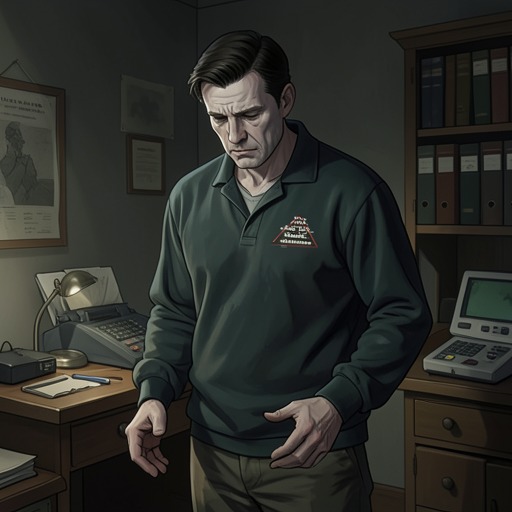
You Should Have LeftThe empty window reflection is a recurring supernatural phenomenon in which the mountain house appears accurately in a windowpane while the unnamed narrator is absent from the reflected room. Its decisive significance lies in the contradiction it creates between ordinary visual confirmation and impossible evidence: the reflection shows the refrigerator, stove, table, doors, lamp, chair, shopping bag, glass, and notebook, yet not the person who is actually sitting among them. The phenomenon therefore becomes both a threat to the narrator’s confidence in reality and a material sign that the house operates according to altered spatial laws.
First Appearance and Recurrence
The anomaly is first registered as something brief and easy to dismiss. When the unnamed narrator later experiences it again, the recognition is immediate: the event is happening once more, linking the present disturbance to the earlier moment rather than allowing it to remain an isolated optical mistake. The recurrence matters because it changes the status of the image. A fleeting irregularity can be blamed on fatigue, light, or distraction; repetition gives the house a pattern.
The second occurrence takes place as evening approaches, after the unnamed narrator has driven down to Gruntner's General Store and returned to the house. The drive back is calmer than the descent: the sun has moved behind the ridge between the glaciers, the valley lies in shadow, and details such as the ruined barn, the rusted tractor, the car’s long shadow, startled birds, and an orange-lit cloud become visible. After putting the groceries in the refrigerator, the unnamed narrator sits at the long table to write. The calm sequence of travel, shopping, return, and note-taking makes the subsequent reflection especially disruptive: the impossible image interrupts a routine that appears to restore order.
What the Window Shows
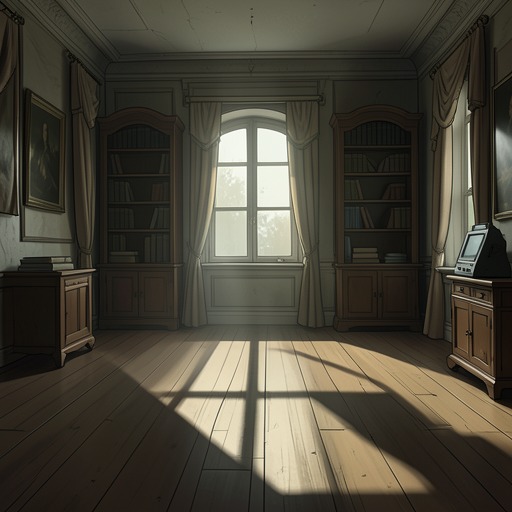
The reflected room is not vague or dreamlike. It contains a precise inventory of domestic objects: the refrigerator, stove, kitchen table, hall door, flat-screen television, low gray-green sofa, lamp above the table, the table itself, and the chair in front of it. The crumpled plastic shopping bag from which the groceries have just been unpacked is visible on the tabletop, as is an empty glass beside it. The reflection therefore preserves the immediate material circumstances of the room, including objects connected with the unnamed narrator’s recent trip to the village.
The image also violates ordinary perspective in a specific way. The unnamed narrator is sitting between the window and the living-room door and should block the view of the door handle, yet the handle remains visible. The back of the chair, the tabletop beneath the narrator, and the open notebook can all be seen as though the body occupying that position were transparent or had never been there. Covering the notebook with a hand does not remove it from the reflected scene; the whole notebook remains visible. The reflected room is consequently not merely missing a face. It is unoccupied while retaining the arrangement of objects that proves someone has been using it.
Observation, Recording, and Doubt
The unnamed narrator responds by trying to convert perception into evidence. The instruction to look closely and write everything down treats the notebook as an external support for memory, a defense against the later suspicion that the incident was imagined. A phone should also provide a record, but the narrator does not know where it is at first, and the moment of searching introduces a break in observation. The effort to document the phenomenon thus becomes part of the instability: the tools intended to preserve reality are themselves difficult to access or unreliable.
The reflection persists. It is reported as still happening, then still present again, with the repeated notation narrowing the distance between event and record. Eventually the unnamed narrator stands up to look for the phone and looks away from the window. When the narrator turns back, the image has normalized: the narrator is again in the room, and the reflection performs the same action of sitting and writing. This apparent restoration does not resolve the incident. Instead, the narrator feels dizzy, experiences the event as though it had happened long ago despite its recency, and anticipates becoming unable to decide whether it really occurred. Even while writing the account, the narrator begins to think it must have been imagination. The notebook preserves an experience that consciousness is already trying to erase or explain away.
Spatial and Psychological Consequences
The empty reflection belongs to a larger breakdown in the mountain house’s relation to ordinary space. The unnamed narrator’s initial drive to Gruntner's General Store is already marked by panic: driving is understood as a dangerous passage from everyday life into catastrophe, and the narrow hairpin road makes that fear physical. After the later reflection, other systems of orientation also fail. A phone displays no network, an attempt to leave the house with Esther through a door returns them to the living room, and backward movement through the hall reveals a half-open room that seems newly present. The window is therefore one element in a sequence of ordinary structures—road, telephone, door, corridor, and reflection—that cease to guarantee access to the world.
The phenomenon also unsettles the unnamed narrator’s sense of self. A reflection conventionally confirms presence by returning the observer’s image, but this one returns the observer’s surroundings without the observer. The body is simultaneously necessary to the scene and absent from its visible duplicate. In that sense, the reflection makes identity appear as unstable as the architecture: the room can be copied without the person, just as a doorway can lead back to where it began. The repeated visual omission turns perception into a test that the narrator cannot conclusively pass.
Final Image and Narrative Significance
The empty reflection returns at the ending. Rain draws lines across the window, and the dense clouds make the room visible in the glass once more: the long table, cabinet, kitchen, and door are clearly reflected, but no one is present there. This time, however, a notebook lies on the table. The final image repeats the earlier pattern while adding the object that carries the unnamed narrator’s attempt to testify. The person disappears, yet the record remains.
That reversal gives the motif its strongest narrative force. The notebook is both proof and a reminder that proof cannot fully stabilize experience: it survives in the reflected room, but the narrator’s presence does not. The empty window reflection consequently functions as a visual emblem of the book’s impossible geometry and its distrust of settled perception. It makes the familiar domestic interior strange, converts observation into a desperate act of self-verification, and leaves behind a final contradiction in which writing remains visible after the writer has vanished from the image.